

218
Use of Radioisotopic Methodology in Aquatic Microbial Ecology
absolutely predominant over the incorporation of phospho organic molecules
from their exogenous sources. The method was tested in the Eastern Pacific
and produced results which were quite comparable with those obtained with
alternative methods (Sorokin 1990b).
The radiophosphorus technique has several important advantages for use
as an estimator of microbial growth in comparison with the usc of CH)-labclcd
nucleosides or 3H-Ieucine: (1) the external pool of P04-P is several orders of
values more than the internal one; however, with nucleosides it is the contrary;
(2) the exact specific radioactivity of 32p or 33p-phosphate is known to the
researcher and can be controlled at any time, which is again opposite with the
nucleosides, and (3) the exogenous radiolabeled P04-P is readily taken up by
bacteria and directly incorporated into the macromolecular constituents of the
cell like RNA, DNA, ATP, and into phospholipids during growth and reproduction of bacterial cells. The percentage of phosphorus in the cell material of
natural bacterioplankton is close to 3-5% of its carbon content. Thus, a reasonable conversion factor for translation of the radioactivity of the incorporated labeled phosphorus into units of bacterial production may be derived
theoretically or can be estimated empirically during calibration by some reference method.
The detailed procedure of measuring P04-P uptake rate by bacterioplankton (Ab) is described below (see Sect. 5.6.2). Bacterial production (Pb) is
calculated using the empirical or theoretically derived conversation factors K f :
P b = A$f' mgCm- 3 day-1, if Ab is expressed as mgPm- 3 day-l. The value of
empirical K f factor is estimated by calibration Ap after the P b is the value measured using the dark 14C02 uptake method. In the waters of the Eeastern
Pacific it was found to be 25mgCm- 3 day-lperl mgm- 3 day-l of P04-P assimilated by bacterioplankton. The theoretical factor is close to 20mg Cm- 3 day-I.
Bacterial production may be calculated from the data on the P04-P uptake
rate also via estimation of specific growth rate Il per day, assuming that the
share of bacteria in the total P04-P uptake by microplankton communities
within the euphotic zone in temperate basins is close to 50%; usually it varies
between 40 to 60% (Sorokin and Wyshkwartzev 1974; Harrison et al. 1977;
Sorokin 1983a, 1985). To estimate Il, the time course of P04-P consumption is
experimentally established as described below (see Sect. 5.6.2) using as ordinate the values 0.5Ri. Then at the linear initial part of this curve two points
are selected and the corresponding values of radioactivity, RJ and R 2 , are
found on the ordinate while on the abscissa the time interval between them
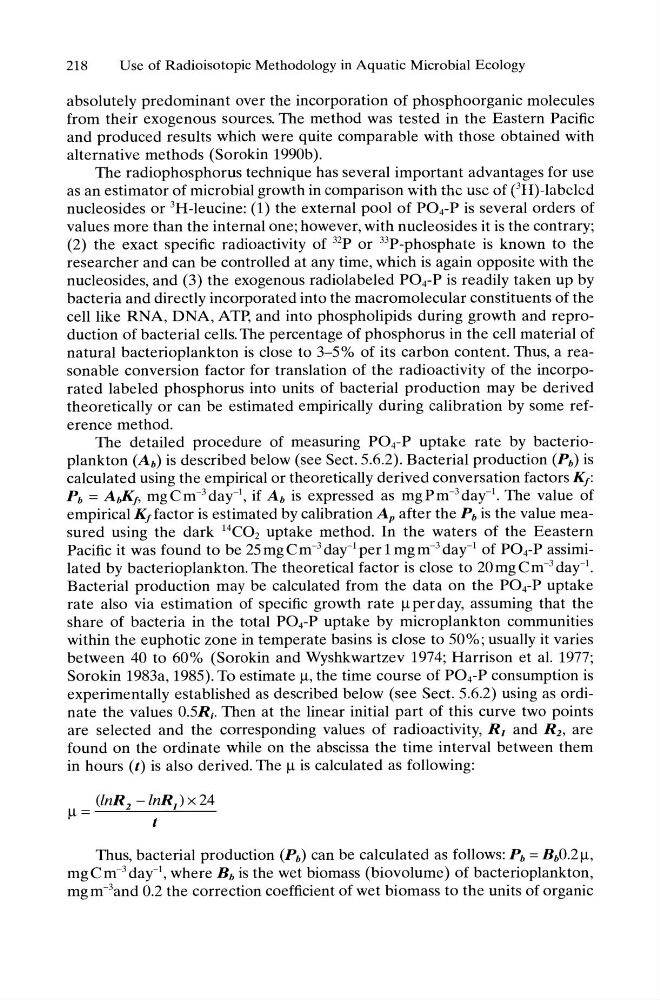
in hours (t) is also derived. The Il is calculated as following:
Thus, bacterial production (Pb) can be calculated as follows: Pb = BbO.21l,
mg C m- 3 day-I, where Bb is the wet biomass (biovolume) of bacterioplankton,
mgm- 3 and 0.2 the correction coefficient of wet biomass to the units of organic
Use of Radioisotopic Methodology in Aquatic Microbial Ecology
absolutely predominant over the incorporation of phospho organic molecules
from their exogenous sources. The method was tested in the Eastern Pacific
and produced results which were quite comparable with those obtained with
alternative methods (Sorokin 1990b).
The radiophosphorus technique has several important advantages for use
as an estimator of microbial growth in comparison with the usc of CH)-labclcd
nucleosides or 3H-Ieucine: (1) the external pool of P04-P is several orders of
values more than the internal one; however, with nucleosides it is the contrary;
(2) the exact specific radioactivity of 32p or 33p-phosphate is known to the
researcher and can be controlled at any time, which is again opposite with the
nucleosides, and (3) the exogenous radiolabeled P04-P is readily taken up by
bacteria and directly incorporated into the macromolecular constituents of the
cell like RNA, DNA, ATP, and into phospholipids during growth and reproduction of bacterial cells. The percentage of phosphorus in the cell material of
natural bacterioplankton is close to 3-5% of its carbon content. Thus, a reasonable conversion factor for translation of the radioactivity of the incorporated labeled phosphorus into units of bacterial production may be derived
theoretically or can be estimated empirically during calibration by some reference method.
The detailed procedure of measuring P04-P uptake rate by bacterioplankton (Ab) is described below (see Sect. 5.6.2). Bacterial production (Pb) is
calculated using the empirical or theoretically derived conversation factors K f :
P b = A$f' mgCm- 3 day-1, if Ab is expressed as mgPm- 3 day-l. The value of
empirical K f factor is estimated by calibration Ap after the P b is the value measured using the dark 14C02 uptake method. In the waters of the Eeastern
Pacific it was found to be 25mgCm- 3 day-lperl mgm- 3 day-l of P04-P assimilated by bacterioplankton. The theoretical factor is close to 20mg Cm- 3 day-I.
Bacterial production may be calculated from the data on the P04-P uptake
rate also via estimation of specific growth rate Il per day, assuming that the
share of bacteria in the total P04-P uptake by microplankton communities
within the euphotic zone in temperate basins is close to 50%; usually it varies
between 40 to 60% (Sorokin and Wyshkwartzev 1974; Harrison et al. 1977;
Sorokin 1983a, 1985). To estimate Il, the time course of P04-P consumption is
experimentally established as described below (see Sect. 5.6.2) using as ordinate the values 0.5Ri. Then at the linear initial part of this curve two points
are selected and the corresponding values of radioactivity, RJ and R 2 , are
found on the ordinate while on the abscissa the time interval between them
in hours (t) is also derived. The Il is calculated as following:
Thus, bacterial production (Pb) can be calculated as follows: Pb = BbO.21l,
mg C m- 3 day-I, where Bb is the wet biomass (biovolume) of bacterioplankton,
mgm- 3 and 0.2 the correction coefficient of wet biomass to the units of organic