

Determination of Microbial Production
183
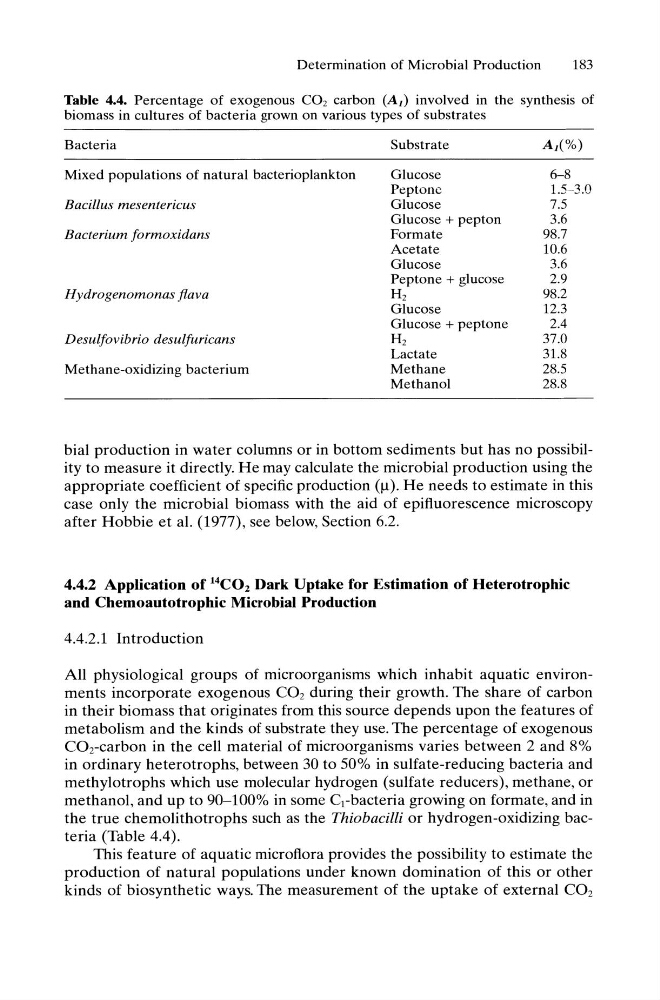
Table 4.4. Percentage of exogenous CO2 carbon (AI) involved in the synthesis of
biomass in cultures of bacteria grown on various types of substrates
Bacteria
Mixed populations of natural bacterioplankton
Bacillus mesentericus
Bacterium formoxidans
Hydrogenomonas fiava
Desulfovibrio desulfuricans
Methane-oxidizing bacterium
Substrate
Glucose
Peptone
Glucose
Glucose + pepton
Formate
Acetate
Glucose
Peptone + glucose
Hz
Glucose
Glucose + peptone
H2
Lactate
Methane
Methanol
6-8
1.5-3.0
7.5
3.6
98.7
10.6
3.6
2.9
98.2
12.3
2.4
37.0
31.8
28.5
28.8
bial production in water columns or in bottom sediments but has no possibility to measure it directly. He may calculate the microbial production using the
appropriate coefficient of specific production (11). He needs to estimate in this
case only the microbial biomass with the aid of epifluorescence microscopy
after Hobbie et al. (1977), see below, Section 6.2.
4.4.2 Application of 14C02 Dark Uptake for Estimation of Heterotrophic
and Chemoautotrophic Microbial Production
4.4.2.1 Introduction
All physiological groups of microorganisms which inhabit aquatic environments incorporate exogenous CO2 during their growth. The share of carbon
in their biomass that originates from this source depends upon the features of
metabolism and the kinds of substrate they use. The percentage of exogenous
COrcarbon in the cell material of microorganisms varies between 2 and 8 %
in ordinary heterotrophs, between 30 to 50% in sulfate-reducing bacteria and
methylotrophs which use molecular hydrogen (sulfate reducers), methane, or
methanol, and up to 90-100% in some C1-bacteria growing on formate, and in
the true chemolithotrophs such as the Thiobacilli or hydrogen-oxidizing bacteria (Table 4.4).
This feature of aquatic microflora provides the possibility to estimate the
production of natural populations under known domination of this or other
kinds of biosynthetic ways. The measurement of the uptake of external CO2
183
Table 4.4. Percentage of exogenous CO2 carbon (AI) involved in the synthesis of
biomass in cultures of bacteria grown on various types of substrates
Bacteria
Mixed populations of natural bacterioplankton
Bacillus mesentericus
Bacterium formoxidans
Hydrogenomonas fiava
Desulfovibrio desulfuricans
Methane-oxidizing bacterium
Substrate
Glucose
Peptone
Glucose
Glucose + pepton
Formate
Acetate
Glucose
Peptone + glucose
Hz
Glucose
Glucose + peptone
H2
Lactate
Methane
Methanol
6-8
1.5-3.0
7.5
3.6
98.7
10.6
3.6
2.9
98.2
12.3
2.4
37.0
31.8
28.5
28.8
bial production in water columns or in bottom sediments but has no possibility to measure it directly. He may calculate the microbial production using the
appropriate coefficient of specific production (11). He needs to estimate in this
case only the microbial biomass with the aid of epifluorescence microscopy
after Hobbie et al. (1977), see below, Section 6.2.
4.4.2 Application of 14C02 Dark Uptake for Estimation of Heterotrophic
and Chemoautotrophic Microbial Production
4.4.2.1 Introduction
All physiological groups of microorganisms which inhabit aquatic environments incorporate exogenous CO2 during their growth. The share of carbon
in their biomass that originates from this source depends upon the features of
metabolism and the kinds of substrate they use. The percentage of exogenous
COrcarbon in the cell material of microorganisms varies between 2 and 8 %
in ordinary heterotrophs, between 30 to 50% in sulfate-reducing bacteria and
methylotrophs which use molecular hydrogen (sulfate reducers), methane, or
methanol, and up to 90-100% in some C1-bacteria growing on formate, and in
the true chemolithotrophs such as the Thiobacilli or hydrogen-oxidizing bacteria (Table 4.4).
This feature of aquatic microflora provides the possibility to estimate the
production of natural populations under known domination of this or other
kinds of biosynthetic ways. The measurement of the uptake of external CO2