

Estimation of Relative Microbial Activity in Aquatic Habitats
165
H,m
II
III
IV
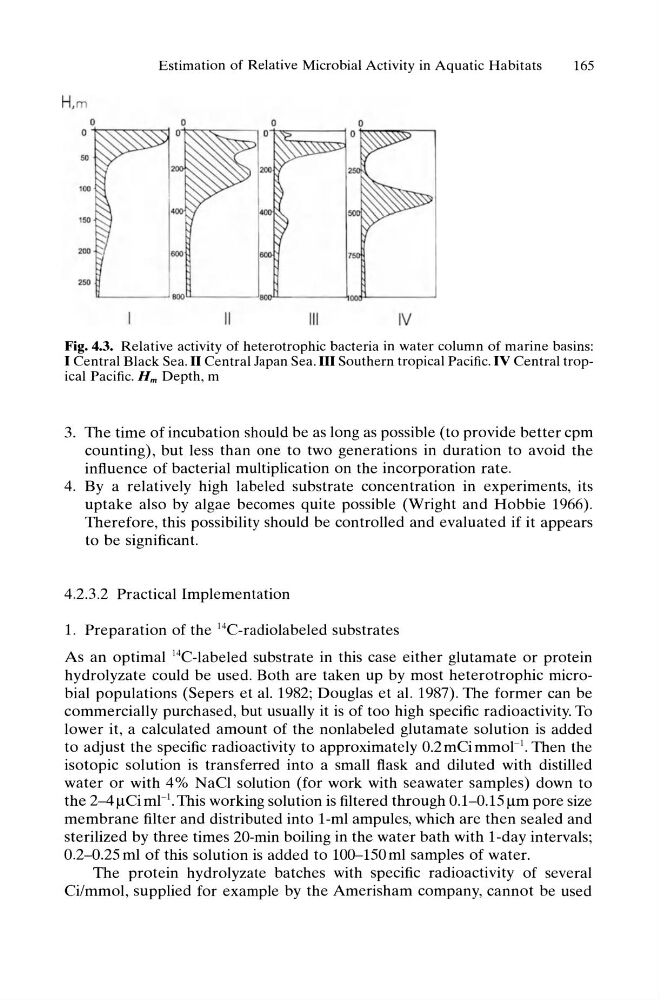
Fig. 4.3. Relative activity of heterotrophic bacteria in water column of marine basins:
I Central Black Sea. II Central Japan Sea. III Southern tropical Pacific. IV Central tropical Pacific. Hm Depth, m
3. The time of incubation should be as long as possible (to provide better cpm
counting), but less than one to two generations in duration to avoid the
influence of bacterial multiplication on the incorporation rate.
4. By a relatively high labeled substrate concentration in experiments, its
uptake also by algae becomes quite possible (Wright and Hobbie 1966).
Therefore, this possibility should be controlled and evaluated if it appears
to be significant.
4.2.3.2 Practical Implementation
1. Preparation of the 14C-radiolabeled substrates
As an optimal 14C-Iabeled substrate in this case either glutamate or protein
hydrolyzate could be used. Both are taken up by most heterotrophic microbial populations (Sepers et al. 1982; Douglas et al. 1987). The former can be
commercially purchased, but usually it is of too high specific radioactivity. To
lower it, a calculated amount of the nonlabeled glutamate solution is added
to adjust the specific radioactivity to approximately 0.2mCimmol- 1 . Then the
isotopic solution is transferred into a small flask and diluted with distilled
water or with 4% NaCI solution (for work with seawater samples) down to
the 2-4 f..lCiml-l. This working solution is filtered through 0.1-0.15 f..lm pore size
membrane filter and distributed into 1-ml ampules, which are then sealed and
sterilized by three times 20-min boiling in the water bath with I-day intervals;
0.2-0.25 ml of this solution is added to 100-150 ml samples of water.
The protein hydrolyzate batches with specific radioactivity of several
Ci/mmol, supplied for example by the Amerisham company, cannot be used
165
H,m
II
III
IV
Fig. 4.3. Relative activity of heterotrophic bacteria in water column of marine basins:
I Central Black Sea. II Central Japan Sea. III Southern tropical Pacific. IV Central tropical Pacific. Hm Depth, m
3. The time of incubation should be as long as possible (to provide better cpm
counting), but less than one to two generations in duration to avoid the
influence of bacterial multiplication on the incorporation rate.
4. By a relatively high labeled substrate concentration in experiments, its
uptake also by algae becomes quite possible (Wright and Hobbie 1966).
Therefore, this possibility should be controlled and evaluated if it appears
to be significant.
4.2.3.2 Practical Implementation
1. Preparation of the 14C-radiolabeled substrates
As an optimal 14C-Iabeled substrate in this case either glutamate or protein
hydrolyzate could be used. Both are taken up by most heterotrophic microbial populations (Sepers et al. 1982; Douglas et al. 1987). The former can be
commercially purchased, but usually it is of too high specific radioactivity. To
lower it, a calculated amount of the nonlabeled glutamate solution is added
to adjust the specific radioactivity to approximately 0.2mCimmol- 1 . Then the
isotopic solution is transferred into a small flask and diluted with distilled
water or with 4% NaCI solution (for work with seawater samples) down to
the 2-4 f..lCiml-l. This working solution is filtered through 0.1-0.15 f..lm pore size
membrane filter and distributed into 1-ml ampules, which are then sealed and
sterilized by three times 20-min boiling in the water bath with I-day intervals;
0.2-0.25 ml of this solution is added to 100-150 ml samples of water.
The protein hydrolyzate batches with specific radioactivity of several
Ci/mmol, supplied for example by the Amerisham company, cannot be used