

90
The Radiocarbon Method to Estimate Primary Production
A
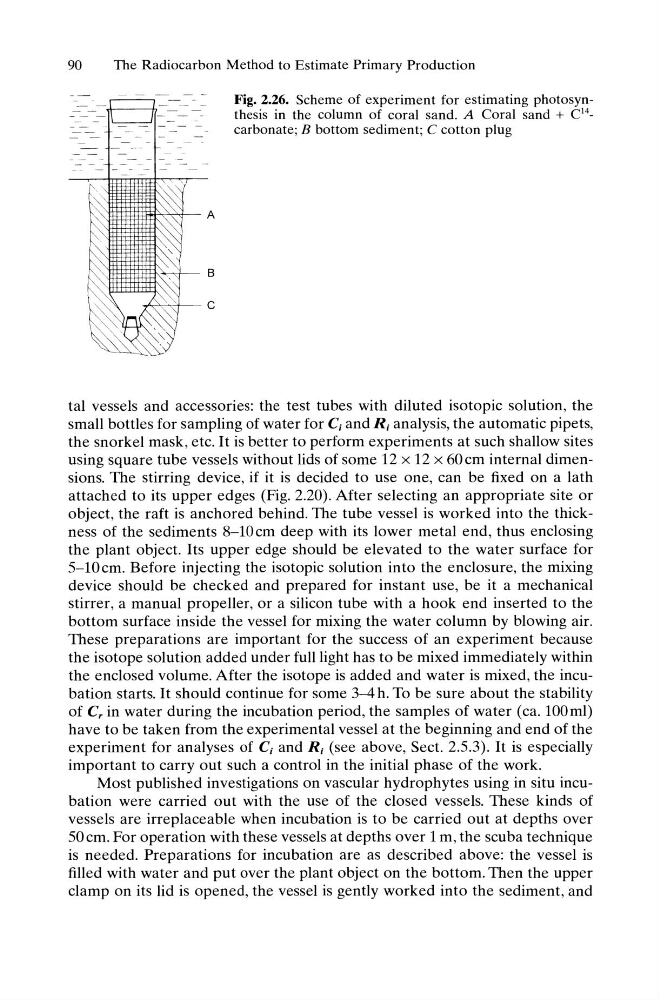
Fig. 2.26. Scheme of experiment for estimating photosynthesis in the column of coral sand. A Coral sand + C 14 _
carbonate; B bottom sediment; C cotton plug
tal vessels and accessories: the test tubes with diluted isotopic solution, the
small bottles for sampling of water for C; and R; analysis, the automatic pipets,
the snorkel mask, etc. It is better to perform experiments at such shallow sites
using square tube vessels without lids of some 12 x 12 x 60cm internal dimensions. The stirring device, if it is decided to use one, can be fixed on a lath
attached to its upper edges (Fig. 2.20). After selecting an appropriate site or
object, the raft is anchored behind. The tube vessel is worked into the thickness of the sediments 8-10 cm deep with its lower metal end, thus enclosing
the plant object. Its upper edge should be elevated to the water surface for
5-10cm. Before injecting the isotopic solution into the enclosure, the mixing
device should be checked and prepared for instant use, be it a mechanical
stirrer, a manual propeller, or a silicon tube with a hook end inserted to the
bottom surface inside the vessel for mixing the water column by blowing air.
These preparations are important for the success of an experiment because
the isotope solution added under full light has to be mixed immediately within
the enclosed volume. After the isotope is added and water is mixed, the incubation starts. It should continue for some 3-4 h. To be sure about the stability
of Cr in water during the incubation period, the samples of water (ca. 100ml)
have to be taken from the experimental vessel at the beginning and end of the
experiment for analyses of C; and R; (see above, Sect. 2.5.3). It is especially
important to carry out such a control in the initial phase of the work.
Most published investigations on vascular hydrophytes using in situ incubation were carried out with the use of the closed vessels. These kinds of
vessels are irreplaceable when incubation is to be carried out at depths over
50cm. For operation with these vessels at depths over 1 m, the scuba technique
is needed. Preparations for incubation are as described above: the vessel is
filled with water and put over the plant object on the bottom. Then the upper
clamp on its lid is opened, the vessel is gently worked into the sediment, and
The Radiocarbon Method to Estimate Primary Production
A
Fig. 2.26. Scheme of experiment for estimating photosynthesis in the column of coral sand. A Coral sand + C 14 _
carbonate; B bottom sediment; C cotton plug
tal vessels and accessories: the test tubes with diluted isotopic solution, the
small bottles for sampling of water for C; and R; analysis, the automatic pipets,
the snorkel mask, etc. It is better to perform experiments at such shallow sites
using square tube vessels without lids of some 12 x 12 x 60cm internal dimensions. The stirring device, if it is decided to use one, can be fixed on a lath
attached to its upper edges (Fig. 2.20). After selecting an appropriate site or
object, the raft is anchored behind. The tube vessel is worked into the thickness of the sediments 8-10 cm deep with its lower metal end, thus enclosing
the plant object. Its upper edge should be elevated to the water surface for
5-10cm. Before injecting the isotopic solution into the enclosure, the mixing
device should be checked and prepared for instant use, be it a mechanical
stirrer, a manual propeller, or a silicon tube with a hook end inserted to the
bottom surface inside the vessel for mixing the water column by blowing air.
These preparations are important for the success of an experiment because
the isotope solution added under full light has to be mixed immediately within
the enclosed volume. After the isotope is added and water is mixed, the incubation starts. It should continue for some 3-4 h. To be sure about the stability
of Cr in water during the incubation period, the samples of water (ca. 100ml)
have to be taken from the experimental vessel at the beginning and end of the
experiment for analyses of C; and R; (see above, Sect. 2.5.3). It is especially
important to carry out such a control in the initial phase of the work.
Most published investigations on vascular hydrophytes using in situ incubation were carried out with the use of the closed vessels. These kinds of
vessels are irreplaceable when incubation is to be carried out at depths over
50cm. For operation with these vessels at depths over 1 m, the scuba technique
is needed. Preparations for incubation are as described above: the vessel is
filled with water and put over the plant object on the bottom. Then the upper
clamp on its lid is opened, the vessel is gently worked into the sediment, and