

Use of the Radiocarbon Method to Determine Primary Production
89
prefiltered seawater, and treated as described above for specimens of
hydrophytes or samples periphyton.
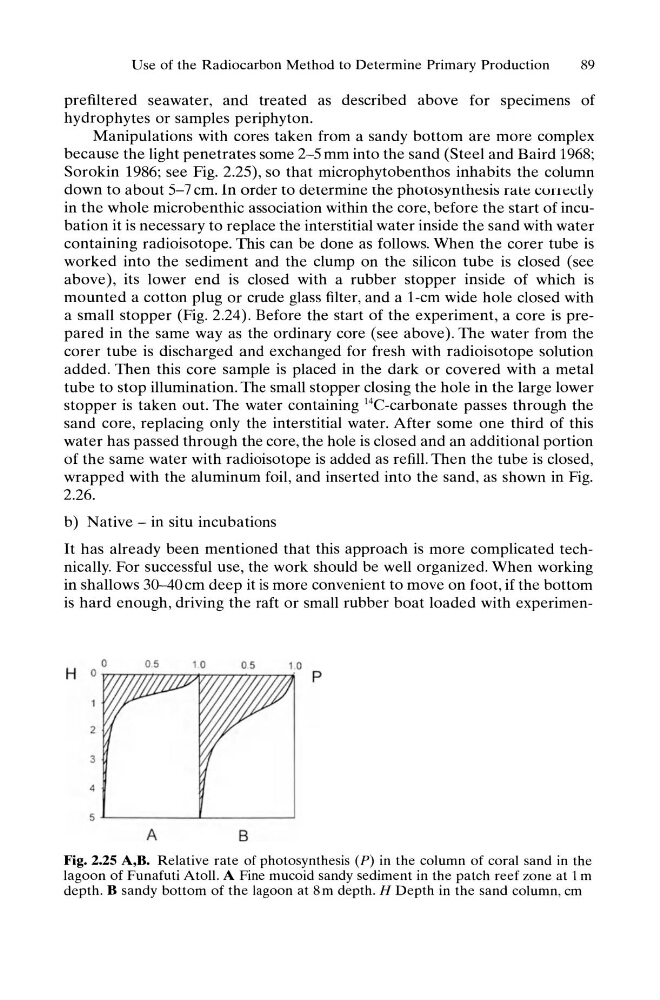
Manipulations with cores taken from a sandy bottom are more complex
because the light penetrates some 2-5 mm into the sand (Steel and Baird 1968;
Sorokin 1986; see Fig. 2.25), so that microphytobenthos inhabits the column
down to about 5-7 cm.In order to determine the photosynlhesis Tale l:unedly
in the whole micro benthic association within the core, before the start of incubation it is necessary to replace the interstitial water inside the sand with water
containing radioisotope. This can be done as follows. When the corer tube is
worked into the sediment and the clump on the silicon tube is closed (see
above), its lower end is closed with a rubber stopper inside of which is
mounted a cotton plug or crude glass filter, and a 1-cm wide hole closed with
a small stopper (Fig. 2.24). Before the start of the experiment, a core is prepared in the same way as the ordinary core (see above). The water from the
corer tube is discharged and exchanged for fresh with radioisotope solution
added. Then this core sample is placed in the dark or covered with a metal
tube to stop illumination. The small stopper closing the hole in the large lower
stopper is taken out. The water containing 14C-carbonate passes through the
sand core, replacing only the interstitial water. After some one third of this
water has passed through the core, the hole is closed and an additional portion
of the same water with radioisotope is added as refill. Then the tube is closed,
wrapped with the aluminum foil, and inserted into the sand, as shown in Fig.
2.26.
b) Native - in situ incubations
It has already been mentioned that this approach is more complicated technically. For successful use, the work should be well organized. When working
in shallows 30-40 cm deep it is more convenient to move on foot, if the bottom
is hard enough, driving the raft or small rubber boat loaded with experimenp
H
05
1 0
05
2
3
4
5 . L - . . - - - _ - - ' ' - -_ _ _ _ --'
A
B
Fig. 2.25 A,B. Relative rate of photosynthesis (P) in the column of coral sand in the
lagoon of Funafuti Atoll. A Fine mucoid sandy sediment in the patch reef zone at 1 m
depth. B sandy bottom of the lagoon at 8 m depth. H Depth in the sand column, cm
89
prefiltered seawater, and treated as described above for specimens of
hydrophytes or samples periphyton.
Manipulations with cores taken from a sandy bottom are more complex
because the light penetrates some 2-5 mm into the sand (Steel and Baird 1968;
Sorokin 1986; see Fig. 2.25), so that microphytobenthos inhabits the column
down to about 5-7 cm.In order to determine the photosynlhesis Tale l:unedly
in the whole micro benthic association within the core, before the start of incubation it is necessary to replace the interstitial water inside the sand with water
containing radioisotope. This can be done as follows. When the corer tube is
worked into the sediment and the clump on the silicon tube is closed (see
above), its lower end is closed with a rubber stopper inside of which is
mounted a cotton plug or crude glass filter, and a 1-cm wide hole closed with
a small stopper (Fig. 2.24). Before the start of the experiment, a core is prepared in the same way as the ordinary core (see above). The water from the
corer tube is discharged and exchanged for fresh with radioisotope solution
added. Then this core sample is placed in the dark or covered with a metal
tube to stop illumination. The small stopper closing the hole in the large lower
stopper is taken out. The water containing 14C-carbonate passes through the
sand core, replacing only the interstitial water. After some one third of this
water has passed through the core, the hole is closed and an additional portion
of the same water with radioisotope is added as refill. Then the tube is closed,
wrapped with the aluminum foil, and inserted into the sand, as shown in Fig.
2.26.
b) Native - in situ incubations
It has already been mentioned that this approach is more complicated technically. For successful use, the work should be well organized. When working
in shallows 30-40 cm deep it is more convenient to move on foot, if the bottom
is hard enough, driving the raft or small rubber boat loaded with experimenp
H
05
1 0
05
2
3
4
5 . L - . . - - - _ - - ' ' - -_ _ _ _ --'
A
B
Fig. 2.25 A,B. Relative rate of photosynthesis (P) in the column of coral sand in the
lagoon of Funafuti Atoll. A Fine mucoid sandy sediment in the patch reef zone at 1 m
depth. B sandy bottom of the lagoon at 8 m depth. H Depth in the sand column, cm