

2 Physical Principles and Technical Aspects of Remote Sensing
21
The symbol () denotes the statistical average.
The scattering cross section per unit volume, (7v (m 2 m- 3 ), is used to
describe scattering from a random medium with many individual scatterers
with the cross section (7;, for example a rain cell:
(2.14)
where Vo is the resolution volume. In the radiative transfer approach (7v
corresponds to ks (Eq. 2.8). If the attenuation between the antenna and the
scattering volume can be neglected, (7 in Eq. 2.12 can be substituted by (7v Vo.
If the diameter D of a particle is small (D .:s 0.05>'), (7; can be described by
the Rayleigh scattering approximation:
. = 21T
5
IKI2 D6
(7,
3>.4
(2.15)
where K = (Es - l)/(Es + 2), and 1'8 is the relative dielectric constant of the
scattering sphere. In order to derive (7v, the size distribution of the particles
has to be taken into account (Ishimaru, 1978). With N(D) particles per unit
volume having a diameter between D and D + dD, we obtain in case of
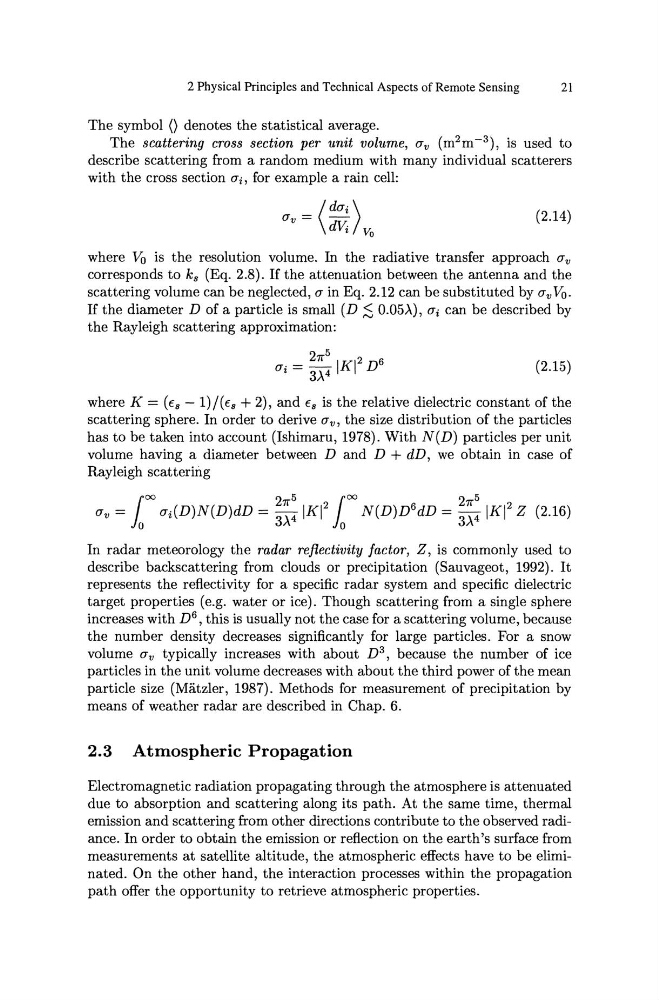
Rayleigh scattering
In radar meteorology the radar reflectivity factor, Z, is commonly used to
describe backscattering from clouds or precipitation (Sauvageot, 1992). It
represents the reflectivity for a specific radar system and specific dielectric
target properties (e.g. water or ice). Though scattering from a single sphere
increases with D 6 , this is usually not the case for a scattering volume, because
the number density decreases significantly for large particles. For a snow
volume (7v typically increases with about D 3 , because the number of ice
particles in the unit volume decreases with about the third power of the mean
particle size (Matzler, 1987). Methods for measurement of precipitation by
means of weather radar are described in Chap. 6.
2.3 Atmospheric Propagation
Electromagnetic radiation propagating through the atmosphere is attenuated
due to absorption and scattering along its path. At the same time, thermal
emission and scattering from other directions contribute to the observed radiance. In order to obtain the emission or reflection on the earth's surface from
measurements at satellite altitude, the atmospheric effects have to be eliminated. On the other hand, the interaction processes within the propagation
path offer the opportunity to retrieve atmospheric properties.
21
The symbol () denotes the statistical average.
The scattering cross section per unit volume, (7v (m 2 m- 3 ), is used to
describe scattering from a random medium with many individual scatterers
with the cross section (7;, for example a rain cell:
(2.14)
where Vo is the resolution volume. In the radiative transfer approach (7v
corresponds to ks (Eq. 2.8). If the attenuation between the antenna and the
scattering volume can be neglected, (7 in Eq. 2.12 can be substituted by (7v Vo.
If the diameter D of a particle is small (D .:s 0.05>'), (7; can be described by
the Rayleigh scattering approximation:
. = 21T
5
IKI2 D6
(7,
3>.4
(2.15)
where K = (Es - l)/(Es + 2), and 1'8 is the relative dielectric constant of the
scattering sphere. In order to derive (7v, the size distribution of the particles
has to be taken into account (Ishimaru, 1978). With N(D) particles per unit
volume having a diameter between D and D + dD, we obtain in case of
Rayleigh scattering
In radar meteorology the radar reflectivity factor, Z, is commonly used to
describe backscattering from clouds or precipitation (Sauvageot, 1992). It
represents the reflectivity for a specific radar system and specific dielectric
target properties (e.g. water or ice). Though scattering from a single sphere
increases with D 6 , this is usually not the case for a scattering volume, because
the number density decreases significantly for large particles. For a snow
volume (7v typically increases with about D 3 , because the number of ice
particles in the unit volume decreases with about the third power of the mean
particle size (Matzler, 1987). Methods for measurement of precipitation by
means of weather radar are described in Chap. 6.
2.3 Atmospheric Propagation
Electromagnetic radiation propagating through the atmosphere is attenuated
due to absorption and scattering along its path. At the same time, thermal
emission and scattering from other directions contribute to the observed radiance. In order to obtain the emission or reflection on the earth's surface from
measurements at satellite altitude, the atmospheric effects have to be eliminated. On the other hand, the interaction processes within the propagation
path offer the opportunity to retrieve atmospheric properties.