

2 Physical Principles and Technical Aspects of Remote Sensing
19
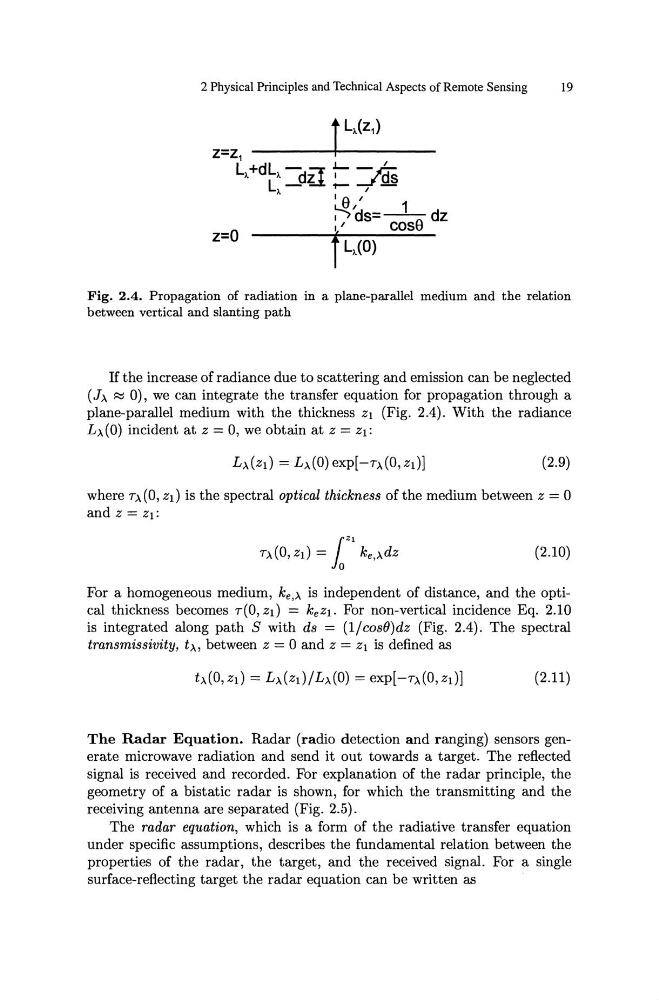
Fig. 2.4. Propagation of radiation in a plane-parallel medium and the relation
between vertical and slanting path
If the increase of radiance due to scattering and emission can be neglected
(1).. ~ 0), we can integrate the transfer equation for propagation through a
plane-parallel medium with the thickness Zl (Fig. 2.4). With the radiance
L>.(O) incident at Z = 0, we obtain at Z = Zl:
(2.9)
where 7>. (0, Zl) is the spectral optical thickness of the medium between Z = 0
andz=zl:
(2.10)
For a homogeneous medium, ke,>. is independent of distance, and the optical thickness becomes 7(0, zd = kez1 • For non-vertical incidence Eq. 2.10
is integrated along path S with ds = (l/cosO)dz (Fig. 2.4). The spectral
transmissivity, t>., between Z = ° and Z = Zl is defined as
(2.11)
The Radar Equation. Radar (radio detection and ranging) sensors generate microwave radiation and send it out towards a target. The reflected
signal is received and recorded. For explanation of the radar principle, the
geometry of a bistatic radar is shown, for which the transmitting and the
receiving antenna are separated (Fig. 2.5).
The radar equation, which is a form of the radiative transfer equation
under specific assumptions, describes the fundamental relation between the
properties of the radar, the target, and the received signal. For a single
surface-reflecting target the radar equation can be written as
19
Fig. 2.4. Propagation of radiation in a plane-parallel medium and the relation
between vertical and slanting path
If the increase of radiance due to scattering and emission can be neglected
(1).. ~ 0), we can integrate the transfer equation for propagation through a
plane-parallel medium with the thickness Zl (Fig. 2.4). With the radiance
L>.(O) incident at Z = 0, we obtain at Z = Zl:
(2.9)
where 7>. (0, Zl) is the spectral optical thickness of the medium between Z = 0
andz=zl:
(2.10)
For a homogeneous medium, ke,>. is independent of distance, and the optical thickness becomes 7(0, zd = kez1 • For non-vertical incidence Eq. 2.10
is integrated along path S with ds = (l/cosO)dz (Fig. 2.4). The spectral
transmissivity, t>., between Z = ° and Z = Zl is defined as
(2.11)
The Radar Equation. Radar (radio detection and ranging) sensors generate microwave radiation and send it out towards a target. The reflected
signal is received and recorded. For explanation of the radar principle, the
geometry of a bistatic radar is shown, for which the transmitting and the
receiving antenna are separated (Fig. 2.5).
The radar equation, which is a form of the radiative transfer equation
under specific assumptions, describes the fundamental relation between the
properties of the radar, the target, and the received signal. For a single
surface-reflecting target the radar equation can be written as