

292
J.C. Ritchie and ER. Schiebe
30 ,-----------------------------------,
Suspended Sediments (mg/I)
25
r,/
j./\ \ 351
20
,I(
\ \'--.....
//1
\ \...._. \ .
;1'
\
\.
.f?
\ 237\
15
fl
\... \
/, I
_ - - ~ " ,
'-_,
"
\
/1 '
,
r/
.
\
\ \
/ i
'
\
-.,
10
y /
'
141 " \ ' ;
--/./
, ,.
V/ .. ,'
', 76
'\ \\
-
- '.
~'''': ~ ,----5
2; '. --.. . ~-~~~~~:_~:;~~
-.-.-.-.-- -----.-~-.----...-. --.---.-~--------------------_. __ . _---_.2
600
800
1000
1200
Wavelength (nm)
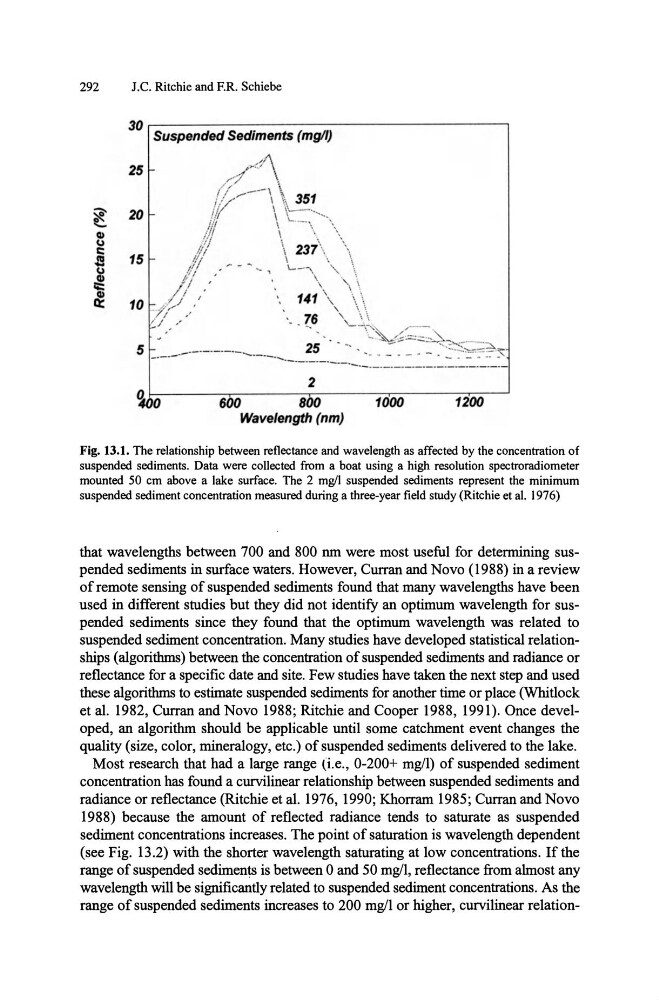
Fig. 13.1. The relationship between reflectance and wavelength as affected by the concentration of
suspended sediments. Data were collected from a boat using a high resolution spectroradiometer
mounted 50 cm above a lake surface. The 2 mgll suspended sediments represent the minimum
suspended sediment concentration measured during a three-year field study (Ritchie et al. 1976)
that wavelengths between 700 and 800 nm were most useful for determining suspended sediments in surface waters. However, Curran and Novo (1988) in a review
of remote sensing of suspended sediments found that many wavelengths have been
used in different studies but they did not identify an optimum wavelength for suspended sediments since they found that the optimum wavelength was related to
suspended sediment concentration. Many studies have developed statistical relationships (algorithms) between the concentration of suspended sediments and radiance or
reflectance for a specific date and site. Few studies have taken the next step and used
these algorithms to estimate suspended sediments for another time or place (Whitlock
et al. 1982, Curran and Novo 1988; Ritchie and Cooper 1988, 1991). Once developed, an algorithm should be applicable until some catchment event changes the
quality (size, color, mineralogy, etc.) of suspended sediments delivered to the lake.
Most research that had a large range ~i.e., 0-200+ mg/l) of suspended sediment
concentration has found a curvilinear relationship between suspended sediments and
radiance or reflectance (Ritchie et al. 1976, 1990; Khorram 1985; Curran and Novo
1988) because the amount of reflected radiance tends to saturate as suspended
sediment concentrations increases. The point of saturation is wavelength dependent
(see Fig. 13.2) with the shorter wavelength saturating at low concentrations. If the
range of suspended sediments is between 0 and 50 mg/l, reflectance from almost any
wavelength will be significantly related to suspended sediment concentrations. As the
range of suspended sediments increases to 200 mg/l or higher, curvilinear relation-
J.C. Ritchie and ER. Schiebe
30 ,-----------------------------------,
Suspended Sediments (mg/I)
25
r,/
j./\ \ 351
20
,I(
\ \'--.....
//1
\ \...._. \ .
;1'
\
\.
.f?
\ 237\
15
fl
\... \
/, I
_ - - ~ " ,
'-_,
"
\
/1 '
,
r/
.
\
\ \
/ i
'
\
-.,
10
y /
'
141 " \ ' ;
--/./
, ,.
V/ .. ,'
', 76
'\ \\
-
- '.
~'''': ~ ,----5
2; '. --.. . ~-~~~~~:_~:;~~
-.-.-.-.-- -----.-~-.----...-. --.---.-~--------------------_. __ . _---_.2
600
800
1000
1200
Wavelength (nm)
Fig. 13.1. The relationship between reflectance and wavelength as affected by the concentration of
suspended sediments. Data were collected from a boat using a high resolution spectroradiometer
mounted 50 cm above a lake surface. The 2 mgll suspended sediments represent the minimum
suspended sediment concentration measured during a three-year field study (Ritchie et al. 1976)
that wavelengths between 700 and 800 nm were most useful for determining suspended sediments in surface waters. However, Curran and Novo (1988) in a review
of remote sensing of suspended sediments found that many wavelengths have been
used in different studies but they did not identify an optimum wavelength for suspended sediments since they found that the optimum wavelength was related to
suspended sediment concentration. Many studies have developed statistical relationships (algorithms) between the concentration of suspended sediments and radiance or
reflectance for a specific date and site. Few studies have taken the next step and used
these algorithms to estimate suspended sediments for another time or place (Whitlock
et al. 1982, Curran and Novo 1988; Ritchie and Cooper 1988, 1991). Once developed, an algorithm should be applicable until some catchment event changes the
quality (size, color, mineralogy, etc.) of suspended sediments delivered to the lake.
Most research that had a large range ~i.e., 0-200+ mg/l) of suspended sediment
concentration has found a curvilinear relationship between suspended sediments and
radiance or reflectance (Ritchie et al. 1976, 1990; Khorram 1985; Curran and Novo
1988) because the amount of reflected radiance tends to saturate as suspended
sediment concentrations increases. The point of saturation is wavelength dependent
(see Fig. 13.2) with the shorter wavelength saturating at low concentrations. If the
range of suspended sediments is between 0 and 50 mg/l, reflectance from almost any
wavelength will be significantly related to suspended sediment concentrations. As the
range of suspended sediments increases to 200 mg/l or higher, curvilinear relation-