

10 Remote Sensing of Surface Water
219
Water has a low reflectivity in the wavebands between 0.7 and 3.0 Il111 (Engman and
Gurney, 1991). This region of the spectrum aligns itself best with Band 7 (0.8-1.1
1l111) on the Landsat MSS sensor, Band 4 of the Landsat TM sensor ( 0.76-0.90 1l111),
Band 3 of the SPOT-HRV sensor (0.79-0.89 1l111) and Band 2 (0.72-1.1 11m) of the
NOAA A VHRR series. All of these sensors have been shown to be quite effective at
these wavelengths for mapping open water regions. Weisnet. (1979) noted that
surface water inventories are readily detected at these wavelengths and point to some
of the earliest work for flood delineation using the near-infrared channel of both the
ERTS-1 (Landsat MSS) satellite (Rango and Salomonson, 1974) and the VHRR-IR
channel of the early NOAA satellites (Weisnet et ai., 1974).
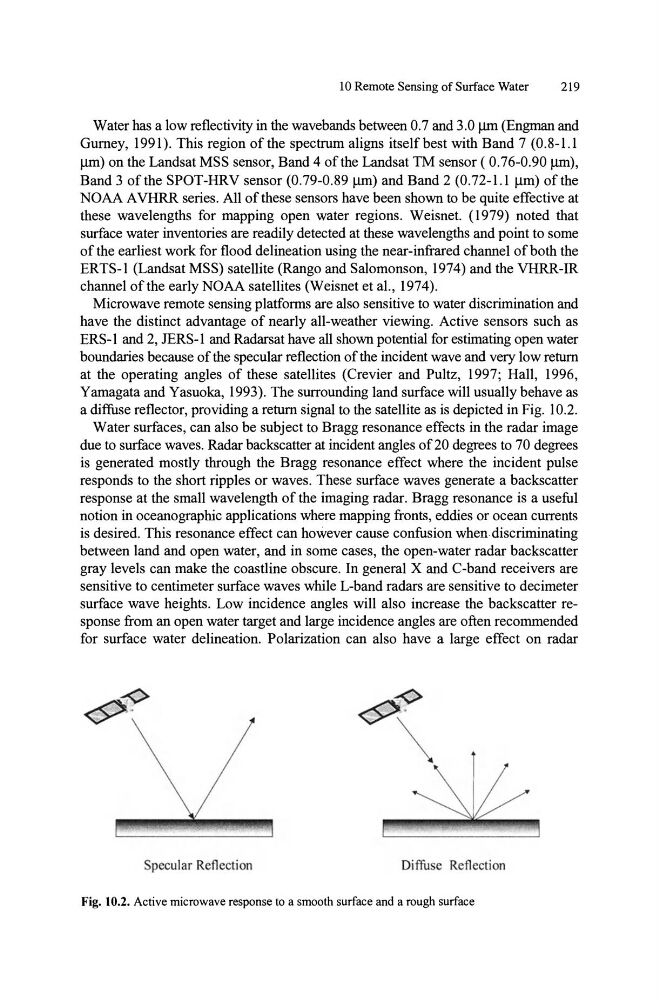
Microwave remote sensing platforms are also sensitive to water discrimination and
have the distinct advantage of nearly all-weather viewing. Active sensors such as
ERS-l and 2, lERS-l and Radarsat have all shown potential for estimating open water
boundaries because of the specular reflection of the incident wave and very low return
at the operating angles of these satellites (Crevier and Pultz, 1997; Hall, 1996,
Yamagata and Yasuoka, 1993). The surrounding land surface will usually behave as
a diffuse reflector, providing a return signal to the satellite as is depicted in Fig. 10.2.
Water surfaces, can also be subject to Bragg resonance effects in the radar image
due to surface waves. Radar backscatter at incident angles of 20 degrees to 70 degrees
is generated mostly through the Bragg resonance effect where the incident pulse
responds to the short ripples or waves. These surface waves generate a backscatter
response at the small wavelength of the imaging radar. Bragg resonance is a useful
notion in oceanographic applications where mapping fronts, eddies or ocean currents
is desired. This resonance effect can however cause confusion when discriminating
between land and open water, and in some cases, the open-water radar backscatter
gray levels can make the coastline obscure. In general X and C-band receivers are
sensitive to centimeter surface waves while L-band radars are sensitive to decimeter
surface wave heights. Low incidence angles will also increase the backscatter response from an open water target and large incidence angles are often recommended
for surface water delineation. Polarization can also have a large effect on radar
Specular Reflection
Diffuse Reflection
Fig. 10.2. Active microwave response to a smooth surface and a rough surface
219
Water has a low reflectivity in the wavebands between 0.7 and 3.0 Il111 (Engman and
Gurney, 1991). This region of the spectrum aligns itself best with Band 7 (0.8-1.1
1l111) on the Landsat MSS sensor, Band 4 of the Landsat TM sensor ( 0.76-0.90 1l111),
Band 3 of the SPOT-HRV sensor (0.79-0.89 1l111) and Band 2 (0.72-1.1 11m) of the
NOAA A VHRR series. All of these sensors have been shown to be quite effective at
these wavelengths for mapping open water regions. Weisnet. (1979) noted that
surface water inventories are readily detected at these wavelengths and point to some
of the earliest work for flood delineation using the near-infrared channel of both the
ERTS-1 (Landsat MSS) satellite (Rango and Salomonson, 1974) and the VHRR-IR
channel of the early NOAA satellites (Weisnet et ai., 1974).
Microwave remote sensing platforms are also sensitive to water discrimination and
have the distinct advantage of nearly all-weather viewing. Active sensors such as
ERS-l and 2, lERS-l and Radarsat have all shown potential for estimating open water
boundaries because of the specular reflection of the incident wave and very low return
at the operating angles of these satellites (Crevier and Pultz, 1997; Hall, 1996,
Yamagata and Yasuoka, 1993). The surrounding land surface will usually behave as
a diffuse reflector, providing a return signal to the satellite as is depicted in Fig. 10.2.
Water surfaces, can also be subject to Bragg resonance effects in the radar image
due to surface waves. Radar backscatter at incident angles of 20 degrees to 70 degrees
is generated mostly through the Bragg resonance effect where the incident pulse
responds to the short ripples or waves. These surface waves generate a backscatter
response at the small wavelength of the imaging radar. Bragg resonance is a useful
notion in oceanographic applications where mapping fronts, eddies or ocean currents
is desired. This resonance effect can however cause confusion when discriminating
between land and open water, and in some cases, the open-water radar backscatter
gray levels can make the coastline obscure. In general X and C-band receivers are
sensitive to centimeter surface waves while L-band radars are sensitive to decimeter
surface wave heights. Low incidence angles will also increase the backscatter response from an open water target and large incidence angles are often recommended
for surface water delineation. Polarization can also have a large effect on radar
Specular Reflection
Diffuse Reflection
Fig. 10.2. Active microwave response to a smooth surface and a rough surface