

8 Evaporation
175
250
X eddy correlation
200
o bowen rat io
(>J
E
• scintillometer
~ 150
U
~
::J
Ul
CII 100
Q)
.s
:::t:
50
0
0
50
100
150
200
250
H [S-SEBI] (W/m2)
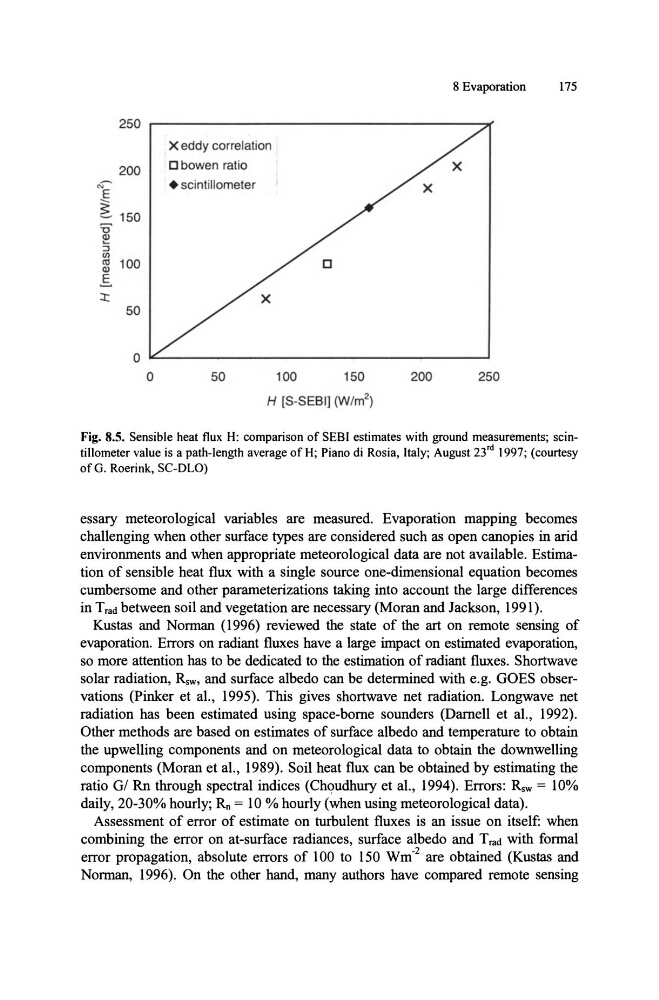
Fig. 8.5. Sensible heat flux H: comparison of SEBI estimates with ground measurements; scintillometer value is a path-length average of H; Piano di Rosia, Italy; August 23 rd 1997; (courtesy
ofG. Roerink, SC-DLO)
essary meteorological variables are measured. Evaporation mapping becomes
challenging when other surface types are considered such as open canopies in arid
environments and when appropriate meteorological data are not available. Estimation of sensible heat flux with a single source one-dimensional equation becomes
cumbersome and other parameterizations taking into account the large differences
in Trad between soil and vegetation are necessary (Moran and Jackson, 1991).
Kustas and Norman (1996) reviewed the state of the art on remote sensing of
evaporation. Errors on radiant fluxes have a large impact on estimated evaporation,
so more attention has to be dedicated to the estimation of radiant fluxes. Shortwave
solar radiation, Rsw, and surface albedo can be determined with e.g. GOES observations (Pinker et aI., 1995). This gives shortwave net radiation. Longwave net
radiation has been estimated using space-borne sounders (Darnell et aI., 1992).
Other methods are based on estimates of surface albedo and temperature to obtain
the upwelling components and on meteorological data to obtain the downwelling
components (Moran et aI., 1989). Soil heat flux can be obtained by estimating the
ratio G/ Rn through spectral indices (Ch(;mdhury et aI., 1994). Errors: Rsw = 10%
daily, 20-30% hourly; Rn = 10 % hourly (when using meteorological data).
Assessment of error of estimate on turbulent fluxes is an issue on itself: when
combining the error on at-surface radiances, surface albedo and Trad with formal
error propagation, absolute errors of 100 to 150 Wm- 2 are obtained (Kustas and
Norman, 1996). On the other hand, many authors have compared remote sensing
175
250
X eddy correlation
200
o bowen rat io
(>J
E
• scintillometer
~ 150
U
~
::J
Ul
CII 100
Q)
.s
:::t:
50
0
0
50
100
150
200
250
H [S-SEBI] (W/m2)
Fig. 8.5. Sensible heat flux H: comparison of SEBI estimates with ground measurements; scintillometer value is a path-length average of H; Piano di Rosia, Italy; August 23 rd 1997; (courtesy
ofG. Roerink, SC-DLO)
essary meteorological variables are measured. Evaporation mapping becomes
challenging when other surface types are considered such as open canopies in arid
environments and when appropriate meteorological data are not available. Estimation of sensible heat flux with a single source one-dimensional equation becomes
cumbersome and other parameterizations taking into account the large differences
in Trad between soil and vegetation are necessary (Moran and Jackson, 1991).
Kustas and Norman (1996) reviewed the state of the art on remote sensing of
evaporation. Errors on radiant fluxes have a large impact on estimated evaporation,
so more attention has to be dedicated to the estimation of radiant fluxes. Shortwave
solar radiation, Rsw, and surface albedo can be determined with e.g. GOES observations (Pinker et aI., 1995). This gives shortwave net radiation. Longwave net
radiation has been estimated using space-borne sounders (Darnell et aI., 1992).
Other methods are based on estimates of surface albedo and temperature to obtain
the upwelling components and on meteorological data to obtain the downwelling
components (Moran et aI., 1989). Soil heat flux can be obtained by estimating the
ratio G/ Rn through spectral indices (Ch(;mdhury et aI., 1994). Errors: Rsw = 10%
daily, 20-30% hourly; Rn = 10 % hourly (when using meteorological data).
Assessment of error of estimate on turbulent fluxes is an issue on itself: when
combining the error on at-surface radiances, surface albedo and Trad with formal
error propagation, absolute errors of 100 to 150 Wm- 2 are obtained (Kustas and
Norman, 1996). On the other hand, many authors have compared remote sensing