

162
M. Menenti
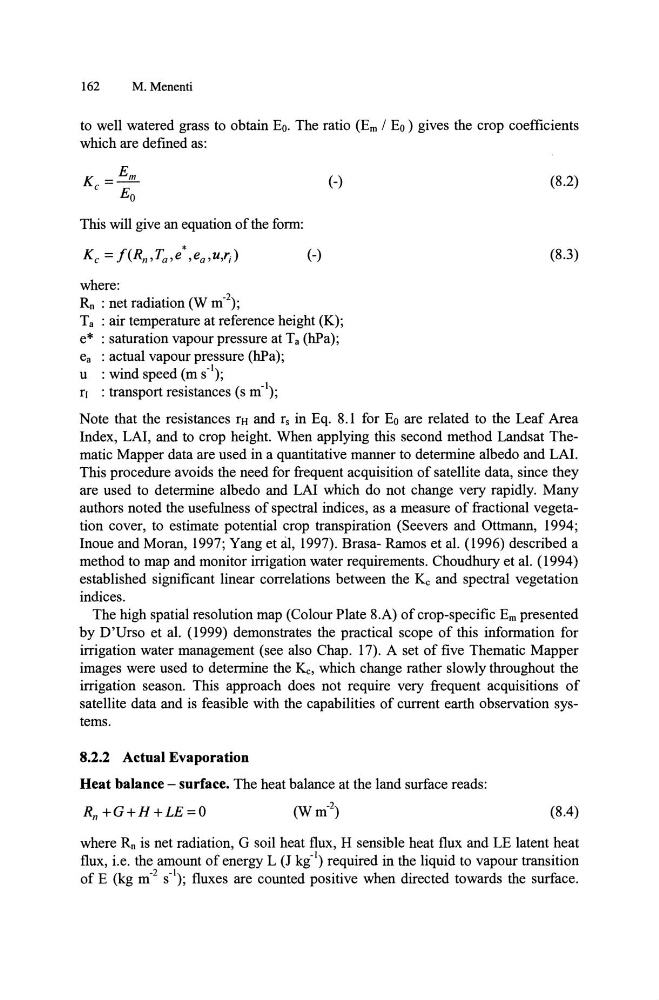
to well watered grass to obtain Eo. The ratio (Em / Eo ) gives the crop coefficients
which are defmed as:
K =E/I1
C
Eo
(-)
This will give an equation of the fonn:
(-)
where:
Rn : net radiation (W m- 2 );
Ta : air temperature at reference height (K);
e* : saturation vapour pressure at Ta (hPa);
ea : actual vapour pressure (hPa);
u : wind speed (m S·I);
rl : transport resistances (s m·\
(8.2)
(8.3)
Note that the resistances rH and rs in Eq. 8.1 for Eo are related to the Leaf Area
Index, LAI, and to crop height. When applying this second method Landsat Thematic Mapper data are used in a quantitative manner to detennine albedo and LAI.
This procedure avoids the need for frequent acquisition of satellite data, since they
are used to detennine albedo and LAI which do not change very rapidly. Many
authors noted the usefulness of spectral indices, as a measure of fractional vegetation cover, to estimate potential crop transpiration (Seevers and Ottmann, 1994;
Inoue and Moran, 1997; Yang et aI, 1997). Brasa- Ramos et al. (1996) described a
method to map and monitor irrigation water requirements. Choudhury et al. (1994)
established significant linear correlations between the I(" and spectral vegetation
indices.
The high spatial resolution map (Colour Plate 8.A) of crop-specific Em presented
by D'Urso et al. (1999) demonstrates the practical scope of this infonnation for
irrigation water management (see also Chap. 17). A set of five Thematic Mapper
images were used to detennine the 1(", which change rather slowly throughout the
irrigation season. This approach does not require very frequent acquisitions of
satellite data and is feasible with the capabilities of current earth observation systems.
8.2.2 Actual Evaporation
Heat balance - surface. The heat balance at the land surface reads:
Rn +G+H +LE=O
(8.4)
where Rn is net radiation, G soil heat flux, H sensible heat flux and LE latent heat
flux, i.e. the amount of energy L (J kil) required in the liquid to vapour transition
of E (kg m- 2 S-I); fluxes are counted positive when directed towards the surface.
M. Menenti
to well watered grass to obtain Eo. The ratio (Em / Eo ) gives the crop coefficients
which are defmed as:
K =E/I1
C
Eo
(-)
This will give an equation of the fonn:
(-)
where:
Rn : net radiation (W m- 2 );
Ta : air temperature at reference height (K);
e* : saturation vapour pressure at Ta (hPa);
ea : actual vapour pressure (hPa);
u : wind speed (m S·I);
rl : transport resistances (s m·\
(8.2)
(8.3)
Note that the resistances rH and rs in Eq. 8.1 for Eo are related to the Leaf Area
Index, LAI, and to crop height. When applying this second method Landsat Thematic Mapper data are used in a quantitative manner to detennine albedo and LAI.
This procedure avoids the need for frequent acquisition of satellite data, since they
are used to detennine albedo and LAI which do not change very rapidly. Many
authors noted the usefulness of spectral indices, as a measure of fractional vegetation cover, to estimate potential crop transpiration (Seevers and Ottmann, 1994;
Inoue and Moran, 1997; Yang et aI, 1997). Brasa- Ramos et al. (1996) described a
method to map and monitor irrigation water requirements. Choudhury et al. (1994)
established significant linear correlations between the I(" and spectral vegetation
indices.
The high spatial resolution map (Colour Plate 8.A) of crop-specific Em presented
by D'Urso et al. (1999) demonstrates the practical scope of this infonnation for
irrigation water management (see also Chap. 17). A set of five Thematic Mapper
images were used to detennine the 1(", which change rather slowly throughout the
irrigation season. This approach does not require very frequent acquisitions of
satellite data and is feasible with the capabilities of current earth observation systems.
8.2.2 Actual Evaporation
Heat balance - surface. The heat balance at the land surface reads:
Rn +G+H +LE=O
(8.4)
where Rn is net radiation, G soil heat flux, H sensible heat flux and LE latent heat
flux, i.e. the amount of energy L (J kil) required in the liquid to vapour transition
of E (kg m- 2 S-I); fluxes are counted positive when directed towards the surface.