

136
B.G.H. Gorte
Table 7.1. Biophysical crop parameters retrievable from remote sensing measurements, and
their association with irrigation management, from [Bastiaanssen, 1998]
Crop parameter
Process
Fractional vegetation cover
Chlorophyll development, soil
and canopy fluxes
Leaf area index
Biomass, minimum canopy
resistance, heat fluxes
Photosynthetically active
Photosynthesis
radiation
Surface roughness
Aerodynamic resistance
Broadband surface albedo
Net radiation
Thermal infrared surface
Net radiation
emissivity
Surface temperature
Net radiation, surface
resistance
Surface resistance
Soil moisture and salinity
Crop coefficients
Gross evapotranspiration
Transpiration coefficients
Potential soil and crop
evaporation
Crop yield
Accumulated biomass
60 ~~~~~-.-,---,--~--~--~--~--~
soil - -
50
CD
40
u
c:
. .
~ 30
~
cr
~ 20
0.4
0.6
0.8
water ........ .
.. , .. , .....
vegetation
1
1.2
1.4
1.6
1.8
2
2.2
Wavelength (urn)
Purpose
Irrigated area
Yield, water use, water
needs
Yield
Water use, water needs
Water use, water needs
Water use, water needs
Water use
Water use
Water needs
Water use, water needs
Production
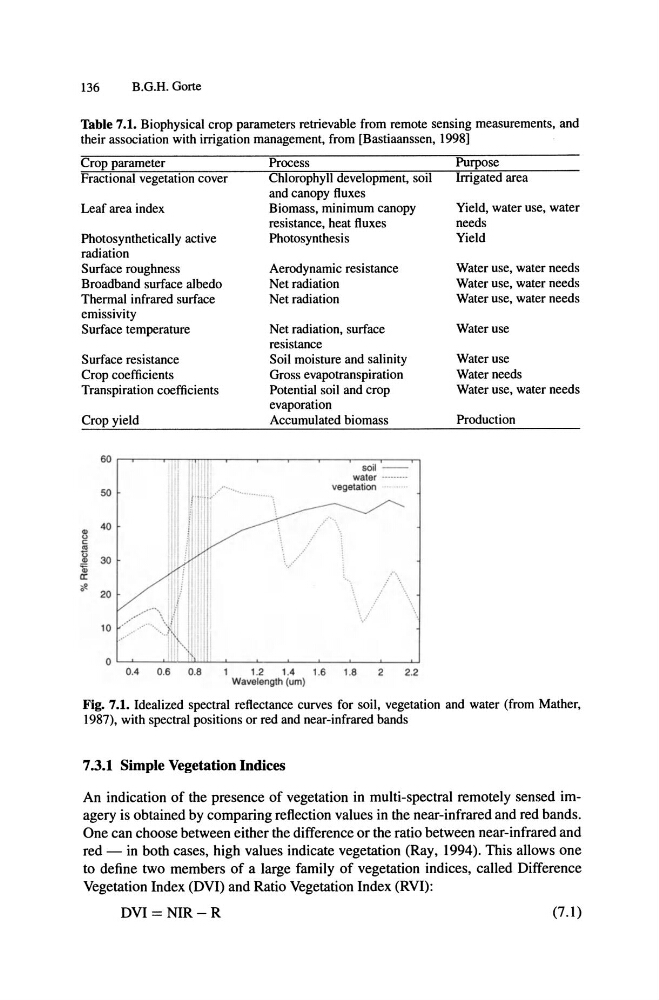
Fig. 7.1. Idealized spectral reflectance curves for soil, vegetation and water (from Mather,
1987), with spectral positions or red and near-infrared bands
7.3.1 Simple Vegetation Indices
An indication of the presence of vegetation in multi-spectral remotely sensed imagery is obtained by comparing reflection values in the near-infrared and red bands.
One can choose between either the difference or the ratio between near-infrared and
red -- in both cases, high values indicate vegetation (Ray, 1994). This allows one
to define two members of a large family of vegetation indices, called Difference
Vegetation Index (DVI) and Ratio Vegetation Index (RVI):
DVI = NIR- R
(7.1)
B.G.H. Gorte
Table 7.1. Biophysical crop parameters retrievable from remote sensing measurements, and
their association with irrigation management, from [Bastiaanssen, 1998]
Crop parameter
Process
Fractional vegetation cover
Chlorophyll development, soil
and canopy fluxes
Leaf area index
Biomass, minimum canopy
resistance, heat fluxes
Photosynthetically active
Photosynthesis
radiation
Surface roughness
Aerodynamic resistance
Broadband surface albedo
Net radiation
Thermal infrared surface
Net radiation
emissivity
Surface temperature
Net radiation, surface
resistance
Surface resistance
Soil moisture and salinity
Crop coefficients
Gross evapotranspiration
Transpiration coefficients
Potential soil and crop
evaporation
Crop yield
Accumulated biomass
60 ~~~~~-.-,---,--~--~--~--~--~
soil - -
50
CD
40
u
c:
. .
~ 30
~
cr
~ 20
0.4
0.6
0.8
water ........ .
.. , .. , .....
vegetation
1
1.2
1.4
1.6
1.8
2
2.2
Wavelength (urn)
Purpose
Irrigated area
Yield, water use, water
needs
Yield
Water use, water needs
Water use, water needs
Water use, water needs
Water use
Water use
Water needs
Water use, water needs
Production
Fig. 7.1. Idealized spectral reflectance curves for soil, vegetation and water (from Mather,
1987), with spectral positions or red and near-infrared bands
7.3.1 Simple Vegetation Indices
An indication of the presence of vegetation in multi-spectral remotely sensed imagery is obtained by comparing reflection values in the near-infrared and red bands.
One can choose between either the difference or the ratio between near-infrared and
red -- in both cases, high values indicate vegetation (Ray, 1994). This allows one
to define two members of a large family of vegetation indices, called Difference
Vegetation Index (DVI) and Ratio Vegetation Index (RVI):
DVI = NIR- R
(7.1)