

120
C.G. Collier
convective rainfall important in flash flood prediction. Therefore techniques for
recognising the presence of hail must be implemented in hydrological measurement
systems. These techniques range from simple (and unreliable) threshold approaches
to procedures involving the height of radar echoes (Waldvogel et al., 1979) and
blending radar with satellite information (Hardaker and Auer, 1994). Multiparameter
radar also offers reliable identification.
6.3.3 Multi-parameter radar
The departure of the shapes of precipitation particles from spherical gives rise to
different radar reflectivity properties. Seliga and Bringi (1976) related signals in two
orthogonal linear polarisation planes, horizontal (H) and vertical (V). to twoparametric drop size distributions. Likewise, circular polarisation has also been used
in this way by McCormich and Hendry (1972).
The obateness of raindrops, when falling at terminal velocity in air, increases with
drop volume. Since models for the shape and minor-to-major axis ratio and fall speed
data exist, it is possible to relate the dropsize distributions so measured to rainfall
rates.
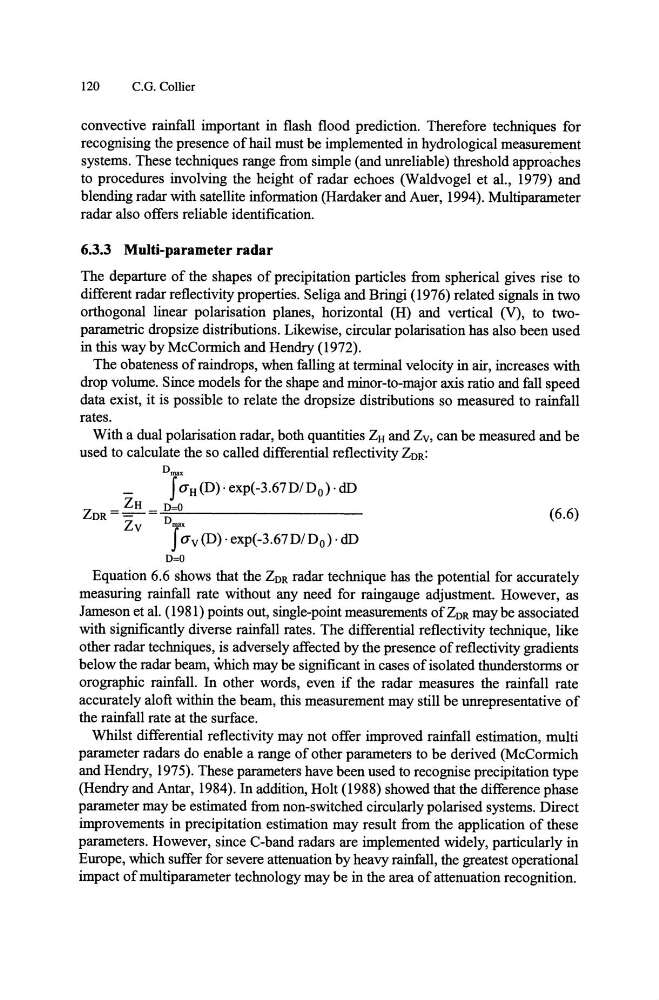
With a dual polarisation radar, both quantities ZH and Zv. can be measured and be
used to calculate the so called differential reflectivity ZDR:
Dma.
J CTH(D)· exp(-3.67D/D o )· dD
_ ZH _ D=O
ZDR -=--~~-------(6.6)
Z
D ....
v
J CTv(D)· exp(-3.67D/D o )· dD
D=O
Equation 6.6 shows that the ZDR radar technique has the potential for accurately
measuring rainfall rate without any need for raingauge adjustment. However, as
Jameson et al. (1981) points out, single-point measurements of ZDR may be associated
with significantly diverse rainfall rates. The differential reflectivity technique, like
other radar techniques, is adversely affected by the presence of reflectivity gradients
below the radar beam, which may be significant in cases of isolated thunderstorms or
orographic rainfall. In other words, even if the radar measures the rainfall rate
accurately aloft within the beam, this measurement may still be unrepresentative of
the rainfall rate at the surface.
Whilst differential reflectivity may not offer improved rainfall estimation, multi
parameter radars do enable a range of other parameters to be derived (McCormich
and Hendry, 1975). These parameters have been used to recognise precipitation type
(Hendry and Antar, 1984). In addition, Holt (1988) showed that the difference phase
parameter may be estimated from non-switched circularly polarised systems. Direct
improvements in precipitation estimation may result from the application of these
parameters. However, since C-band radars are implemented widely, particularly in
Europe, which suffer for severe attenuation by heavy rainfall, the greatest operational
impact of multiparameter technology may be in the area of attenuation recognition.
C.G. Collier
convective rainfall important in flash flood prediction. Therefore techniques for
recognising the presence of hail must be implemented in hydrological measurement
systems. These techniques range from simple (and unreliable) threshold approaches
to procedures involving the height of radar echoes (Waldvogel et al., 1979) and
blending radar with satellite information (Hardaker and Auer, 1994). Multiparameter
radar also offers reliable identification.
6.3.3 Multi-parameter radar
The departure of the shapes of precipitation particles from spherical gives rise to
different radar reflectivity properties. Seliga and Bringi (1976) related signals in two
orthogonal linear polarisation planes, horizontal (H) and vertical (V). to twoparametric drop size distributions. Likewise, circular polarisation has also been used
in this way by McCormich and Hendry (1972).
The obateness of raindrops, when falling at terminal velocity in air, increases with
drop volume. Since models for the shape and minor-to-major axis ratio and fall speed
data exist, it is possible to relate the dropsize distributions so measured to rainfall
rates.
With a dual polarisation radar, both quantities ZH and Zv. can be measured and be
used to calculate the so called differential reflectivity ZDR:
Dma.
J CTH(D)· exp(-3.67D/D o )· dD
_ ZH _ D=O
ZDR -=--~~-------(6.6)
Z
D ....
v
J CTv(D)· exp(-3.67D/D o )· dD
D=O
Equation 6.6 shows that the ZDR radar technique has the potential for accurately
measuring rainfall rate without any need for raingauge adjustment. However, as
Jameson et al. (1981) points out, single-point measurements of ZDR may be associated
with significantly diverse rainfall rates. The differential reflectivity technique, like
other radar techniques, is adversely affected by the presence of reflectivity gradients
below the radar beam, which may be significant in cases of isolated thunderstorms or
orographic rainfall. In other words, even if the radar measures the rainfall rate
accurately aloft within the beam, this measurement may still be unrepresentative of
the rainfall rate at the surface.
Whilst differential reflectivity may not offer improved rainfall estimation, multi
parameter radars do enable a range of other parameters to be derived (McCormich
and Hendry, 1975). These parameters have been used to recognise precipitation type
(Hendry and Antar, 1984). In addition, Holt (1988) showed that the difference phase
parameter may be estimated from non-switched circularly polarised systems. Direct
improvements in precipitation estimation may result from the application of these
parameters. However, since C-band radars are implemented widely, particularly in
Europe, which suffer for severe attenuation by heavy rainfall, the greatest operational
impact of multiparameter technology may be in the area of attenuation recognition.