

6 Precipitation
119
IKI~ 1
Z =_·Z
(6.3)
e IKI2
w
where IKI~ and IKI: are the dielectric constants for ice and water respectively. There
are two possible 'correct' values for IKI~ depending upon how the particle sizes are
determined. If the particle sizes used are melted drop diameters then IKI~ is 0.208
and,
Ze= 0.224 Z
(6.4)
However, if the particle sizes are expressed as equivalent ice sphere diameters then
IKI~ is 0.176 and,
Ze=0.189Z
(6.5)
Normally radars use the "water equivalent" Ze defmed with IKI: = 0.93, and the
dielectric factor is not changed when the precipitation form changes from liquid to
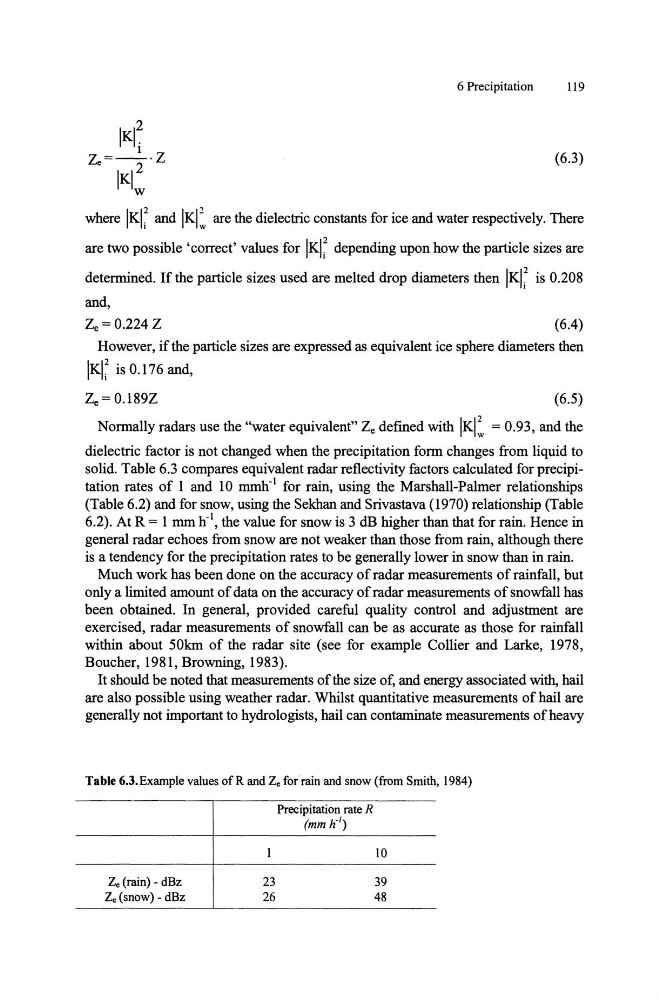
solid. Table 6.3 compares equivalent radar reflectivity factors calculated for precipitation rates of 1 and 10 mmh- I for rain, using the Marshall-Palmer relationships
(Table 6.2) and for snow, using the Sekhan and Srivastava (1970) relationship (Table
6.2). At R = 1 mm h- I , the value for snow is 3 dB higher than that for rain. Hence in
general radar echoes from snow are not weaker than those from rain, although there
is a tendency for the precipitation rates to be generally lower in snow than in rain.
Much work has been done on the accuracy of radar measurements of rainfall, but
only a limited amount of data on the accuracy of radar measurements of snowfall has
been obtained. In general, provided careful quality control and adjustment are
exercised, radar measurements of snowfall can be as accurate as those for rainfall
within about 50km of the radar site (see for example Collier and Larke, 1978,
Boucher, 1981, Browning, 1983).
It should be noted that measurements of the size of, and energy associated with, hail
are also possible using weather radar. Whilst quantitative measurements of hail are
generally not important to hydrologists, hail can contaminate measurements of heavy
Table 6.3. Example values ofR and Ze for rain and snow (from Smith, 1984)
Ze (rain) - dBz
Ze (snow) - dBz
23
26
Precipitation rate R
(mm h- l )
10
39
48
119
IKI~ 1
Z =_·Z
(6.3)
e IKI2
w
where IKI~ and IKI: are the dielectric constants for ice and water respectively. There
are two possible 'correct' values for IKI~ depending upon how the particle sizes are
determined. If the particle sizes used are melted drop diameters then IKI~ is 0.208
and,
Ze= 0.224 Z
(6.4)
However, if the particle sizes are expressed as equivalent ice sphere diameters then
IKI~ is 0.176 and,
Ze=0.189Z
(6.5)
Normally radars use the "water equivalent" Ze defmed with IKI: = 0.93, and the
dielectric factor is not changed when the precipitation form changes from liquid to
solid. Table 6.3 compares equivalent radar reflectivity factors calculated for precipitation rates of 1 and 10 mmh- I for rain, using the Marshall-Palmer relationships
(Table 6.2) and for snow, using the Sekhan and Srivastava (1970) relationship (Table
6.2). At R = 1 mm h- I , the value for snow is 3 dB higher than that for rain. Hence in
general radar echoes from snow are not weaker than those from rain, although there
is a tendency for the precipitation rates to be generally lower in snow than in rain.
Much work has been done on the accuracy of radar measurements of rainfall, but
only a limited amount of data on the accuracy of radar measurements of snowfall has
been obtained. In general, provided careful quality control and adjustment are
exercised, radar measurements of snowfall can be as accurate as those for rainfall
within about 50km of the radar site (see for example Collier and Larke, 1978,
Boucher, 1981, Browning, 1983).
It should be noted that measurements of the size of, and energy associated with, hail
are also possible using weather radar. Whilst quantitative measurements of hail are
generally not important to hydrologists, hail can contaminate measurements of heavy
Table 6.3. Example values ofR and Ze for rain and snow (from Smith, 1984)
Ze (rain) - dBz
Ze (snow) - dBz
23
26
Precipitation rate R
(mm h- l )
10
39
48