

92
R.O. Dubayah, E.F. Wood, E.T. Engman et al.
PRECIPITATION
SHORTWAVE
RADIATION
LONGWAVE
RADIATION
SOILS DATA
LAND COVER
DATA
-- -HYDROLOGIC
MODEL
AS=P-E- Q
RUNOFF
SOIL MOISTURE
SURFACE ENERGY
FLUX
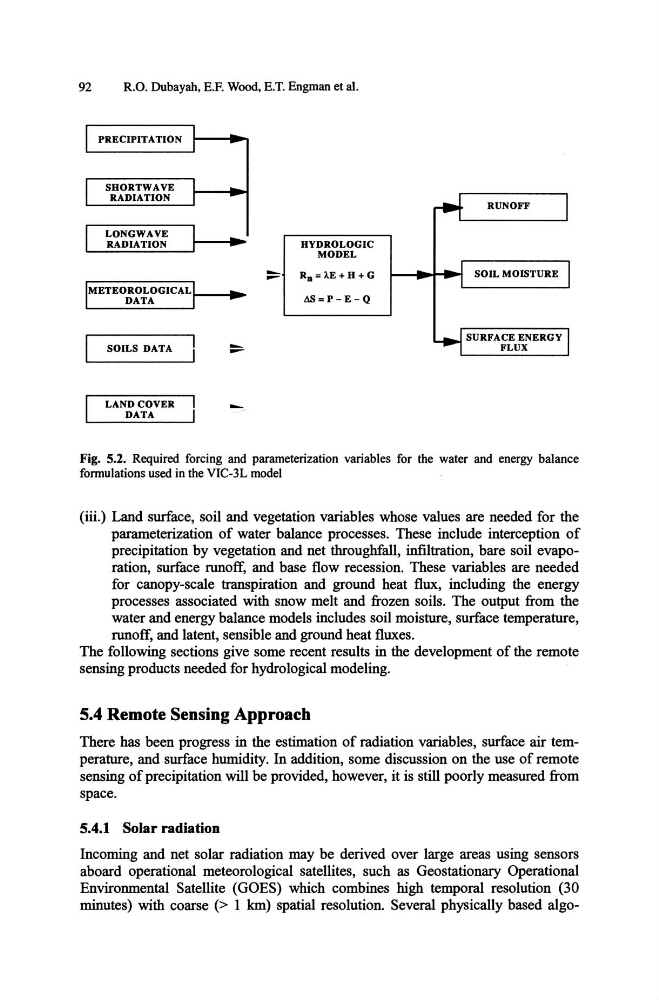
Fig. 5.2. Required forcing and parameterization variables for the water and energy balance
fonnulations used in the VIC-3L model
(iii.) Land surface, soil and vegetation variables whose values are needed for the
parameterization of water balance processes. These include interception of
precipitation by vegetation and net throughfall, inftltration, bare soil evaporation, surface runoff, and base flow recession. These variables are needed
for canopy-scale transpiration and ground heat flux, including the energy
processes associated with snow melt and frozen soils. The output from the
water and energy balance models includes soil moisture, surface temperature,
runoff, and latent, sensible and ground heat fluxes.
The following sections give some recent results in the development of the remote
sensing products needed for hydrological modeling.
5.4 Remote Sensing Approach
There has been progress in the estimation of radiation variables, surface air temperature, and surface humidity. In addition, some discussion on the use of remote
sensing of precipitation will be provided, however, it is still poorly measured from
space.
5.4.1 Solar radiation
Incoming and net solar radiation may be derived over large areas using sensors
aboard operational meteorological satellites, such as Geostationary Operational
Environmental Satellite (GOES) which combines high temporal resolution (30
minutes) with coarse (> 1 km) spatial resolution. Several physically based algo-
R.O. Dubayah, E.F. Wood, E.T. Engman et al.
PRECIPITATION
SHORTWAVE
RADIATION
LONGWAVE
RADIATION
SOILS DATA
LAND COVER
DATA
-- -HYDROLOGIC
MODEL
AS=P-E- Q
RUNOFF
SOIL MOISTURE
SURFACE ENERGY
FLUX
Fig. 5.2. Required forcing and parameterization variables for the water and energy balance
fonnulations used in the VIC-3L model
(iii.) Land surface, soil and vegetation variables whose values are needed for the
parameterization of water balance processes. These include interception of
precipitation by vegetation and net throughfall, inftltration, bare soil evaporation, surface runoff, and base flow recession. These variables are needed
for canopy-scale transpiration and ground heat flux, including the energy
processes associated with snow melt and frozen soils. The output from the
water and energy balance models includes soil moisture, surface temperature,
runoff, and latent, sensible and ground heat fluxes.
The following sections give some recent results in the development of the remote
sensing products needed for hydrological modeling.
5.4 Remote Sensing Approach
There has been progress in the estimation of radiation variables, surface air temperature, and surface humidity. In addition, some discussion on the use of remote
sensing of precipitation will be provided, however, it is still poorly measured from
space.
5.4.1 Solar radiation
Incoming and net solar radiation may be derived over large areas using sensors
aboard operational meteorological satellites, such as Geostationary Operational
Environmental Satellite (GOES) which combines high temporal resolution (30
minutes) with coarse (> 1 km) spatial resolution. Several physically based algo-