

THE NEAR-SURFACE LAYER OF THE OCEAN
1.6.5 Statistical description of surface waves
The detailed configuration of the ocean surface generally varies
irregularly in time and space due to a broad spectrum of surface waves.
Ocean waves can therefore be treated as a random process and analyzed with
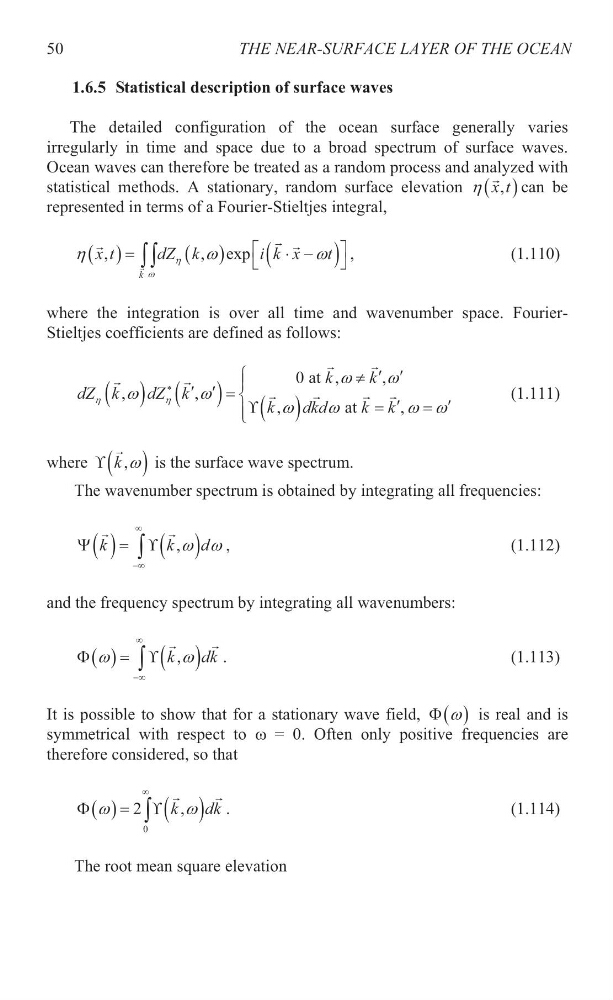
statistical methods. A stationary, random surface elevation
,
x t
K
G can be
represented in terms of a Fourier-Stieltjes integral,
,
, e x p
k
x t
dZ k
i k x
t
K
Z
K
Z
Z
ª
º
¬
¼
³³ G
G
G
G
,
(1.110)
where the integration is over all time and wavenumber space. FourierStieltjes coefficients are defined as follows:
0 at ,
,
,
,
,
a t
,
k
k
dZ k
dZ k
k
dkd
k k
K
K
Z
Z
Z
Z
Z
Z
Z Z
c c
z
°
c c ®
c
c
b
° ¯
G
G
G
G
G
G
G G
(1.111)
where
,
k Z
b
G
is the surface wave spectrum.
The wavenumber spectrum is obtained by integrating all frequencies:
,
k
k
d
Z Z
f
f
<
b
³
G
G
,
(1.112)
and the frequency spectrum by integrating all wavenumbers:
,
k
dk
Z
Z
f
f
)
b
³
G
G
.
(1.113)
It is possible to show that for a stationary wave field,
Z
)
is real and is
symmetrical with respect to Z = 0. Often only positive frequencies are
therefore considered, so that
0
2
,
k
dk
Z
Z
f
)
b
³
G
G
.
(1.114)
The root mean square elevation
50
1.6.5 Statistical description of surface waves
The detailed configuration of the ocean surface generally varies
irregularly in time and space due to a broad spectrum of surface waves.
Ocean waves can therefore be treated as a random process and analyzed with
statistical methods. A stationary, random surface elevation
,
x t
K
G can be
represented in terms of a Fourier-Stieltjes integral,
,
, e x p
k
x t
dZ k
i k x
t
K
Z
K
Z
Z
ª
º
¬
¼
³³ G
G
G
G
,
(1.110)
where the integration is over all time and wavenumber space. FourierStieltjes coefficients are defined as follows:
0 at ,
,
,
,
,
a t
,
k
k
dZ k
dZ k
k
dkd
k k
K
K
Z
Z
Z
Z
Z
Z
Z Z
c c
z
°
c c ®
c
c
b
° ¯
G
G
G
G
G
G
G G
(1.111)
where
,
k Z
b
G
is the surface wave spectrum.
The wavenumber spectrum is obtained by integrating all frequencies:
,
k
k
d
Z Z
f
f
<
b
³
G
G
,
(1.112)
and the frequency spectrum by integrating all wavenumbers:
,
k
dk
Z
Z
f
f
)
b
³
G
G
.
(1.113)
It is possible to show that for a stationary wave field,
Z
)
is real and is
symmetrical with respect to Z = 0. Often only positive frequencies are
therefore considered, so that
0
2
,
k
dk
Z
Z
f
)
b
³
G
G
.
(1.114)
The root mean square elevation
50