

THE NEAR-SURFACE LAYER OF THE OCEAN
Discussion of these components based on the physics of the turbulent
boundary layer and the properties of the sea surface is given below.
7.5.2 Interfacial component
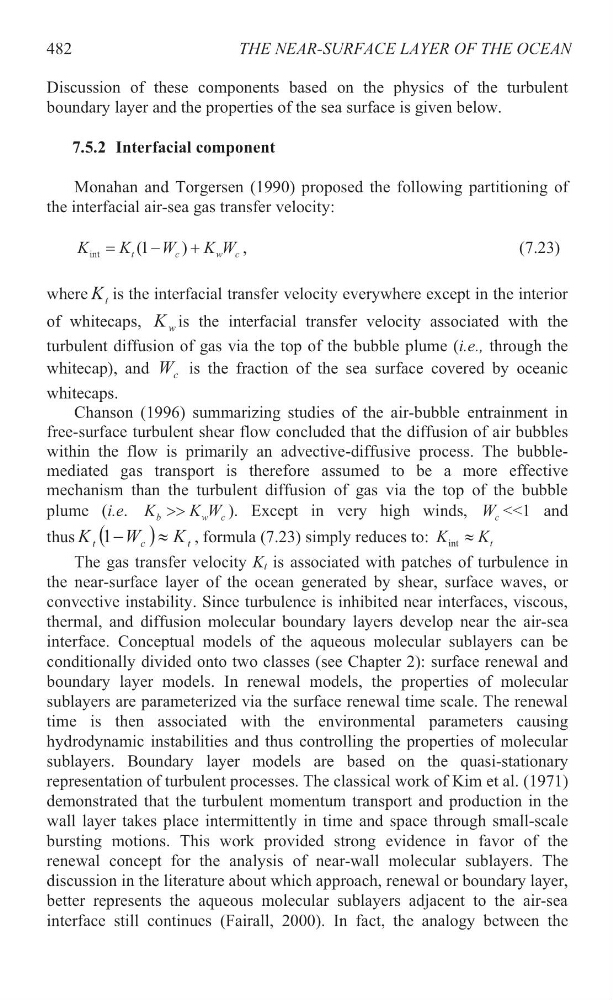
Monahan and Torgersen (1990) proposed the following partitioning of
the interfacial air-sea gas transfer velocity:
int
(1
)
t
c
w c
K
K
W
K W
,
(7.23)
where t
K is the interfacial transfer velocity everywhere except in the interior
of whitecaps,
w
K is the interfacial transfer velocity associated with the
turbulent diffusion of gas via the top of the bubble plume (i.e., through the
whitecap), and c
W is the fraction of the sea surface covered by oceanic
whitecaps.
Chanson (1996) summarizing studies of the air-bubble entrainment in
free-surface turbulent shear flow concluded that the diffusion of air bubbles
within the flow is primarily an advective-diffusive process. The bubblemediated gas transport is therefore assumed to be a more effective
mechanism than the turbulent diffusion of gas via the top of the bubble
plume (i.e.
b
w c
K
K W
!!
). Except in very high winds,
c
W <<1 and
thus
t
c
t
K
W
K
|
1
, formula (7.23) simply reduces to: int
t
K
K
|
The gas transfer velocity K t is associated with patches of turbulence in
the near-surface layer of the ocean generated by shear, surface waves, or
convective instability. Since turbulence is inhibited near interfaces, viscous,
thermal, and diffusion molecular boundary layers develop near the air-sea
interface. Conceptual models of the aqueous molecular sublayers can be
conditionally divided onto two classes (see Chapter 2): surface renewal and
boundary layer models. In renewal models, the properties of molecular
sublayers are parameterized via the surface renewal time scale. The renewal
time is then associated with the environmental parameters causing
hydrodynamic instabilities and thus controlling the properties of molecular
sublayers. Boundary layer models are based on the quasi-stationary
representation of turbulent processes. The classical work of Kim et al. (1971)
demonstrated that the turbulent momentum transport and production in the
wall layer takes place intermittently in time and space through small-scale
bursting motions. This work provided strong evidence in favor of the
renewal concept for the analysis of near-wall molecular sublayers. The
discussion in the literature about which approach, renewal or boundary layer,
better represents the aqueous molecular sublayers adjacent to the air-sea
interface still continues (Fairall, 2000). In fact, the analogy between the
482
Discussion of these components based on the physics of the turbulent
boundary layer and the properties of the sea surface is given below.
7.5.2 Interfacial component
Monahan and Torgersen (1990) proposed the following partitioning of
the interfacial air-sea gas transfer velocity:
int
(1
)
t
c
w c
K
K
W
K W
,
(7.23)
where t
K is the interfacial transfer velocity everywhere except in the interior
of whitecaps,
w
K is the interfacial transfer velocity associated with the
turbulent diffusion of gas via the top of the bubble plume (i.e., through the
whitecap), and c
W is the fraction of the sea surface covered by oceanic
whitecaps.
Chanson (1996) summarizing studies of the air-bubble entrainment in
free-surface turbulent shear flow concluded that the diffusion of air bubbles
within the flow is primarily an advective-diffusive process. The bubblemediated gas transport is therefore assumed to be a more effective
mechanism than the turbulent diffusion of gas via the top of the bubble
plume (i.e.
b
w c
K
K W
!!
). Except in very high winds,
c
W <<1 and
thus
t
c
t
K
W
K
|
1
, formula (7.23) simply reduces to: int
t
K
K
|
The gas transfer velocity K t is associated with patches of turbulence in
the near-surface layer of the ocean generated by shear, surface waves, or
convective instability. Since turbulence is inhibited near interfaces, viscous,
thermal, and diffusion molecular boundary layers develop near the air-sea
interface. Conceptual models of the aqueous molecular sublayers can be
conditionally divided onto two classes (see Chapter 2): surface renewal and
boundary layer models. In renewal models, the properties of molecular
sublayers are parameterized via the surface renewal time scale. The renewal
time is then associated with the environmental parameters causing
hydrodynamic instabilities and thus controlling the properties of molecular
sublayers. Boundary layer models are based on the quasi-stationary
representation of turbulent processes. The classical work of Kim et al. (1971)
demonstrated that the turbulent momentum transport and production in the
wall layer takes place intermittently in time and space through small-scale
bursting motions. This work provided strong evidence in favor of the
renewal concept for the analysis of near-wall molecular sublayers. The
discussion in the literature about which approach, renewal or boundary layer,
better represents the aqueous molecular sublayers adjacent to the air-sea
interface still continues (Fairall, 2000). In fact, the analogy between the
482