

Chapter 7: APPLICATIONS
2
0.01( / )
i
e
i
U U
' |
,
(7.22)
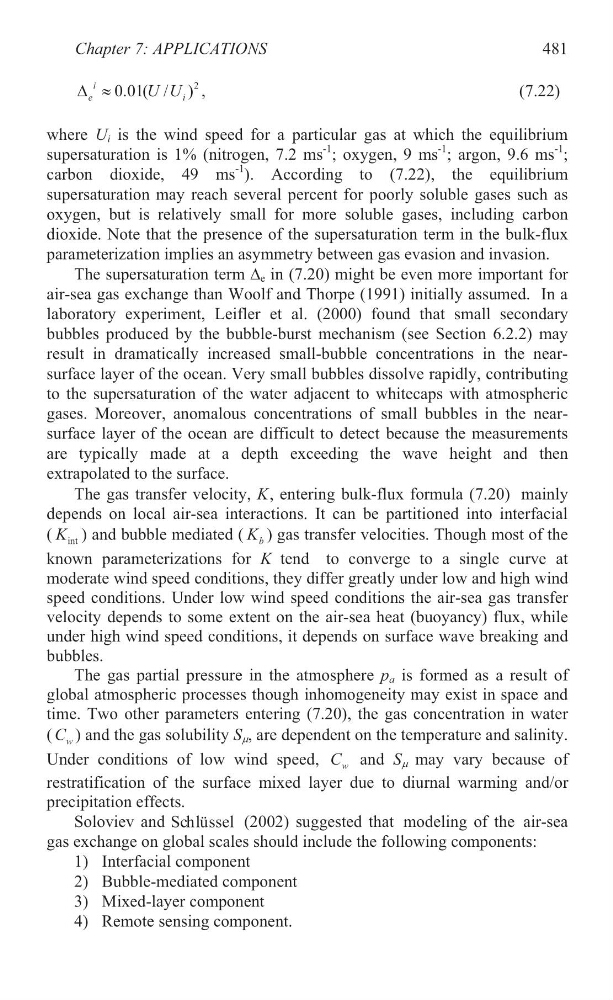
where U i is the wind speed for a particular gas at which the equilibrium
supersaturation is 1% (nitrogen, 7.2 ms
-1 ; oxygen, 9 ms
-1 ; argon, 9.6 ms
-1 ;
carbon dioxide, 49 ms
-1 ). According to (7.22), the equilibrium
supersaturation may reach several percent for poorly soluble gases such as
oxygen, but is relatively small for more soluble gases, including carbon
dioxide. Note that the presence of the supersaturation term in the bulk-flux
parameterization implies an asymmetry between gas evasion and invasion.
The supersaturation term ' e in (7.20) might be even more important for
air-sea gas exchange than Woolf and Thorpe (1991) initially assumed. In a
laboratory experiment, Leifler et al. (2000) found that small secondary
bubbles produced by the bubble-burst mechanism (see Section 6.2.2) may
result in dramatically increased small-bubble concentrations in the nearsurface layer of the ocean. Very small bubbles dissolve rapidly, contributing
to the supersaturation of the water adjacent to whitecaps with atmospheric
gases. Moreover, anomalous concentrations of small bubbles in the nearsurface layer of the ocean are difficult to detect because the measurements
are typically made at a depth exceeding the wave height and then
extrapolated to the surface.
The gas transfer velocity, K, entering bulk-flux formula (7.20) mainly
depends on local air-sea interactions. It can be partitioned into interfacial
( int
K ) and bubble mediated ( b
K ) gas transfer velocities. Though most of the
known parameterizations for K tend to converge to a single curve at
moderate wind speed conditions, they differ greatly under low and high wind
speed conditions. Under low wind speed conditions the air-sea gas transfer
velocity depends to some extent on the air-sea heat (buoyancy) flux, while
under high wind speed conditions, it depends on surface wave breaking and
bubbles.
The gas partial pressure in the atmosphere p a is formed as a result of
global atmospheric processes though inhomogeneity may exist in space and
time. Two other parameters entering (7.20), the gas concentration in water
( w
C ) and the gas solubility S P , are dependent on the temperature and salinity.
Under conditions of low wind speed, w
C and S P may vary because of
restratification of the surface mixed layer due to diurnal warming and/or
precipitation effects.
gas exchange on global scales should include the following components:
1) Interfacial component
2) Bubble-mediated component
3) Mixed-layer component
4) Remote sensing component.
481
Soloviev and
(2002) suggested that modeling of the air-sea
Schl ssel
ü
2
0.01( / )
i
e
i
U U
' |
,
(7.22)
where U i is the wind speed for a particular gas at which the equilibrium
supersaturation is 1% (nitrogen, 7.2 ms
-1 ; oxygen, 9 ms
-1 ; argon, 9.6 ms
-1 ;
carbon dioxide, 49 ms
-1 ). According to (7.22), the equilibrium
supersaturation may reach several percent for poorly soluble gases such as
oxygen, but is relatively small for more soluble gases, including carbon
dioxide. Note that the presence of the supersaturation term in the bulk-flux
parameterization implies an asymmetry between gas evasion and invasion.
The supersaturation term ' e in (7.20) might be even more important for
air-sea gas exchange than Woolf and Thorpe (1991) initially assumed. In a
laboratory experiment, Leifler et al. (2000) found that small secondary
bubbles produced by the bubble-burst mechanism (see Section 6.2.2) may
result in dramatically increased small-bubble concentrations in the nearsurface layer of the ocean. Very small bubbles dissolve rapidly, contributing
to the supersaturation of the water adjacent to whitecaps with atmospheric
gases. Moreover, anomalous concentrations of small bubbles in the nearsurface layer of the ocean are difficult to detect because the measurements
are typically made at a depth exceeding the wave height and then
extrapolated to the surface.
The gas transfer velocity, K, entering bulk-flux formula (7.20) mainly
depends on local air-sea interactions. It can be partitioned into interfacial
( int
K ) and bubble mediated ( b
K ) gas transfer velocities. Though most of the
known parameterizations for K tend to converge to a single curve at
moderate wind speed conditions, they differ greatly under low and high wind
speed conditions. Under low wind speed conditions the air-sea gas transfer
velocity depends to some extent on the air-sea heat (buoyancy) flux, while
under high wind speed conditions, it depends on surface wave breaking and
bubbles.
The gas partial pressure in the atmosphere p a is formed as a result of
global atmospheric processes though inhomogeneity may exist in space and
time. Two other parameters entering (7.20), the gas concentration in water
( w
C ) and the gas solubility S P , are dependent on the temperature and salinity.
Under conditions of low wind speed, w
C and S P may vary because of
restratification of the surface mixed layer due to diurnal warming and/or
precipitation effects.
gas exchange on global scales should include the following components:
1) Interfacial component
2) Bubble-mediated component
3) Mixed-layer component
4) Remote sensing component.
481
Soloviev and
(2002) suggested that modeling of the air-sea
Schl ssel
ü