

The spilling wave breaker resembles a turbulent bore (Section 1.6.4),
which is an organized structure characterized by the regime of marginal
stability in which the buoyancy and inertial forces are balanced in such a
way that the Richardson number is close to its critical value (Turner, 1973).
The rising-bubble fragmentation mechanism is not a Kolmogorov cascade.
The Kolmogorov cascade is replaced here with the concept of marginal
stability in the bore-like wave breaker.
If we assume that the mechanism of bubble fragmentation due to
buoyancy forces dominates in spilling breakers and identify w b as the
determining parameter (replacing dissipation rate H ), then standard
dimensional analysis leads to the following size spectrum:
1 3
b
N r
Qw r
v
.
(6.9)
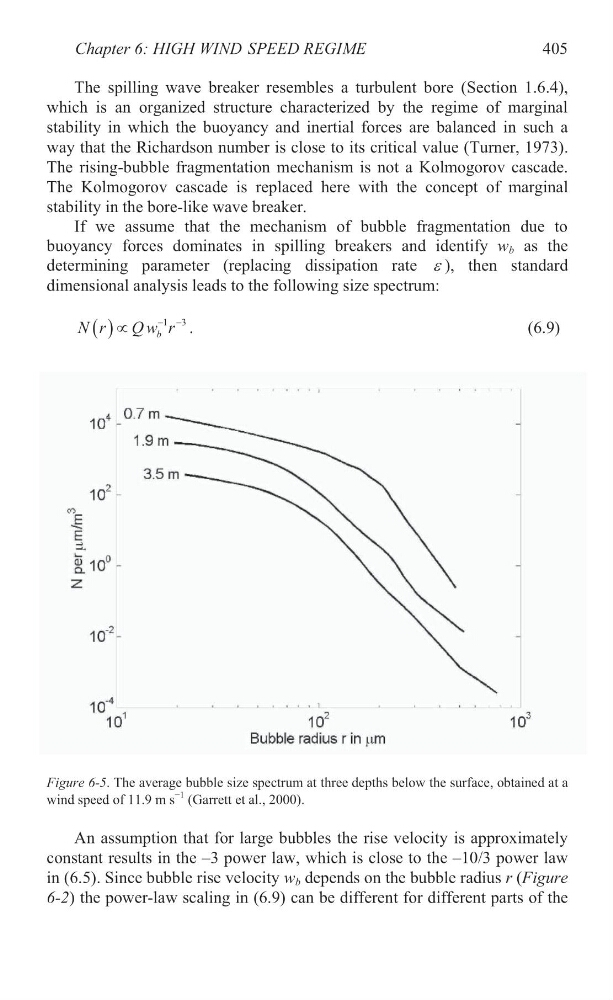
Figure 6-5. The average bubble size spectrum at three depths below the surface, obtained at a
wind speed of 11.9 m s
í1 (Garrett et al., 2000).
An assumption that for large bubbles the rise velocity is approximately
constant results in the –3 power law, which is close to the –10/3 power law
in (6.5). Since bubble rise velocity w b depends on the bubble radius r (Figure
6-2) the power-law scaling in (6.9) can be different for different parts of the
Chapter 6: HIGH WIND SPEED REGIME
405
which is an organized structure characterized by the regime of marginal
stability in which the buoyancy and inertial forces are balanced in such a
way that the Richardson number is close to its critical value (Turner, 1973).
The rising-bubble fragmentation mechanism is not a Kolmogorov cascade.
The Kolmogorov cascade is replaced here with the concept of marginal
stability in the bore-like wave breaker.
If we assume that the mechanism of bubble fragmentation due to
buoyancy forces dominates in spilling breakers and identify w b as the
determining parameter (replacing dissipation rate H ), then standard
dimensional analysis leads to the following size spectrum:
1 3
b
N r
Qw r
v
.
(6.9)
Figure 6-5. The average bubble size spectrum at three depths below the surface, obtained at a
wind speed of 11.9 m s
í1 (Garrett et al., 2000).
An assumption that for large bubbles the rise velocity is approximately
constant results in the –3 power law, which is close to the –10/3 power law
in (6.5). Since bubble rise velocity w b depends on the bubble radius r (Figure
6-2) the power-law scaling in (6.9) can be different for different parts of the
Chapter 6: HIGH WIND SPEED REGIME
405