

THE NEAR-SURFACE LAYER OF THE OCEAN
173
t J
is the day of the summer solstice, and
365.25
y
d
is the average
number of days per year.
Factor m a depends strongly on atmospheric variables. Numerous
formulae have been proposed to estimate this factor. Lumb (1964) found
from an interpolation of the stationary weather ship data (52
o 30’N, 20
o W)
that under virtually clear skies,
cos
a
L
L
m a b
T
|
, where a L = 0.61 and b L =
0.2.
More sophisticated algorithms for m a have since been developed. A
relatively simple yet accurate analytical formula to compute surface
irradiance and PAR at the ocean surface under clear skies was proposed by
Frouin et al. (1989). Their formula represents a parameterization of the more
complex radiative transfer model of Tanre et al. (1979) and requires inputs
of date, solar zenith angle, visibility, aerosol type, and the vertically
integrated concentrations of ozone and water vapor. When compared to the
Tanre et al. (1979) model, the Frouin et al. (1989) formulation is accurate to
1-2% for solar zenith angles below 75
o .
1.4.4 Insolation under cloudy skies
Bishop and Rossow (1991) developed a computationally effective
scheme for computing the surface solar irradiance during cloudy conditions.
The fast algorithm for surface solar irradiance (FAST) utilizes the solar
zenith angle (T ), atmospheric water vapor profile (H 2 O) and ozone column
abundance (O 3 ), the cloud fraction and optical thickness, the visible surface
reflectance (R S ), the surface type (land, water, coast, ice), and the surface
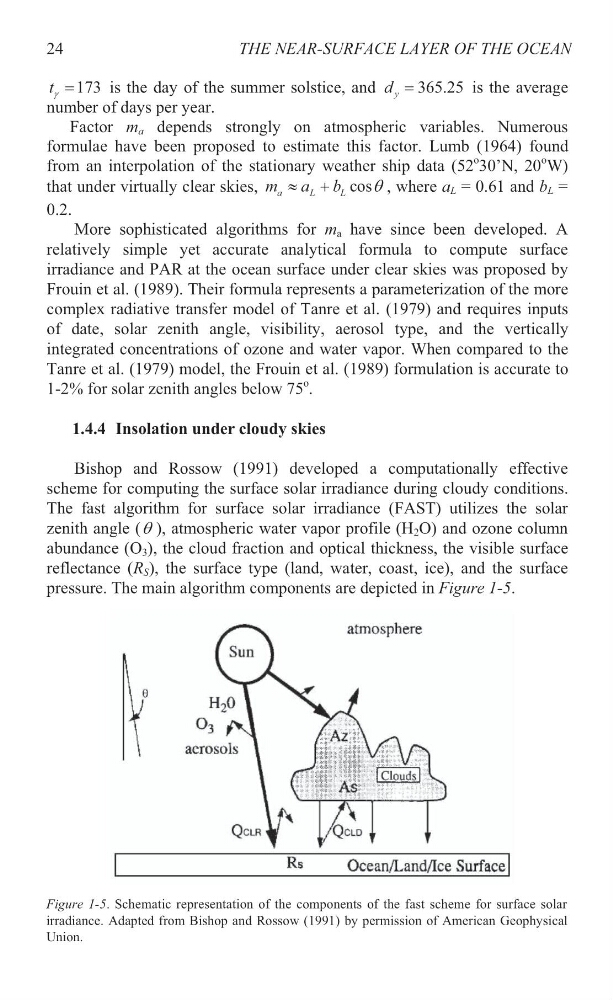
pressure. The main algorithm components are depicted in Figure 1-5.
24
Figure 1-5. Schematic representation of the components of the fast scheme for surface solar
irradiance. Adapted from Bishop and Rossow (1991) by permission of American Geophysical
Union.
173
t J
is the day of the summer solstice, and
365.25
y
d
is the average
number of days per year.
Factor m a depends strongly on atmospheric variables. Numerous
formulae have been proposed to estimate this factor. Lumb (1964) found
from an interpolation of the stationary weather ship data (52
o 30’N, 20
o W)
that under virtually clear skies,
cos
a
L
L
m a b
T
|
, where a L = 0.61 and b L =
0.2.
More sophisticated algorithms for m a have since been developed. A
relatively simple yet accurate analytical formula to compute surface
irradiance and PAR at the ocean surface under clear skies was proposed by
Frouin et al. (1989). Their formula represents a parameterization of the more
complex radiative transfer model of Tanre et al. (1979) and requires inputs
of date, solar zenith angle, visibility, aerosol type, and the vertically
integrated concentrations of ozone and water vapor. When compared to the
Tanre et al. (1979) model, the Frouin et al. (1989) formulation is accurate to
1-2% for solar zenith angles below 75
o .
1.4.4 Insolation under cloudy skies
Bishop and Rossow (1991) developed a computationally effective
scheme for computing the surface solar irradiance during cloudy conditions.
The fast algorithm for surface solar irradiance (FAST) utilizes the solar
zenith angle (T ), atmospheric water vapor profile (H 2 O) and ozone column
abundance (O 3 ), the cloud fraction and optical thickness, the visible surface
reflectance (R S ), the surface type (land, water, coast, ice), and the surface
pressure. The main algorithm components are depicted in Figure 1-5.
24
Figure 1-5. Schematic representation of the components of the fast scheme for surface solar
irradiance. Adapted from Bishop and Rossow (1991) by permission of American Geophysical
Union.