

Chapter 1: INTRODUCTION
Molecular scattering by gases in the atmosphere closely follows a
Raleigh law, obeying a O
-4.09 relationship, which mainly results from the
anisotropy of the air molecules involved in the scattering. The solid particles
suspended in the atmosphere scatter the light close to a O
-1 relationship,
while the water droplets in clouds and fog scatter the light with no
wavelength dependence. The water droplets, nevertheless, absorb strongly in
the infrared part of the solar spectrum.
For the analysis of the solar radiation as a volume source of energy in the
near-surface layer of the ocean, it is important to know the surface solar
irradiance and its spectral distribution. The magnitude of the solar energy
reaching sea level is essentially a function of cloudiness and the thickness of
the section of atmosphere penetrated (i.e., of the latitude, month of year, and
time of day–the sun’s elevation). We first consider the case of clear skies
and, then, the more complex problem of skies partially or totally covered by
clouds.
1.4.3 Insolation under clear skies
The surface solar irradiance CLR
I
under a clear sky is proportional to
cosT , where T is the zenith angle. This leads to the following formula
(Lumb, 1964):
0 cos
CLR
a
I
m I
T ,
(1.51)
where I o is the solar constant, and m a is a factor determined by the optical
properties of the atmosphere.
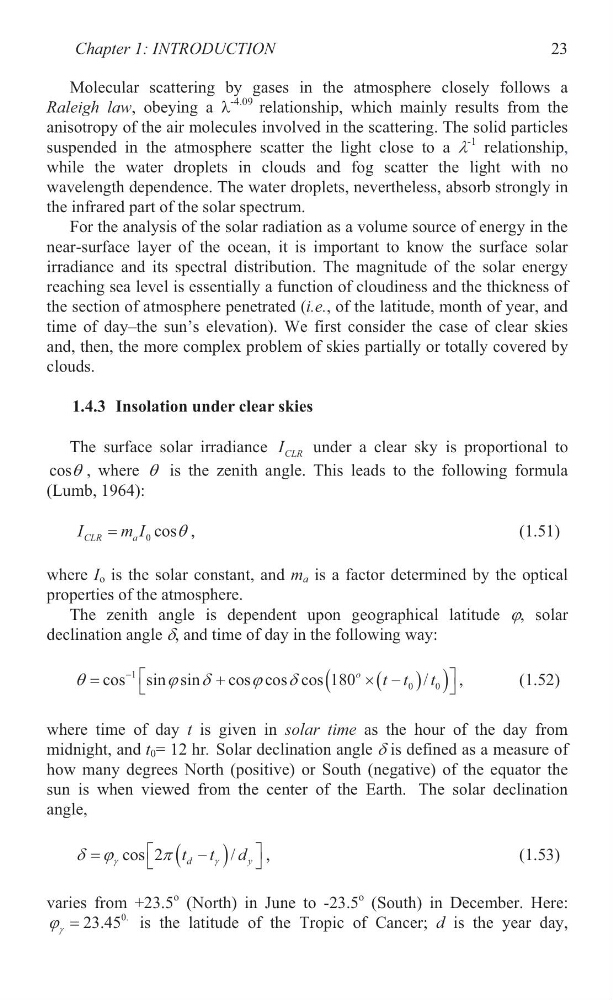
The zenith angle is dependent upon geographical latitude M, solar
declination angle Gand time of day in the following way:
1
0
0
cos sin sin
cos cos cos 180
/
o
t t t
T
M G
M
G
ª
º
u
¬
¼ ,
(1.52)
where time of day t is given in solar time as the hour of the day from
midnight, and t 0 = 12 hr. Solar declination angle G is defined as a measure of
how many degrees North (positive) or South (negative) of the equator the
sun is when viewed from the center of the Earth. The solar declination
angle,
cos 2
/
d
y
t t d
J
J
G M
S
ª
º
¬
¼ ,
(1.53)
varies from +23.5
o (North) in June to -23.5
o (South) in December. Here:
0.
23.45
J
M
is the latitude of the Tropic of Cancer; d is the year day,
23
Molecular scattering by gases in the atmosphere closely follows a
Raleigh law, obeying a O
-4.09 relationship, which mainly results from the
anisotropy of the air molecules involved in the scattering. The solid particles
suspended in the atmosphere scatter the light close to a O
-1 relationship,
while the water droplets in clouds and fog scatter the light with no
wavelength dependence. The water droplets, nevertheless, absorb strongly in
the infrared part of the solar spectrum.
For the analysis of the solar radiation as a volume source of energy in the
near-surface layer of the ocean, it is important to know the surface solar
irradiance and its spectral distribution. The magnitude of the solar energy
reaching sea level is essentially a function of cloudiness and the thickness of
the section of atmosphere penetrated (i.e., of the latitude, month of year, and
time of day–the sun’s elevation). We first consider the case of clear skies
and, then, the more complex problem of skies partially or totally covered by
clouds.
1.4.3 Insolation under clear skies
The surface solar irradiance CLR
I
under a clear sky is proportional to
cosT , where T is the zenith angle. This leads to the following formula
(Lumb, 1964):
0 cos
CLR
a
I
m I
T ,
(1.51)
where I o is the solar constant, and m a is a factor determined by the optical
properties of the atmosphere.
The zenith angle is dependent upon geographical latitude M, solar
declination angle Gand time of day in the following way:
1
0
0
cos sin sin
cos cos cos 180
/
o
t t t
T
M G
M
G
ª
º
u
¬
¼ ,
(1.52)
where time of day t is given in solar time as the hour of the day from
midnight, and t 0 = 12 hr. Solar declination angle G is defined as a measure of
how many degrees North (positive) or South (negative) of the equator the
sun is when viewed from the center of the Earth. The solar declination
angle,
cos 2
/
d
y
t t d
J
J
G M
S
ª
º
¬
¼ ,
(1.53)
varies from +23.5
o (North) in June to -23.5
o (South) in December. Here:
0.
23.45
J
M
is the latitude of the Tropic of Cancer; d is the year day,
23