

Chapter 5. SPATIALLY-COHERENT STRUCTURES
v(z) components,
^ `
,
k
k l
G
is the horizontal wavenumber vector consisting
of the zonal k and meridional l components, Z is the complex frequency,
2
0
/
z
N z
g U U
w
is the mean squared buoyancy frequency , U and 0
U
are the horizontal mean and the overall mean densities, respectively. The
solution for (5.47) is sought in the form of a plane wave:
, , ,
exp
W x y z t w z
i kx ly
t
Z
ª
º
¬
¼
(5.48)
For complex frequency
r
i
i
Z Z Z
the exponential in (5.48) has a real and
growing part (for
0
i
Z ! ), so that all wave variables have a growth rate i
Z .
The Howard (1961) theorem states that the complex phase speed of any
unstable modal solution in parallel flows of an inviscid fluid must lie inside
the semicircle in the upper half of the complex phase speed plane, which has
the range of the mean flow as the diameter. Mack and Hebert (1997) altered
slightly this theorem in application to the three-dimensional version of the
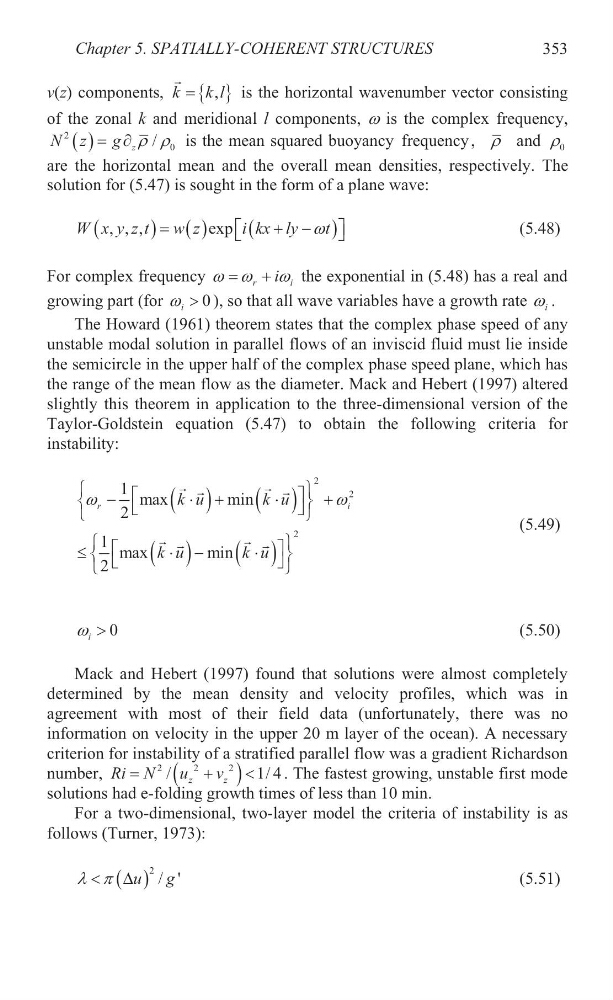
Taylor-Goldstein equation (5.47) to obtain the following criteria for
instability:
2
2
2
1 max
min
2
1 max
min
2
r
i
k u
k u
k u
k u
Z
Z
½
ª
º
®
¾
¬
¼
¯
¿
½
ª
º
d
®
¾
¬
¼
¯
¿
G
G
G
G
G
G
G
G
(5.49)
0
i
Z !
(5.50)
Mack and Hebert (1997) found that solutions were almost completely
determined by the mean density and velocity profiles, which was in
agreement with most of their field data (unfortunately, there was no
information on velocity in the upper 20 m layer of the ocean). A necessary
criterion for instability of a stratified parallel flow was a gradient Richardson
number,
2
2
2
/
1 / 4
z
z
Ri N u
v
. The fastest growing, unstable first mode
solutions had e-folding growth times of less than 10 min.
For a two-dimensional, two-layer model the criteria of instability is as
follows (Turner, 1973):
2 / '
u g
O S
'
(5.51)
353
v(z) components,
^ `
,
k
k l
G
is the horizontal wavenumber vector consisting
of the zonal k and meridional l components, Z is the complex frequency,
2
0
/
z
N z
g U U
w
is the mean squared buoyancy frequency , U and 0
U
are the horizontal mean and the overall mean densities, respectively. The
solution for (5.47) is sought in the form of a plane wave:
, , ,
exp
W x y z t w z
i kx ly
t
Z
ª
º
¬
¼
(5.48)
For complex frequency
r
i
i
Z Z Z
the exponential in (5.48) has a real and
growing part (for
0
i
Z ! ), so that all wave variables have a growth rate i
Z .
The Howard (1961) theorem states that the complex phase speed of any
unstable modal solution in parallel flows of an inviscid fluid must lie inside
the semicircle in the upper half of the complex phase speed plane, which has
the range of the mean flow as the diameter. Mack and Hebert (1997) altered
slightly this theorem in application to the three-dimensional version of the
Taylor-Goldstein equation (5.47) to obtain the following criteria for
instability:
2
2
2
1 max
min
2
1 max
min
2
r
i
k u
k u
k u
k u
Z
Z
½
ª
º
®
¾
¬
¼
¯
¿
½
ª
º
d
®
¾
¬
¼
¯
¿
G
G
G
G
G
G
G
G
(5.49)
0
i
Z !
(5.50)
Mack and Hebert (1997) found that solutions were almost completely
determined by the mean density and velocity profiles, which was in
agreement with most of their field data (unfortunately, there was no
information on velocity in the upper 20 m layer of the ocean). A necessary
criterion for instability of a stratified parallel flow was a gradient Richardson
number,
2
2
2
/
1 / 4
z
z
Ri N u
v
. The fastest growing, unstable first mode
solutions had e-folding growth times of less than 10 min.
For a two-dimensional, two-layer model the criteria of instability is as
follows (Turner, 1973):
2 / '
u g
O S
'
(5.51)
353