

THE NEAR-SURFACE LAYER OF THE OCEAN
except for winds > 20 m s
-1 , only the modulation mechanism is of practical
significance (but with energy flow from the internal to the surface waves). In
contrast to this result for the wind waves, Watson (1990) also found that a
strong, narrow-band ocean swell can lead to rapid growth of high frequency
internal waves. The application of the theoretical models cited above,
however, demands advanced measurement for both internal and surface
wave components, which has not yet been done.
5.5.3 Kelvin-Helmholtz instability of a sheared stratified flow
The kinetic energy accumulated by the diurnal jet during a period of
intensive warming is a possible source of mechanical energy for the
generation of internal waves and billows in the diurnal thermocline. During a
period of intensive solar heating, the turbulent friction in the diurnal
thermocline is substantially reduced due to buoyancy forces (Kudryavtsev
and Soloviev 1990). The shallow diurnal jet accumulates the momentum
transferred from the wind. In the evening the net surface buoyancy flux at
the ocean-air interface decreases and when becomes negative convection
develops (see Section 5.8.3); the slippery conditions within the diurnal
thermocline disappear and the momentum flux at the lower boundary of the
diurnal jet increases. This provides favorable conditions for the KelvinHelmholtz instability. The atmospheric forcing may significantly vary
during the day (e.g., because of clouds) producing short-term conditions for
Kelvin-Helmholtz instability in the diurnal thermocline (see an example in
Figure 4-20).
The instability of a continuously stratified shear flow can be described
with the Taylor-Goldstein equation (Taylor, 1931; Goldsten, 1931). The
Taylor-Goldstein equation is derived under the assumption of an inviscid,
Boussinesq fluid; the vertical structure equation is linearized around the
vertical profiles of horizontal velocity and density representing the basic
state. The upper equatorial ocean typically has strong mean shear, which in
general may not coincide with the direction of the diurnal jet (the latter
largely depends on wind stress direction). Mack and Hebert (1997)
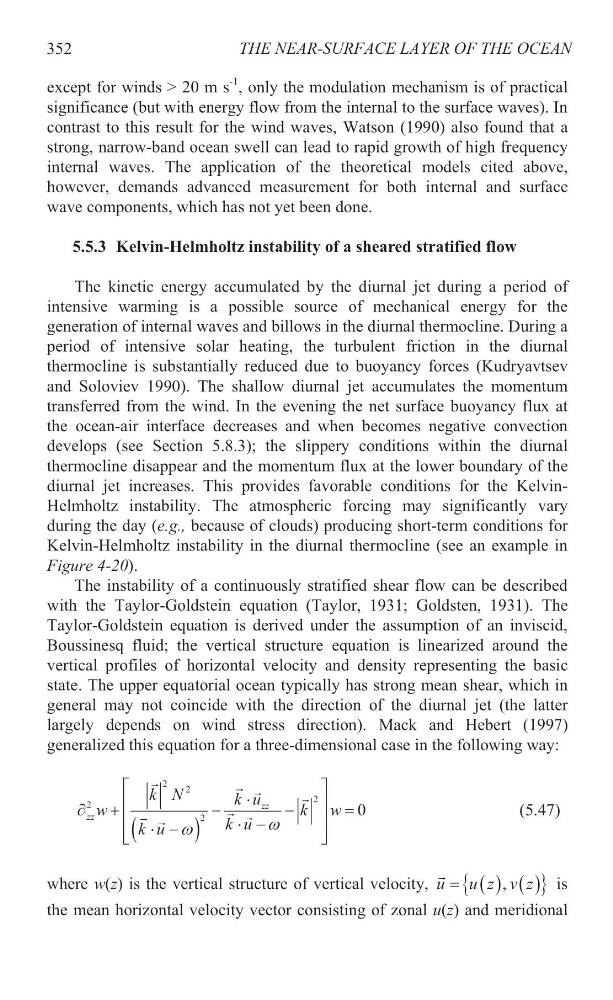
generalized this equation for a three-dimensional case in the following way:
2
2
2
2
2
0
zz
zz
k N
k u
w
k w
k u
k u
Z
Z
ª
º
«
»
w
«
»
«
»
¬
¼
G
G G
G
G G
G G
(5.47)
where w(z) is the vertical structure of vertical velocity,
^
`
,
u u z v z
G
is
the mean horizontal velocity vector consisting of zonal u(z) and meridional
352
except for winds > 20 m s
-1 , only the modulation mechanism is of practical
significance (but with energy flow from the internal to the surface waves). In
contrast to this result for the wind waves, Watson (1990) also found that a
strong, narrow-band ocean swell can lead to rapid growth of high frequency
internal waves. The application of the theoretical models cited above,
however, demands advanced measurement for both internal and surface
wave components, which has not yet been done.
5.5.3 Kelvin-Helmholtz instability of a sheared stratified flow
The kinetic energy accumulated by the diurnal jet during a period of
intensive warming is a possible source of mechanical energy for the
generation of internal waves and billows in the diurnal thermocline. During a
period of intensive solar heating, the turbulent friction in the diurnal
thermocline is substantially reduced due to buoyancy forces (Kudryavtsev
and Soloviev 1990). The shallow diurnal jet accumulates the momentum
transferred from the wind. In the evening the net surface buoyancy flux at
the ocean-air interface decreases and when becomes negative convection
develops (see Section 5.8.3); the slippery conditions within the diurnal
thermocline disappear and the momentum flux at the lower boundary of the
diurnal jet increases. This provides favorable conditions for the KelvinHelmholtz instability. The atmospheric forcing may significantly vary
during the day (e.g., because of clouds) producing short-term conditions for
Kelvin-Helmholtz instability in the diurnal thermocline (see an example in
Figure 4-20).
The instability of a continuously stratified shear flow can be described
with the Taylor-Goldstein equation (Taylor, 1931; Goldsten, 1931). The
Taylor-Goldstein equation is derived under the assumption of an inviscid,
Boussinesq fluid; the vertical structure equation is linearized around the
vertical profiles of horizontal velocity and density representing the basic
state. The upper equatorial ocean typically has strong mean shear, which in
general may not coincide with the direction of the diurnal jet (the latter
largely depends on wind stress direction). Mack and Hebert (1997)
generalized this equation for a three-dimensional case in the following way:
2
2
2
2
2
0
zz
zz
k N
k u
w
k w
k u
k u
Z
Z
ª
º
«
»
w
«
»
«
»
¬
¼
G
G G
G
G G
G G
(5.47)
where w(z) is the vertical structure of vertical velocity,
^
`
,
u u z v z
G
is
the mean horizontal velocity vector consisting of zonal u(z) and meridional
352