

THE NEAR-SURFACE LAYER OF THE OCEAN
2
2
0
0
0
1
3
1
0
6
4
e
xx
x
U
h
c
c
Q
]
]
]
]
§
·
¨
¸
©
¹
,
(5.31)
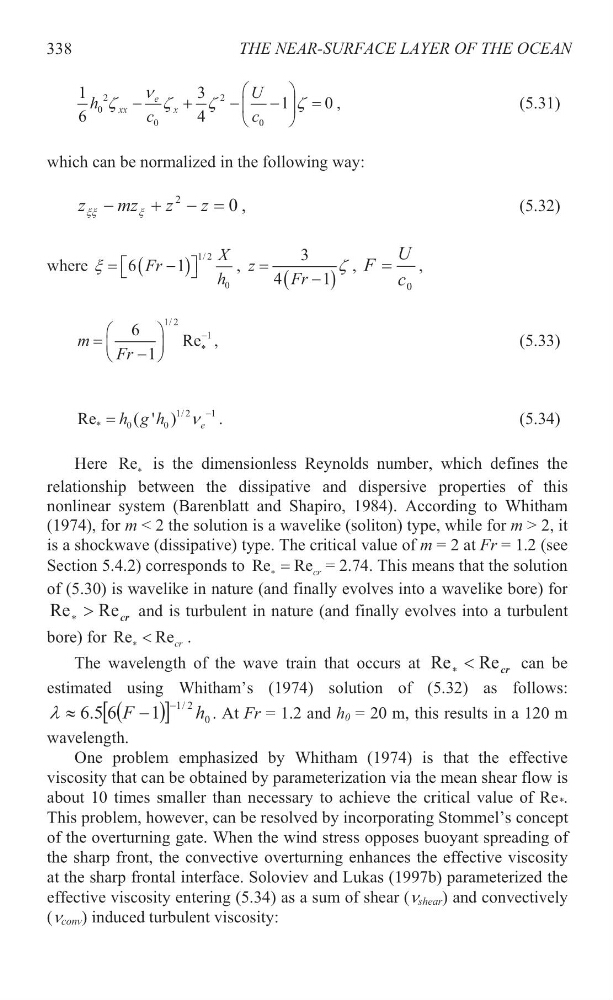
which can be normalized in the following way:
0
2
z
z
mz
z
[
[[
,
(5.32)
where
1/ 2
0
6
1
X
Fr
h
[ ª
º
¬
¼
,
3
4
1
z
Fr
]
,
0
c
U
F
,
1/ 2
1
6
Re
1
m
Fr
§
·
¨
¸
©
¹
,
(5.33)
1/ 2
1
*
0
0
Re
( ' ) e
h g h
Q
.
(5.34)
Here Re is the dimensionless Reynolds number, which defines the
relationship between the dissipative and dispersive properties of this
nonlinear system (Barenblatt and Shapiro, 1984). According to Whitham
(1974), for m < 2 the solution is a wavelike (soliton) type, while for m > 2, it
is a shockwave (dissipative) type. The critical value of m = 2 at Fr = 1.2 (see
Section 5.4.2) corresponds to Re Re cr
= 2.74. This means that the solution
of (5.30) is wavelike in nature (and finally evolves into a wavelike bore) for
cr
Re
Re !
and is turbulent in nature (and finally evolves into a turbulent
bore) for Re Re cr
.
The wavelength of the wave train that occurs at
cr
Re
Re
can be
estimated using Whitham’s (1974) solution of (5.32) as follows:
>
@ 0
2
/
1
1
6
5
.
6
h
F
|
O
. At Fr = 1.2 and h 0 = 20 m, this results in a 120 m
wavelength.
One problem emphasized by Whitham (1974) is that the effective
viscosity that can be obtained by parameterization via the mean shear flow is
about 10 times smaller than necessary to achieve the critical value of Re * .
This problem, however, can be resolved by incorporating Stommel’s concept
of the overturning gate. When the wind stress opposes buoyant spreading of
the sharp front, the convective overturning enhances the effective viscosity
at the sharp frontal interface. Soloviev and Lukas (1997b) parameterized the
effective viscosity entering (5.34) as a sum of shear (Q shear ) and convectively
(Q conv ) induced turbulent viscosity:
338
2
2
0
0
0
1
3
1
0
6
4
e
xx
x
U
h
c
c
Q
]
]
]
]
§
·
¨
¸
©
¹
,
(5.31)
which can be normalized in the following way:
0
2
z
z
mz
z
[
[[
,
(5.32)
where
1/ 2
0
6
1
X
Fr
h
[ ª
º
¬
¼
,
3
4
1
z
Fr
]
,
0
c
U
F
,
1/ 2
1
6
Re
1
m
Fr
§
·
¨
¸
©
¹
,
(5.33)
1/ 2
1
*
0
0
Re
( ' ) e
h g h
Q
.
(5.34)
Here Re is the dimensionless Reynolds number, which defines the
relationship between the dissipative and dispersive properties of this
nonlinear system (Barenblatt and Shapiro, 1984). According to Whitham
(1974), for m < 2 the solution is a wavelike (soliton) type, while for m > 2, it
is a shockwave (dissipative) type. The critical value of m = 2 at Fr = 1.2 (see
Section 5.4.2) corresponds to Re Re cr
= 2.74. This means that the solution
of (5.30) is wavelike in nature (and finally evolves into a wavelike bore) for
cr
Re
Re !
and is turbulent in nature (and finally evolves into a turbulent
bore) for Re Re cr
.
The wavelength of the wave train that occurs at
cr
Re
Re
can be
estimated using Whitham’s (1974) solution of (5.32) as follows:
>
@ 0
2
/
1
1
6
5
.
6
h
F
|
O
. At Fr = 1.2 and h 0 = 20 m, this results in a 120 m
wavelength.
One problem emphasized by Whitham (1974) is that the effective
viscosity that can be obtained by parameterization via the mean shear flow is
about 10 times smaller than necessary to achieve the critical value of Re * .
This problem, however, can be resolved by incorporating Stommel’s concept
of the overturning gate. When the wind stress opposes buoyant spreading of
the sharp front, the convective overturning enhances the effective viscosity
at the sharp frontal interface. Soloviev and Lukas (1997b) parameterized the
effective viscosity entering (5.34) as a sum of shear (Q shear ) and convectively
(Q conv ) induced turbulent viscosity:
338