

Chapter 5. SPATIALLY-COHERENT STRUCTURES
(the overturning gate is closed) the intensive mixing effectively eliminates
noncompensated sharp frontal interfaces (this process is illustrated in Figure
5-28). The lifetime of an noncompensated sharp frontal interface opposing
the wind stress is relatively small; the probability of its observation is
reduced.
Stommel’s overturning gate is a complicated nonlinear problem. Its
faithful solution in the framework of the hydrodynamics equations is not
feasible now, though the internal wave–shear flow interaction theory
described in the previous section has a good chance to succeed in this
direction.
At the same time, the structural form of the sharp frontal interfaces has
some similarity to that of the internal surge previously observed in long
stably stratified lakes (Thorpe, 1971; Hunkins and Fliegel, 1973; Farmer,
1978). Evolution of an initially smooth perturbation with wavelength O>> h 0
into an asymmetric shockwave structure can be described in the framework
of shallow water theory similar to the analysis of Farmer (1978) for a long
stably stratified lake, but in our case, h 0 is the depth of the intermediate
thermocline associated with the front.
At the stage when the internal perturbation’s slope becomes very steep,
dispersion and dissipation effects are important in this nonlinear system.
Whitham (1974) and Barenblatt and Shapiro (1984) applied an equation of
Korteweg-deVries-Burgers type to explore a simple nonlinear system with
dispersion and dissipation. Applied to a two-layer upper ocean with an
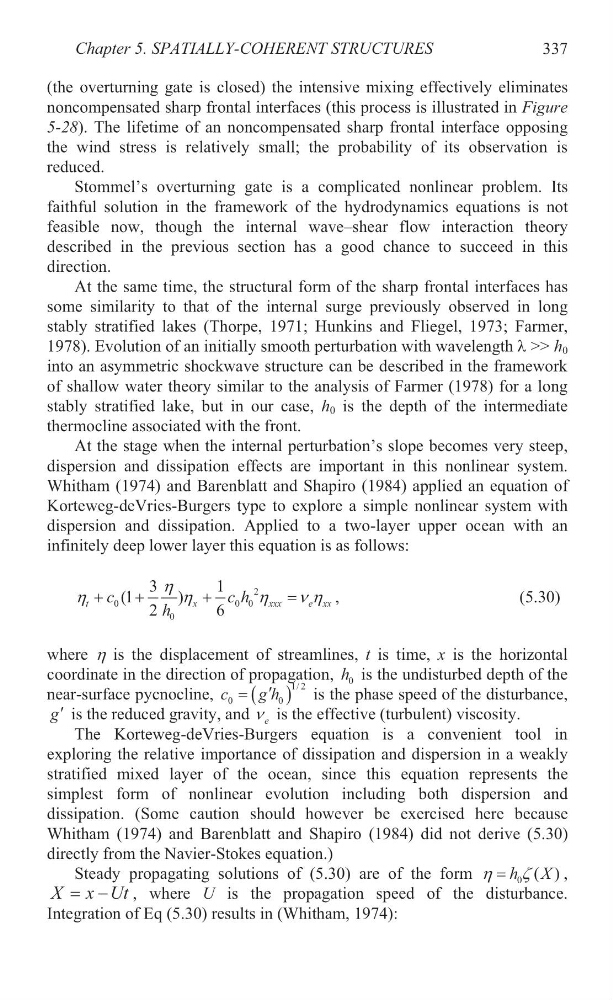
infinitely deep lower layer this equation is as follows:
2
0
0 0
0
3
1
(1
)
2
6
t
x
xxx
e xx
c
ch
h
K
K
K
K
QK
,
(5.30)
where K is the displacement of streamlines, t is time, x is the horizontal
coordinate in the direction of propagation, 0
h is the undisturbed depth of the
near-surface pycnocline,
1/ 2
0
0
c
gh c
is the phase speed of the disturbance,
gc is the reduced gravity, and e
Q is the effective (turbulent) viscosity.
The Korteweg-deVries-Burgers equation is a convenient tool in
exploring the relative importance of dissipation and dispersion in a weakly
stratified mixed layer of the ocean, since this equation represents the
simplest form of nonlinear evolution including both dispersion and
dissipation. (Some caution should however be exercised here because
Whitham (1974) and Barenblatt and Shapiro (1984) did not derive (5.30)
directly from the Navier-Stokes equation.)
Steady propagating solutions of (5.30) are of the form
0 ( )
h X
K
]
,
Ut
x
X
, where U is the propagation speed of the disturbance.
Integration of Eq (5.30) results in (Whitham, 1974):
337
(the overturning gate is closed) the intensive mixing effectively eliminates
noncompensated sharp frontal interfaces (this process is illustrated in Figure
5-28). The lifetime of an noncompensated sharp frontal interface opposing
the wind stress is relatively small; the probability of its observation is
reduced.
Stommel’s overturning gate is a complicated nonlinear problem. Its
faithful solution in the framework of the hydrodynamics equations is not
feasible now, though the internal wave–shear flow interaction theory
described in the previous section has a good chance to succeed in this
direction.
At the same time, the structural form of the sharp frontal interfaces has
some similarity to that of the internal surge previously observed in long
stably stratified lakes (Thorpe, 1971; Hunkins and Fliegel, 1973; Farmer,
1978). Evolution of an initially smooth perturbation with wavelength O>> h 0
into an asymmetric shockwave structure can be described in the framework
of shallow water theory similar to the analysis of Farmer (1978) for a long
stably stratified lake, but in our case, h 0 is the depth of the intermediate
thermocline associated with the front.
At the stage when the internal perturbation’s slope becomes very steep,
dispersion and dissipation effects are important in this nonlinear system.
Whitham (1974) and Barenblatt and Shapiro (1984) applied an equation of
Korteweg-deVries-Burgers type to explore a simple nonlinear system with
dispersion and dissipation. Applied to a two-layer upper ocean with an
infinitely deep lower layer this equation is as follows:
2
0
0 0
0
3
1
(1
)
2
6
t
x
xxx
e xx
c
ch
h
K
K
K
K
QK
,
(5.30)
where K is the displacement of streamlines, t is time, x is the horizontal
coordinate in the direction of propagation, 0
h is the undisturbed depth of the
near-surface pycnocline,
1/ 2
0
0
c
gh c
is the phase speed of the disturbance,
gc is the reduced gravity, and e
Q is the effective (turbulent) viscosity.
The Korteweg-deVries-Burgers equation is a convenient tool in
exploring the relative importance of dissipation and dispersion in a weakly
stratified mixed layer of the ocean, since this equation represents the
simplest form of nonlinear evolution including both dispersion and
dissipation. (Some caution should however be exercised here because
Whitham (1974) and Barenblatt and Shapiro (1984) did not derive (5.30)
directly from the Navier-Stokes equation.)
Steady propagating solutions of (5.30) are of the form
0 ( )
h X
K
]
,
Ut
x
X
, where U is the propagation speed of the disturbance.
Integration of Eq (5.30) results in (Whitham, 1974):
337