

to preserve the integrity of the BL02 model we accept the same typical
numerical values, Pr H = 1.3, c 1 =1.44, c v = 0.09, c 2 = 1.92 as in the original
BL02 model. The impact of the variability of constants on the BL02 model
output has not yet been studied.
The term
v
3 in the equation for H describing the “production of
dissipation” due to the wave kinetic energy w
b is not known. From general
considerations, it should vanish as z o f because the wave motion
degrades far enough from the ocean surface. The system of equations (3.54)(3.56) has hence two unknown functions: the kinetic energy of potential
waves, b w , and the production of the dissipation rate by waves, v
3 .
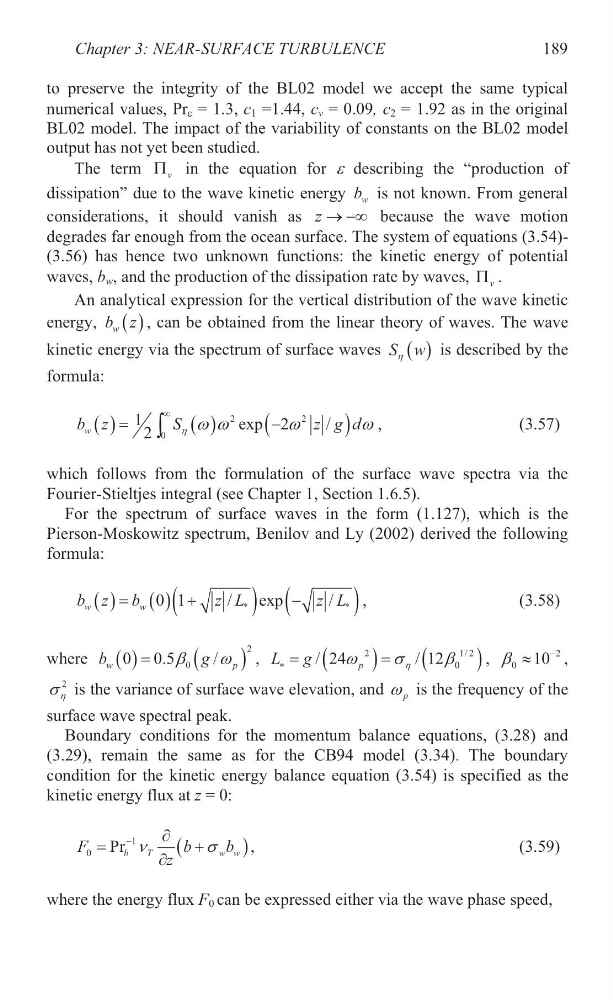
An analytical expression for the vertical distribution of the wave kinetic
energy,
w
b z , can be obtained from the linear theory of waves. The wave
kinetic energy via the spectrum of surface waves
S w
K
is described by the
formula:
2
2
0
1
exp 2
/
2
w
b z
S
z g d
K Z Z
Z
Z
f
³
,
(3.57)
which follows from the formulation of the surface wave spectra via the
Fourier-Stieltjes integral (see Chapter 1, Section 1.6.5).
For the spectrum of surface waves in the form (1.127), which is the
Pierson-Moskowitz spectrum, Benilov and Ly (2002) derived the following
formula:
*
*
0 1
/
exp
/
w
w
b z b
z L
z L
,
(3.58)
where
2
0
0 0.5
/
w
p
b
g
E
Z ,
2
1 / 2
0
/ 24
/ 12
p
L g
K
Z
V
E
,
2
0
10
E
|
,
2
K
V is the variance of surface wave elevation, and p
Z is the frequency of the
surface wave spectral peak.
Boundary conditions for the momentum balance equations, (3.28) and
(3.29), remain the same as for the CB94 model (3.34). The boundary
condition for the kinetic energy balance equation (3.54) is specified as the
kinetic energy flux at z = 0:
1
0
Pr b T
w w
F
b
b
z
Q
V
w
w
,
(3.59)
where the energy flux F 0 can be expressed either via the wave phase speed,
Chapter 3: NEAR-SURFACE TURBULENCE
189
numerical values, Pr H = 1.3, c 1 =1.44, c v = 0.09, c 2 = 1.92 as in the original
BL02 model. The impact of the variability of constants on the BL02 model
output has not yet been studied.
The term
v
3 in the equation for H describing the “production of
dissipation” due to the wave kinetic energy w
b is not known. From general
considerations, it should vanish as z o f because the wave motion
degrades far enough from the ocean surface. The system of equations (3.54)(3.56) has hence two unknown functions: the kinetic energy of potential
waves, b w , and the production of the dissipation rate by waves, v
3 .
An analytical expression for the vertical distribution of the wave kinetic
energy,
w
b z , can be obtained from the linear theory of waves. The wave
kinetic energy via the spectrum of surface waves
S w
K
is described by the
formula:
2
2
0
1
exp 2
/
2
w
b z
S
z g d
K Z Z
Z
Z
f
³
,
(3.57)
which follows from the formulation of the surface wave spectra via the
Fourier-Stieltjes integral (see Chapter 1, Section 1.6.5).
For the spectrum of surface waves in the form (1.127), which is the
Pierson-Moskowitz spectrum, Benilov and Ly (2002) derived the following
formula:
*
*
0 1
/
exp
/
w
w
b z b
z L
z L
,
(3.58)
where
2
0
0 0.5
/
w
p
b
g
E
Z ,
2
1 / 2
0
/ 24
/ 12
p
L g
K
Z
V
E
,
2
0
10
E
|
,
2
K
V is the variance of surface wave elevation, and p
Z is the frequency of the
surface wave spectral peak.
Boundary conditions for the momentum balance equations, (3.28) and
(3.29), remain the same as for the CB94 model (3.34). The boundary
condition for the kinetic energy balance equation (3.54) is specified as the
kinetic energy flux at z = 0:
1
0
Pr b T
w w
F
b
b
z
Q
V
w
w
,
(3.59)
where the energy flux F 0 can be expressed either via the wave phase speed,
Chapter 3: NEAR-SURFACE TURBULENCE
189