

THE NEAR-SURFACE LAYER OF THE OCEAN
2
2
1
Pr
w
b
T
w
T
b
b
b
u
v
t
z
z
z
z
z
Q
V
Q
H
ª
º
ª
º
w
w
w
w
w
w
§
·
§ · § ·
«
»
¨ ¸ ¨ ¸
¨
¸
«
»
w
w
w
w
w
w
© ¹ © ¹
©
¹
¬
¼
«
»
¬
¼
,
(3.54)
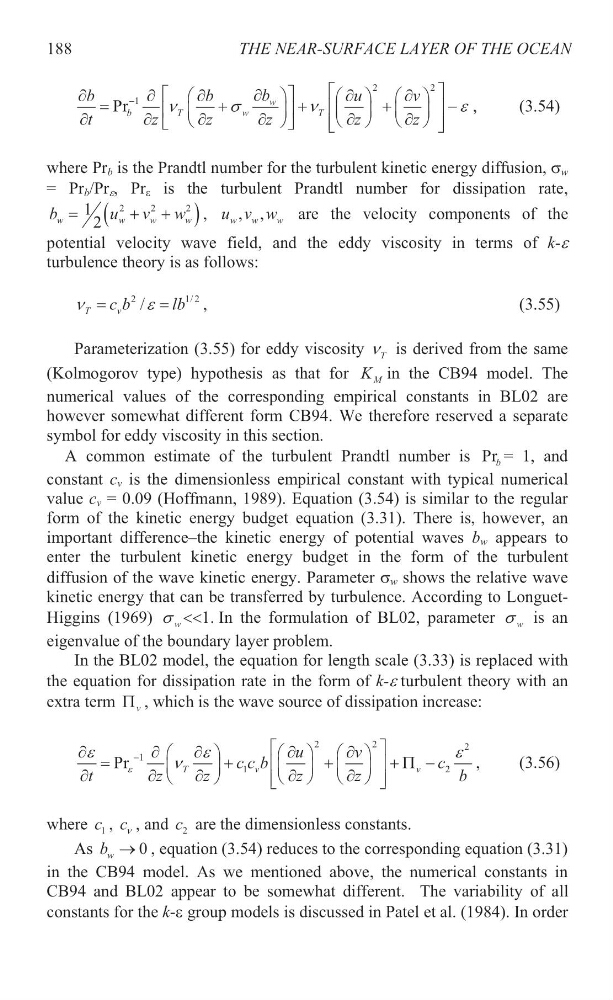
where Pr b is the Prandtl number for the turbulent kinetic energy diffusion, V w
= Pr b /Pr H , Pr H is the turbulent Prandtl number for dissipation rate,
2
2
2
1
2
w
w
w
w
b
u v w
,
, ,
w
w
w
u v w are the velocity components of the
potential velocity wave field, and the eddy viscosity in terms of k-H
turbulence theory is as follows:
2
1 / 2
/
T
v
c b
lb
Q
H
,
(3.55)
Parameterization (3.55) for eddy viscosity T
Q is derived from the same
(Kolmogorov type) hypothesis as that for M
K in the CB94 model. The
numerical values of the corresponding empirical constants in BL02 are
however somewhat different form CB94. We therefore reserved a separate
symbol for eddy viscosity in this section.
A common estimate of the turbulent Prandtl number is Pr b = 1, and
constant c v is the dimensionless empirical constant with typical numerical
value c v = 0.09 (Hoffmann, 1989). Equation (3.54) is similar to the regular
form of the kinetic energy budget equation (3.31). There is, however, an
important difference–the kinetic energy of potential waves b w appears to
enter the turbulent kinetic energy budget in the form of the turbulent
diffusion of the wave kinetic energy. Parameter V w shows the relative wave
kinetic energy that can be transferred by turbulence. According to LonguetHiggins (1969) w
V In the formulation of BL02, parameter w
V is an
eigenvalue of the boundary layer problem.
In the BL02 model, the equation for length scale (3.33) is replaced with
the equation for dissipation rate in the form of k-Hturbulent theory with an
extra term v
3 , which is the wave source of dissipation increase:
2
2
2
1
1
2
Pr
T
v
v
u
v
c c b
c
t
z
z
z
z
b
H
H
H
H
Q
ª
º
w
w
w
w
w
§
·
§ · § ·
3
«
»
¨
¸
¨ ¸ ¨ ¸
w
w
w
w
w
©
¹
© ¹ © ¹
«
»
¬
¼
,
(3.56)
where 1
c , c Q , and 2
c are the dimensionless constants.
As
0
w
b o , equation (3.54) reduces to the corresponding equation (3.31)
in the CB94 model. As we mentioned above, the numerical constants in
CB94 and BL02 appear to be somewhat different. The variability of all
constants for the k-H group models is discussed in Patel et al. (1984). In order
188
2
2
1
Pr
w
b
T
w
T
b
b
b
u
v
t
z
z
z
z
z
Q
V
Q
H
ª
º
ª
º
w
w
w
w
w
w
§
·
§ · § ·
«
»
¨ ¸ ¨ ¸
¨
¸
«
»
w
w
w
w
w
w
© ¹ © ¹
©
¹
¬
¼
«
»
¬
¼
,
(3.54)
where Pr b is the Prandtl number for the turbulent kinetic energy diffusion, V w
= Pr b /Pr H , Pr H is the turbulent Prandtl number for dissipation rate,
2
2
2
1
2
w
w
w
w
b
u v w
,
, ,
w
w
w
u v w are the velocity components of the
potential velocity wave field, and the eddy viscosity in terms of k-H
turbulence theory is as follows:
2
1 / 2
/
T
v
c b
lb
Q
H
,
(3.55)
Parameterization (3.55) for eddy viscosity T
Q is derived from the same
(Kolmogorov type) hypothesis as that for M
K in the CB94 model. The
numerical values of the corresponding empirical constants in BL02 are
however somewhat different form CB94. We therefore reserved a separate
symbol for eddy viscosity in this section.
A common estimate of the turbulent Prandtl number is Pr b = 1, and
constant c v is the dimensionless empirical constant with typical numerical
value c v = 0.09 (Hoffmann, 1989). Equation (3.54) is similar to the regular
form of the kinetic energy budget equation (3.31). There is, however, an
important difference–the kinetic energy of potential waves b w appears to
enter the turbulent kinetic energy budget in the form of the turbulent
diffusion of the wave kinetic energy. Parameter V w shows the relative wave
kinetic energy that can be transferred by turbulence. According to LonguetHiggins (1969) w
V In the formulation of BL02, parameter w
V is an
eigenvalue of the boundary layer problem.
In the BL02 model, the equation for length scale (3.33) is replaced with
the equation for dissipation rate in the form of k-Hturbulent theory with an
extra term v
3 , which is the wave source of dissipation increase:
2
2
2
1
1
2
Pr
T
v
v
u
v
c c b
c
t
z
z
z
z
b
H
H
H
H
Q
ª
º
w
w
w
w
w
§
·
§ · § ·
3
«
»
¨
¸
¨ ¸ ¨ ¸
w
w
w
w
w
©
¹
© ¹ © ¹
«
»
¬
¼
,
(3.56)
where 1
c , c Q , and 2
c are the dimensionless constants.
As
0
w
b o , equation (3.54) reduces to the corresponding equation (3.31)
in the CB94 model. As we mentioned above, the numerical constants in
CB94 and BL02 appear to be somewhat different. The variability of all
constants for the k-H group models is discussed in Patel et al. (1984). In order
188