

Chapter 2: SEA SURFACE MICROLAYER
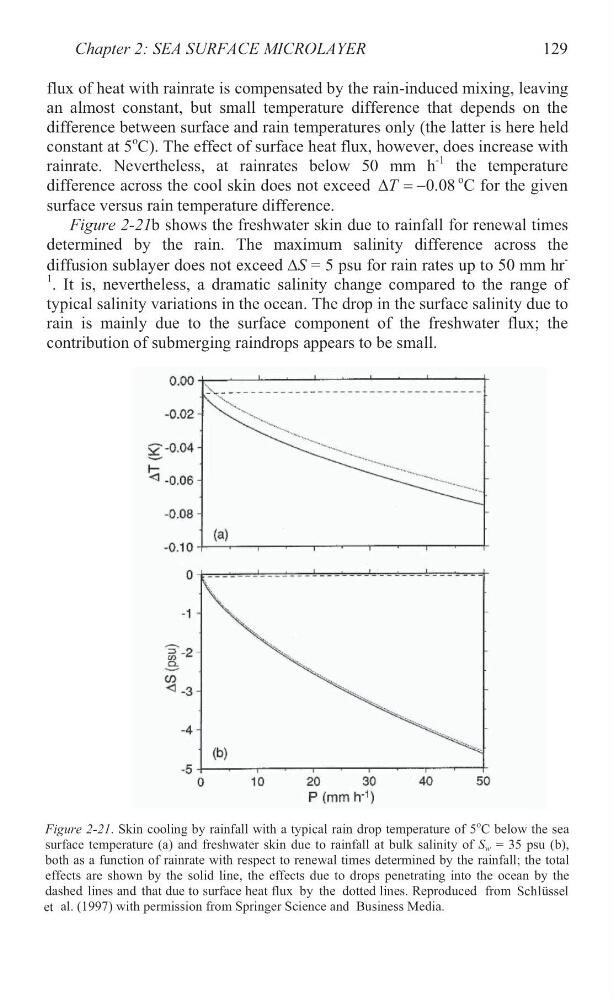
flux of heat with rainrate is compensated by the rain-induced mixing, leaving
an almost constant, but small temperature difference that depends on the
difference between surface and rain temperatures only (the latter is here held
constant at 5
o
C). The effect of surface heat flux, however, does increase with
rainrate. Nevertheless, at rainrates below 50 mm h
-1 the temperature
difference across the cool skin does not exceed
0.08
T
'
o C for the given
surface versus rain temperature difference.
Figure 2-21b shows the freshwater skin due to rainfall for renewal times
determined by the rain. The maximum salinity difference across the
diffusion sublayer does not exceed 'S = 5 psu for rain rates up to 50 mm hr
-
1 . It is, nevertheless, a dramatic salinity change compared to the range of
typical salinity variations in the ocean. The drop in the surface salinity due to
rain is mainly due to the surface component of the freshwater flux; the
contribution of submerging raindrops appears to be small.
129
Figure 2-21. Skin cooling by rainfall with a typical rain drop temperature of 5
o C below the sea
surface temperature (a) and freshwater skin due to rainfall at bulk salinity of S w = 35 psu (b),
both as a function of rainrate with respect to renewal times determined by the rainfall; the total
effects are shown by the solid line, the effects due to drops penetrating into the ocean by the
dashed lines and that due to surface heat flux by the dotted lines. Reproduced from
et al. (1997) with permission from Springer Science and Business Media.
Schl ssel
ü
flux of heat with rainrate is compensated by the rain-induced mixing, leaving
an almost constant, but small temperature difference that depends on the
difference between surface and rain temperatures only (the latter is here held
constant at 5
o
C). The effect of surface heat flux, however, does increase with
rainrate. Nevertheless, at rainrates below 50 mm h
-1 the temperature
difference across the cool skin does not exceed
0.08
T
'
o C for the given
surface versus rain temperature difference.
Figure 2-21b shows the freshwater skin due to rainfall for renewal times
determined by the rain. The maximum salinity difference across the
diffusion sublayer does not exceed 'S = 5 psu for rain rates up to 50 mm hr
-
1 . It is, nevertheless, a dramatic salinity change compared to the range of
typical salinity variations in the ocean. The drop in the surface salinity due to
rain is mainly due to the surface component of the freshwater flux; the
contribution of submerging raindrops appears to be small.
129
Figure 2-21. Skin cooling by rainfall with a typical rain drop temperature of 5
o C below the sea
surface temperature (a) and freshwater skin due to rainfall at bulk salinity of S w = 35 psu (b),
both as a function of rainrate with respect to renewal times determined by the rainfall; the total
effects are shown by the solid line, the effects due to drops penetrating into the ocean by the
dashed lines and that due to surface heat flux by the dotted lines. Reproduced from
et al. (1997) with permission from Springer Science and Business Media.
Schl ssel
ü