

THE NEAR-SURFACE LAYER OF THE OCEAN
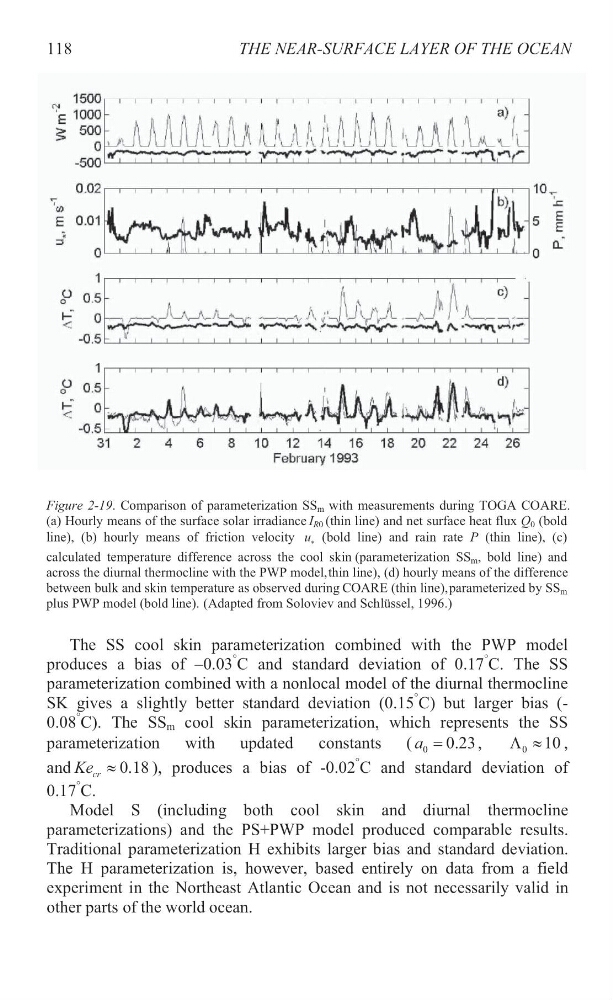
The SS cool skin parameterization combined with the PWP model
produces a bias of –0.03
° C and standard deviation of 0.17
°
C. The SS
parameterization combined with a nonlocal model of the diurnal thermocline
SK gives a slightly better standard deviation (0.15
° C) but larger bias (0.08
° C). The SS m cool skin parameterization, which represents the SS
parameterization with updated constants ( 0 0.23
a
,
0
10
/ | ,
and
0.18
cr
Ke |
), produces a bias of -0.02
° C and standard deviation of
0.17
° C.
Model S (including both cool skin and diurnal thermocline
parameterizations) and the PS+PWP model produced comparable results.
Traditional parameterization H exhibits larger bias and standard deviation.
The H parameterization is, however, based entirely on data from a field
experiment in the Northeast Atlantic Ocean and is not necessarily valid in
other parts of the world ocean.
118
Figure 2-19. Comparison of parameterization SS m with measurements during TOGA COARE.
(a) Hourly means of the surface solar irradiance I R0 (thin line) and net surface heat flux Q 0 (bold
line), (b) hourly means of friction velocity u (bold line) and rain rate P (thin line), (c)
calculated temperature difference across the cool skin (parameterization SS m , bold line) and
across the diurnal thermocline with the PWP model, thin line), (d) hourly means of the difference
between bulk and skin temperature as observed during COARE (thin line), parameterized by SS m
plus PWP model (bold line). (Adapted from Soloviev and Sc l
h üssel, 1996.)
The SS cool skin parameterization combined with the PWP model
produces a bias of –0.03
° C and standard deviation of 0.17
°
C. The SS
parameterization combined with a nonlocal model of the diurnal thermocline
SK gives a slightly better standard deviation (0.15
° C) but larger bias (0.08
° C). The SS m cool skin parameterization, which represents the SS
parameterization with updated constants ( 0 0.23
a
,
0
10
/ | ,
and
0.18
cr
Ke |
), produces a bias of -0.02
° C and standard deviation of
0.17
° C.
Model S (including both cool skin and diurnal thermocline
parameterizations) and the PS+PWP model produced comparable results.
Traditional parameterization H exhibits larger bias and standard deviation.
The H parameterization is, however, based entirely on data from a field
experiment in the Northeast Atlantic Ocean and is not necessarily valid in
other parts of the world ocean.
118
Figure 2-19. Comparison of parameterization SS m with measurements during TOGA COARE.
(a) Hourly means of the surface solar irradiance I R0 (thin line) and net surface heat flux Q 0 (bold
line), (b) hourly means of friction velocity u (bold line) and rain rate P (thin line), (c)
calculated temperature difference across the cool skin (parameterization SS m , bold line) and
across the diurnal thermocline with the PWP model, thin line), (d) hourly means of the difference
between bulk and skin temperature as observed during COARE (thin line), parameterized by SS m
plus PWP model (bold line). (Adapted from Soloviev and Sc l
h üssel, 1996.)