

THE NEAR-SURFACE LAYER OF THE OCEAN
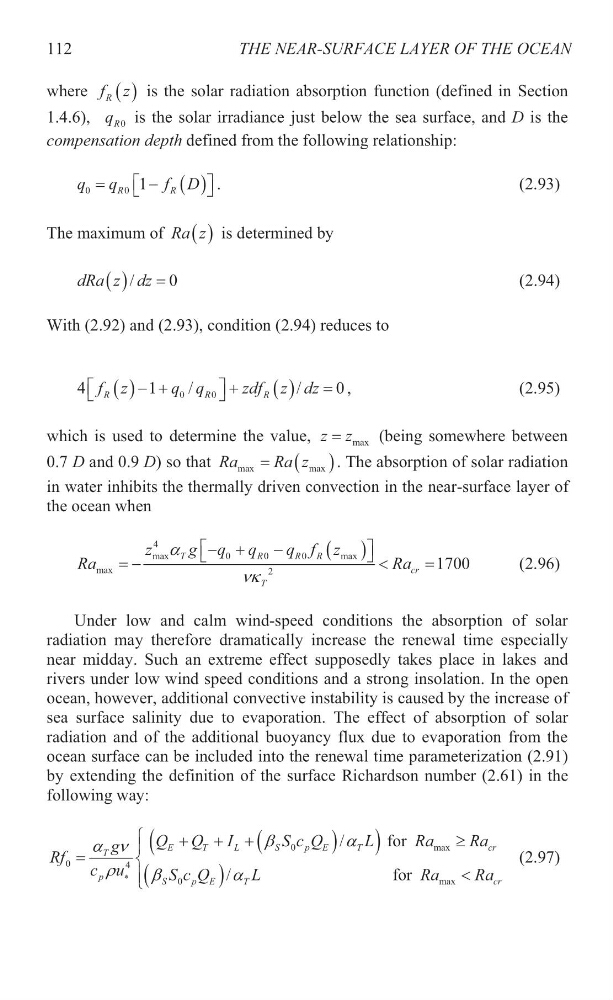
where
R
f z is the solar radiation absorption function (defined in Section
1.4.6),
0
R
q is the solar irradiance just below the sea surface, and D is the
compensation depth defined from the following relationship:
0
0 1
R
R
q q
f D
ª
º
¬
¼ .
(2.93)
The maximum of
Ra z is determined by
/
0
dRa z dz
(2.94)
With (2.92) and (2.93), condition (2.94) reduces to
0
0
4
1
/
/
0
R
R
R
f z
q q
zdf z dz
ª
º
¬
¼
,
(2.95)
which is used to determine the value,
max
z z
(being somewhere between
0.7 D and 0.9 D) so that
max
max
Ra
Ra z
. The absorption of solar radiation
in water inhibits the thermally driven convection in the near-surface layer of
the ocean when
4
max
0
0
0
max
max
2
1700
T
R
R
R
cr
T
z
g q q
q f z
Ra
Ra
D
QN
ª
º
¬
¼
(2.96)
Under low and calm wind-speed conditions the absorption of solar
radiation may therefore dramatically increase the renewal time especially
near midday. Such an extreme effect supposedly takes place in lakes and
rivers under low wind speed conditions and a strong insolation. In the open
ocean, however, additional convective instability is caused by the increase of
sea surface salinity due to evaporation. The effect of absorption of solar
radiation and of the additional buoyancy flux due to evaporation from the
ocean surface can be included into the renewal time parameterization (2.91)
by extending the definition of the surface Richardson number (2.61) in the
following way:
0
m a x
0
4
0
m a x
/
for
/
for
E
T
L
S
p E
T
c r
T
p
S
p E
T
c r
Q Q I
S c Q
L
Ra
Ra
g
Rf
c u
S c Q
L
Ra
Ra
E
D
D Q
U
E
D
t
°
®
° ¯
(2.97)
112
where
R
f z is the solar radiation absorption function (defined in Section
1.4.6),
0
R
q is the solar irradiance just below the sea surface, and D is the
compensation depth defined from the following relationship:
0
0 1
R
R
q q
f D
ª
º
¬
¼ .
(2.93)
The maximum of
Ra z is determined by
/
0
dRa z dz
(2.94)
With (2.92) and (2.93), condition (2.94) reduces to
0
0
4
1
/
/
0
R
R
R
f z
q q
zdf z dz
ª
º
¬
¼
,
(2.95)
which is used to determine the value,
max
z z
(being somewhere between
0.7 D and 0.9 D) so that
max
max
Ra
Ra z
. The absorption of solar radiation
in water inhibits the thermally driven convection in the near-surface layer of
the ocean when
4
max
0
0
0
max
max
2
1700
T
R
R
R
cr
T
z
g q q
q f z
Ra
Ra
D
QN
ª
º
¬
¼
(2.96)
Under low and calm wind-speed conditions the absorption of solar
radiation may therefore dramatically increase the renewal time especially
near midday. Such an extreme effect supposedly takes place in lakes and
rivers under low wind speed conditions and a strong insolation. In the open
ocean, however, additional convective instability is caused by the increase of
sea surface salinity due to evaporation. The effect of absorption of solar
radiation and of the additional buoyancy flux due to evaporation from the
ocean surface can be included into the renewal time parameterization (2.91)
by extending the definition of the surface Richardson number (2.61) in the
following way:
0
m a x
0
4
0
m a x
/
for
/
for
E
T
L
S
p E
T
c r
T
p
S
p E
T
c r
Q Q I
S c Q
L
Ra
Ra
g
Rf
c u
S c Q
L
Ra
Ra
E
D
D Q
U
E
D
t
°
®
° ¯
(2.97)
112