

Chapter 2: SEA SURFACE MICROLAYER
logarithm of the random variable t. Transformation to the logarithmic
variable ln
t is required to estimate integral (2.89) numerically.
2.4.2 Renewal time
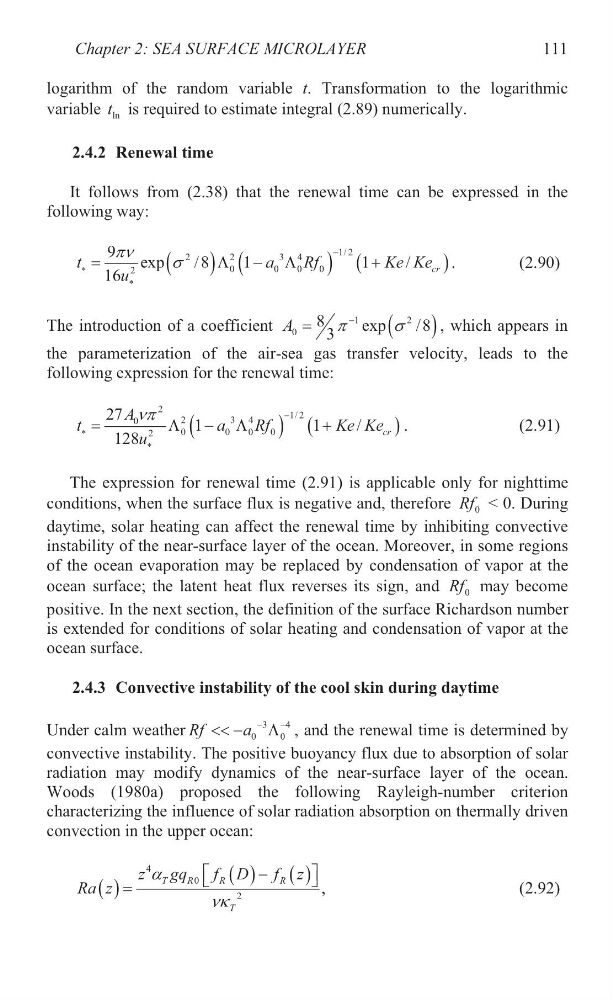
It follows from (2.38) that the renewal time can be expressed in the
following way:
1/ 2
2
2
3 4
0
0
0
0
2
9 exp
/ 8
1
1
/
16
cr
t
a
Rf
Ke Ke
u
SQ
V
/ /
.
(2.90)
The introduction of a coefficient
1
2
0
8
exp
/ 8
3
A
S
V
, which appears in
the parameterization of the air-sea gas transfer velocity, leads to the
following expression for the renewal time:
2
1/ 2
2
3 4
0
0
0
0
0
2
27
1
1
/
128
cr
A
t
a
Rf
Ke Ke
u
QS
/ /
.
(2.91)
The expression for renewal time (2.91) is applicable only for nighttime
conditions, when the surface flux is negative and, therefore 0
Rf < 0. During
daytime, solar heating can affect the renewal time by inhibiting convective
instability of the near-surface layer of the ocean. Moreover, in some regions
of the ocean evaporation may be replaced by condensation of vapor at the
ocean surface; the latent heat flux reverses its sign, and
0
Rf may become
positive. In the next section, the definition of the surface Richardson number
is extended for conditions of solar heating and condensation of vapor at the
ocean surface.
2.4.3 Convective instability of the cool skin during daytime
Under calm weather
3
4
0
0
Rf
a
/ , and the renewal time is determined by
convective instability. The positive buoyancy flux due to absorption of solar
radiation may modify dynamics of the near-surface layer of the ocean.
Woods (1980a) proposed the following Rayleigh-number criterion
characterizing the influence of solar radiation absorption on thermally driven
convection in the upper ocean:
4
0
2
,
T
R
R
R
T
z gq
f D
f z
Ra z
D
QN
ª
º
¬
¼
(2.92)
111
logarithm of the random variable t. Transformation to the logarithmic
variable ln
t is required to estimate integral (2.89) numerically.
2.4.2 Renewal time
It follows from (2.38) that the renewal time can be expressed in the
following way:
1/ 2
2
2
3 4
0
0
0
0
2
9 exp
/ 8
1
1
/
16
cr
t
a
Rf
Ke Ke
u
SQ
V
/ /
.
(2.90)
The introduction of a coefficient
1
2
0
8
exp
/ 8
3
A
S
V
, which appears in
the parameterization of the air-sea gas transfer velocity, leads to the
following expression for the renewal time:
2
1/ 2
2
3 4
0
0
0
0
0
2
27
1
1
/
128
cr
A
t
a
Rf
Ke Ke
u
QS
/ /
.
(2.91)
The expression for renewal time (2.91) is applicable only for nighttime
conditions, when the surface flux is negative and, therefore 0
Rf < 0. During
daytime, solar heating can affect the renewal time by inhibiting convective
instability of the near-surface layer of the ocean. Moreover, in some regions
of the ocean evaporation may be replaced by condensation of vapor at the
ocean surface; the latent heat flux reverses its sign, and
0
Rf may become
positive. In the next section, the definition of the surface Richardson number
is extended for conditions of solar heating and condensation of vapor at the
ocean surface.
2.4.3 Convective instability of the cool skin during daytime
Under calm weather
3
4
0
0
Rf
a
/ , and the renewal time is determined by
convective instability. The positive buoyancy flux due to absorption of solar
radiation may modify dynamics of the near-surface layer of the ocean.
Woods (1980a) proposed the following Rayleigh-number criterion
characterizing the influence of solar radiation absorption on thermally driven
convection in the upper ocean:
4
0
2
,
T
R
R
R
T
z gq
f D
f z
Ra z
D
QN
ª
º
¬
¼
(2.92)
111