

THE NEAR-SURFACE LAYER OF THE OCEAN
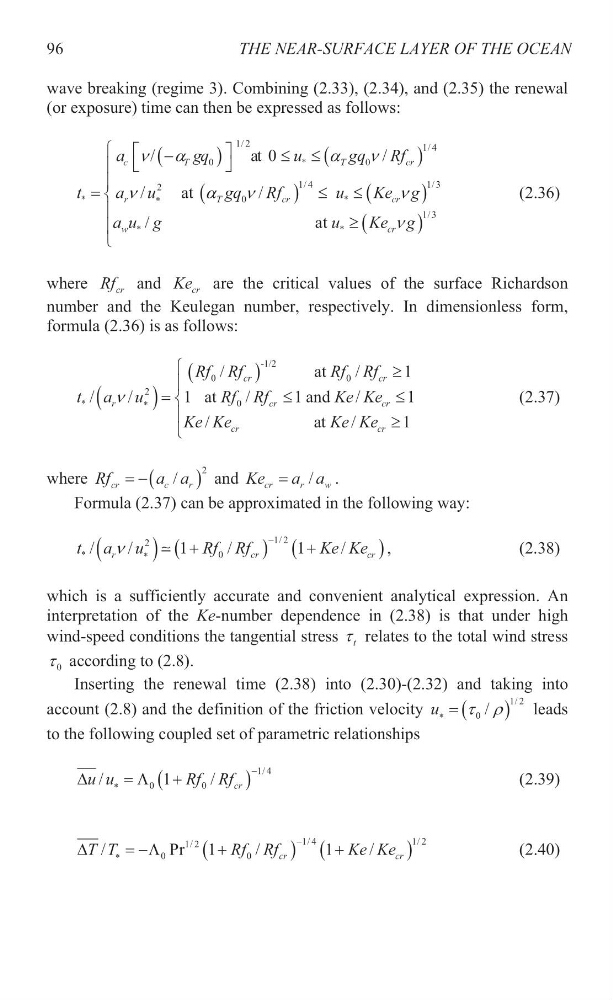
wave breaking (regime 3). Combining (2.33), (2.34), and (2.35) the renewal
(or exposure) time can then be expressed as follows:
1/ 2
1/ 4
0
*
0
1/ 4
1/ 3
2
*
0
*
1/ 3
*
*
/
a t 0
/
/
at
/
/
at
c
T
T
c r
r
T
c r
c r
w
c r
a
g q
u
g q R f
t
a u
gq Rf
u
Ke g
a u g
u
Ke g
Q D
D
Q
Q
D
Q
Q
Q
ª
º
d d
¬
¼
°
°
d
d
®
°
t
°
¯
(2.36)
where
cr
Rf and
cr
Ke are the critical values of the surface Richardson
number and the Keulegan number, respectively. In dimensionless form,
formula (2.36) is as follows:
-1/2
0
0
2
*
0
/
at
/
1
/
/
1 at
/
1 and /
1
/
at
/
1
cr
cr
r
c r
c r
cr
cr
Rf Rf
Rf Rf
t a u
Rf Rf
Ke Ke
Ke Ke
Ke Ke
Q
t
°
d
d
®
°
t
¯
(2.37)
where
2
/
cr
c
r
Rf
a a
and
/
cr
r
w
Ke
a a .
Formula (2.37) can be approximated in the following way:
1/ 2
2
*
0
/
/
1
/
1
/
r
c r
c r
t a u
Rf Rf
Ke Ke
Q
,
(2.38)
which is a sufficiently accurate and convenient analytical expression. An
interpretation of the Ke-number dependence in (2.38) is that under high
wind-speed conditions the tangential stress t
W relates to the total wind stress
0
W according to (2.8).
Inserting the renewal time (2.38) into (2.30)-(2.32) and taking into
account (2.8) and the definition of the friction velocity
1/ 2
0 /
u
W U
leads
to the following coupled set of parametric relationships
1/ 4
0
0
/
1
/ cr
u u
Rf Rf
'
/
(2.39)
1/ 4
1/ 2
1/ 2
0
0
/
P r 1
/
1
/
cr
cr
T T
Rf Rf
Ke Ke
'
/
(2.40)
96
wave breaking (regime 3). Combining (2.33), (2.34), and (2.35) the renewal
(or exposure) time can then be expressed as follows:
1/ 2
1/ 4
0
*
0
1/ 4
1/ 3
2
*
0
*
1/ 3
*
*
/
a t 0
/
/
at
/
/
at
c
T
T
c r
r
T
c r
c r
w
c r
a
g q
u
g q R f
t
a u
gq Rf
u
Ke g
a u g
u
Ke g
Q D
D
Q
Q
D
Q
Q
Q
ª
º
d d
¬
¼
°
°
d
d
®
°
t
°
¯
(2.36)
where
cr
Rf and
cr
Ke are the critical values of the surface Richardson
number and the Keulegan number, respectively. In dimensionless form,
formula (2.36) is as follows:
-1/2
0
0
2
*
0
/
at
/
1
/
/
1 at
/
1 and /
1
/
at
/
1
cr
cr
r
c r
c r
cr
cr
Rf Rf
Rf Rf
t a u
Rf Rf
Ke Ke
Ke Ke
Ke Ke
Q
t
°
d
d
®
°
t
¯
(2.37)
where
2
/
cr
c
r
Rf
a a
and
/
cr
r
w
Ke
a a .
Formula (2.37) can be approximated in the following way:
1/ 2
2
*
0
/
/
1
/
1
/
r
c r
c r
t a u
Rf Rf
Ke Ke
Q
,
(2.38)
which is a sufficiently accurate and convenient analytical expression. An
interpretation of the Ke-number dependence in (2.38) is that under high
wind-speed conditions the tangential stress t
W relates to the total wind stress
0
W according to (2.8).
Inserting the renewal time (2.38) into (2.30)-(2.32) and taking into
account (2.8) and the definition of the friction velocity
1/ 2
0 /
u
W U
leads
to the following coupled set of parametric relationships
1/ 4
0
0
/
1
/ cr
u u
Rf Rf
'
/
(2.39)
1/ 4
1/ 2
1/ 2
0
0
/
P r 1
/
1
/
cr
cr
T T
Rf Rf
Ke Ke
'
/
(2.40)
96