

Chapter 2: SEA SURFACE MICROLAYER
1/ 2
1/ 2
2
2
exp 3 /16
/
K
t
P
S
V
P
,
(2.32)
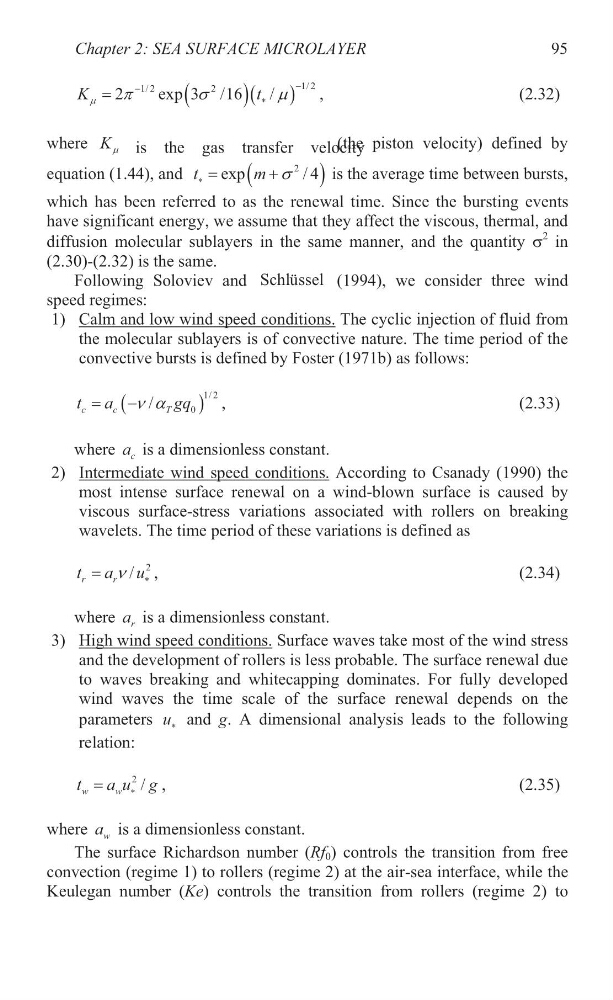
where K P is the gas transfer velocity (the piston velocity) defined by
equation (1.44), and
2
exp
/ 4
t
m V
is the average time between bursts,
which has been referred to as the renewal time. Since the bursting events
have significant energy, we assume that they affect the viscous, thermal, and
diffusion molecular sublayers in the same manner, and the quantity V
2 in
(2.30)-(2.32) is the same.
Following Soloviev and
(1994), we consider three wind
speed regimes:
1) Calm and low wind speed conditions. The cyclic injection of fluid from
the molecular sublayers is of convective nature. The time period of the
convective bursts is defined by Foster (1971b) as follows:
1/ 2
0
/
c
c
T
t a
gq
Q D
,
(2.33)
where c
a is a dimensionless constant.
2) Intermediate wind speed conditions. According to Csanady (1990) the
most intense surface renewal on a wind-blown surface is caused by
viscous surface-stress variations associated with rollers on breaking
wavelets. The time period of these variations is defined as
2
/
r
r
t a u
Q ,
(2.34)
where r
a is a dimensionless constant.
3) High wind speed conditions. Surface waves take most of the wind stress
and the development of rollers is less probable. The surface renewal due
to waves breaking and whitecapping dominates. For fully developed
wind waves the time scale of the surface renewal depends on the
parameters u and g. A dimensional analysis leads to the following
relation:
2 /
w
w
t
a u g
,
(2.35)
where w
a is a dimensionless constant.
The surface Richardson number (Rf 0 ) controls the transition from free
convection (regime 1) to rollers (regime 2) at the air-sea interface, while the
Keulegan number (Ke) controls the transition from rollers (regime 2) to
95
Schl ssel
ü
1/ 2
1/ 2
2
2
exp 3 /16
/
K
t
P
S
V
P
,
(2.32)
where K P is the gas transfer velocity (the piston velocity) defined by
equation (1.44), and
2
exp
/ 4
t
m V
is the average time between bursts,
which has been referred to as the renewal time. Since the bursting events
have significant energy, we assume that they affect the viscous, thermal, and
diffusion molecular sublayers in the same manner, and the quantity V
2 in
(2.30)-(2.32) is the same.
Following Soloviev and
(1994), we consider three wind
speed regimes:
1) Calm and low wind speed conditions. The cyclic injection of fluid from
the molecular sublayers is of convective nature. The time period of the
convective bursts is defined by Foster (1971b) as follows:
1/ 2
0
/
c
c
T
t a
gq
Q D
,
(2.33)
where c
a is a dimensionless constant.
2) Intermediate wind speed conditions. According to Csanady (1990) the
most intense surface renewal on a wind-blown surface is caused by
viscous surface-stress variations associated with rollers on breaking
wavelets. The time period of these variations is defined as
2
/
r
r
t a u
Q ,
(2.34)
where r
a is a dimensionless constant.
3) High wind speed conditions. Surface waves take most of the wind stress
and the development of rollers is less probable. The surface renewal due
to waves breaking and whitecapping dominates. For fully developed
wind waves the time scale of the surface renewal depends on the
parameters u and g. A dimensional analysis leads to the following
relation:
2 /
w
w
t
a u g
,
(2.35)
where w
a is a dimensionless constant.
The surface Richardson number (Rf 0 ) controls the transition from free
convection (regime 1) to rollers (regime 2) at the air-sea interface, while the
Keulegan number (Ke) controls the transition from rollers (regime 2) to
95
Schl ssel
ü