

78
DYNAMICAL OCEANOGRAPHY
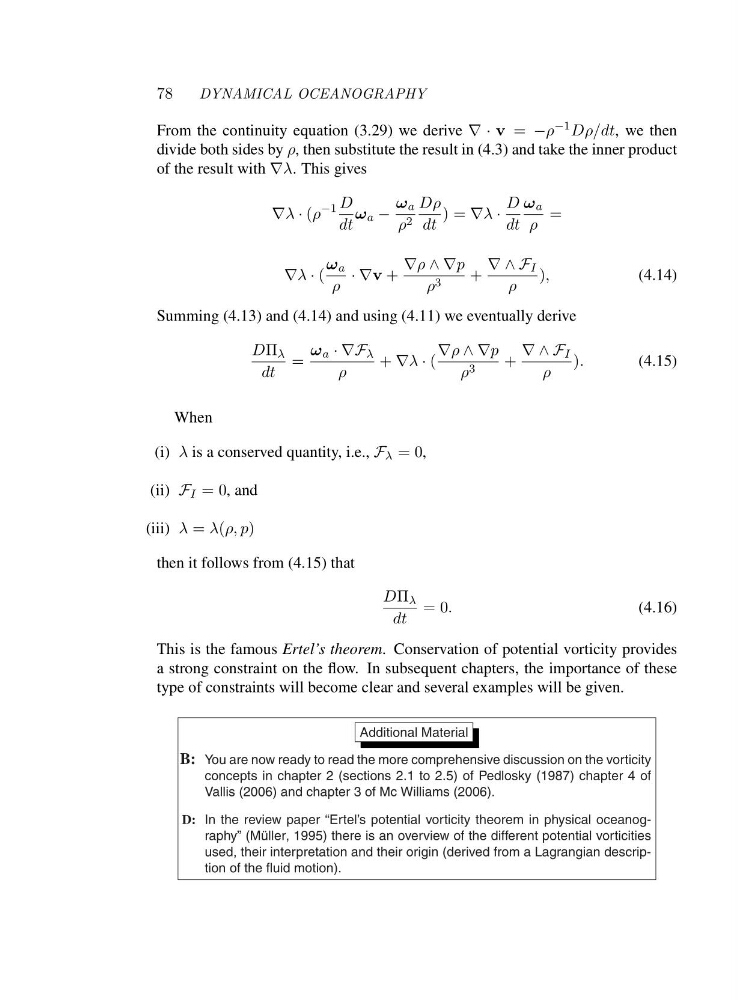
From the continuity equation (3.29) we derive ∇·v = −ρ −1 Dρ/dt,w et h e n
divide both sides by ρ, then substitute the result in (4.3) and take the inner product
of the result with ∇λ.T h i sg i v e s
∇λ · (ρ
−1 D
dt
ω a −
ω a
ρ 2
Dρ
dt
)=∇λ ·
D
dt
ω a
ρ
=
∇λ · (
ω a
ρ
·∇v +
∇ρ ∧∇p
ρ 3
+
∇∧F I
ρ
),
(4.14)
Summing (4.13) and (4.14) and using (4.11) we eventually derive
DΠ λ
dt
=
ω a ·∇F λ
ρ
+ ∇λ · (
∇ρ ∧∇p
ρ 3
+
∇∧F I
ρ
).
(4.15)
When
(i) λ is a conserved quantity, i.e., F λ =0,
(ii) F I =0,and
(iii) λ = λ(ρ, p)
then it follows from (4.15) that
DΠ λ
dt
=0.
(4.16)
This is the famous Ertel’s theorem. Conservation of potential vorticity provides
a strong constraint on the flow. In subsequent chapters, the importance of these
type of constraints will become clear and several examples will be given.
Additional Material
B: You are now ready to read the more comprehensive discussion on the vorticity
concepts in chapter 2 (sections 2.1 to 2.5) of Pedlosky (1987) chapter 4 of
Vallis (2006) and chapter 3 of Mc Williams (2006).
D: In the review paper “Ertel’s potential vorticity theorem in physical oceanography” (M ¨
uller, 1995) there is an overview of the different potential vorticities
used, their interpretation and their origin (derived from a Lagrangian description of the fluid motion).
DYNAMICAL OCEANOGRAPHY
From the continuity equation (3.29) we derive ∇·v = −ρ −1 Dρ/dt,w et h e n
divide both sides by ρ, then substitute the result in (4.3) and take the inner product
of the result with ∇λ.T h i sg i v e s
∇λ · (ρ
−1 D
dt
ω a −
ω a
ρ 2
Dρ
dt
)=∇λ ·
D
dt
ω a
ρ
=
∇λ · (
ω a
ρ
·∇v +
∇ρ ∧∇p
ρ 3
+
∇∧F I
ρ
),
(4.14)
Summing (4.13) and (4.14) and using (4.11) we eventually derive
DΠ λ
dt
=
ω a ·∇F λ
ρ
+ ∇λ · (
∇ρ ∧∇p
ρ 3
+
∇∧F I
ρ
).
(4.15)
When
(i) λ is a conserved quantity, i.e., F λ =0,
(ii) F I =0,and
(iii) λ = λ(ρ, p)
then it follows from (4.15) that
DΠ λ
dt
=0.
(4.16)
This is the famous Ertel’s theorem. Conservation of potential vorticity provides
a strong constraint on the flow. In subsequent chapters, the importance of these
type of constraints will become clear and several examples will be given.
Additional Material
B: You are now ready to read the more comprehensive discussion on the vorticity
concepts in chapter 2 (sections 2.1 to 2.5) of Pedlosky (1987) chapter 4 of
Vallis (2006) and chapter 3 of Mc Williams (2006).
D: In the review paper “Ertel’s potential vorticity theorem in physical oceanography” (M ¨
uller, 1995) there is an overview of the different potential vorticities
used, their interpretation and their origin (derived from a Lagrangian description of the fluid motion).