

64
DYNAMICAL OCEANOGRAPHY
φ e = φ e (θ) and φ w = φ w (θ). On these lateral boundaries, we also assume that
there is no-slip and no transport of heat and salt. This gives the same conditions
as (3.35), where n is now the outward normal on the eastern or western boundary.
The ocean-atmosphere interface is described by
z = h(φ, θ, t),
(3.36)
where the average interface position is at z =0 . The tangential stress and the
normal stress are continuous over this interface and the interface is a material
surface. If we denote the atmospheric pressure at the interface by p a (φ, θ, t),the
boundary conditions at z = h(φ, θ, t) become
D
dt
(z − h(φ, θ, t)) = 0,
(3.37a)
ρ 0 A V r
∂
∂r
(
u
r
)+
ρ 0 A H
r cos θ
∂w
∂φ
= τ
φ ,
(3.37b)
ρ 0 A V r
∂
∂r
(
v
r
) −
ρ 0 A H
r
∂w
∂θ
= τ
θ ,
(3.37c)
p − p a (φ, θ, t)=0 ,
(3.37d)
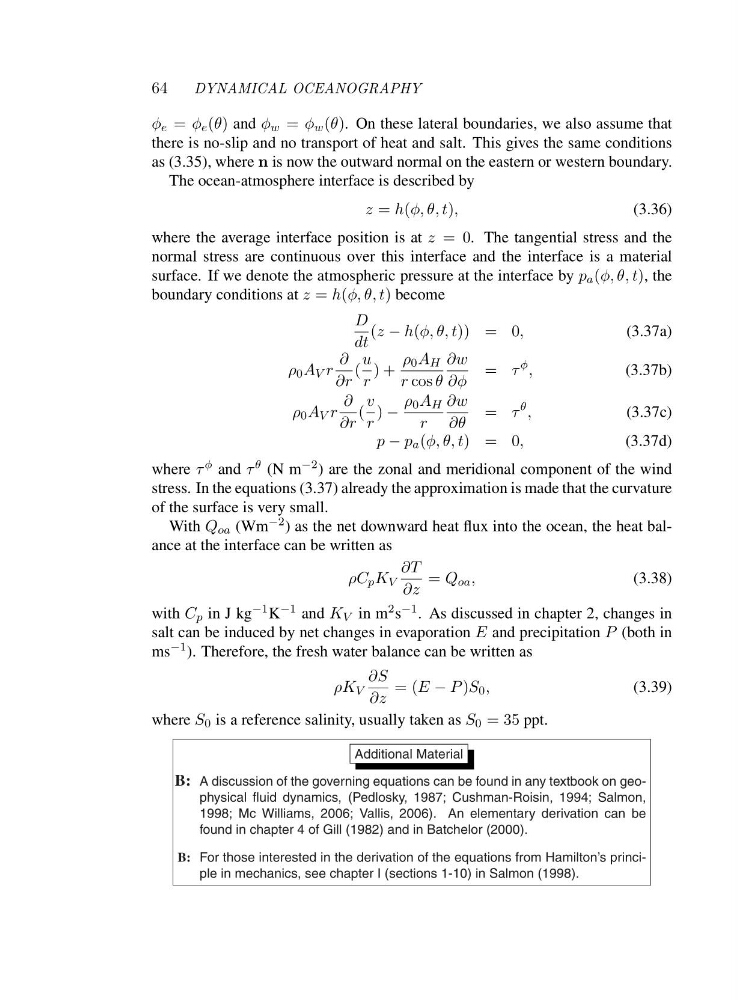
where τ φ and τ θ (N m −2 ) are the zonal and meridional component of the wind
stress. In the equations (3.37) already the approximation is made that the curvature
of the surface is very small.
With Q oa (Wm −2 ) as the net downward heat flux into the ocean, the heat balance at the interface can be written as
ρC p K V
∂T
∂z
= Q oa ,
(3.38)
with C p in J kg −1 K −1 and K V in m 2 s −1 . As discussed in chapter 2, changes in
salt can be induced by net changes in evaporation E and precipitation P (both in
ms −1 ). Therefore, the fresh water balance can be written as
ρK V
∂S
∂z
=(E − P )S 0 ,
(3.39)
where S 0 is a reference salinity, usually taken as S 0 =35ppt.
Additional Material
B: A discussion of the governing equations can be found in any textbook on geophysical fluid dynamics, (Pedlosky, 1987; Cushman-Roisin, 1994; Salmon,
1998; Mc Williams, 2006; Vallis, 2006). An elementary derivation can be
found in chapter 4 of Gill (1982) and in Batchelor (2000).
B: For those interested in the derivation of the equations from Hamilton’s principle in mechanics, see chapter I (sections 1-10) in Salmon (1998).
DYNAMICAL OCEANOGRAPHY
φ e = φ e (θ) and φ w = φ w (θ). On these lateral boundaries, we also assume that
there is no-slip and no transport of heat and salt. This gives the same conditions
as (3.35), where n is now the outward normal on the eastern or western boundary.
The ocean-atmosphere interface is described by
z = h(φ, θ, t),
(3.36)
where the average interface position is at z =0 . The tangential stress and the
normal stress are continuous over this interface and the interface is a material
surface. If we denote the atmospheric pressure at the interface by p a (φ, θ, t),the
boundary conditions at z = h(φ, θ, t) become
D
dt
(z − h(φ, θ, t)) = 0,
(3.37a)
ρ 0 A V r
∂
∂r
(
u
r
)+
ρ 0 A H
r cos θ
∂w
∂φ
= τ
φ ,
(3.37b)
ρ 0 A V r
∂
∂r
(
v
r
) −
ρ 0 A H
r
∂w
∂θ
= τ
θ ,
(3.37c)
p − p a (φ, θ, t)=0 ,
(3.37d)
where τ φ and τ θ (N m −2 ) are the zonal and meridional component of the wind
stress. In the equations (3.37) already the approximation is made that the curvature
of the surface is very small.
With Q oa (Wm −2 ) as the net downward heat flux into the ocean, the heat balance at the interface can be written as
ρC p K V
∂T
∂z
= Q oa ,
(3.38)
with C p in J kg −1 K −1 and K V in m 2 s −1 . As discussed in chapter 2, changes in
salt can be induced by net changes in evaporation E and precipitation P (both in
ms −1 ). Therefore, the fresh water balance can be written as
ρK V
∂S
∂z
=(E − P )S 0 ,
(3.39)
where S 0 is a reference salinity, usually taken as S 0 =35ppt.
Additional Material
B: A discussion of the governing equations can be found in any textbook on geophysical fluid dynamics, (Pedlosky, 1987; Cushman-Roisin, 1994; Salmon,
1998; Mc Williams, 2006; Vallis, 2006). An elementary derivation can be
found in chapter 4 of Gill (1982) and in Batchelor (2000).
B: For those interested in the derivation of the equations from Hamilton’s principle in mechanics, see chapter I (sections 1-10) in Salmon (1998).