

Present ocean circulation
35
Some typical transports of the prominent ocean currents
Current
Location
Value
Agulhas
31 ◦ S, Indian
70 Sv
Gulf Stream
26 ◦ N, Atlantic
32 Sv
Gulf Stream
38 ◦ N, Atlantic
88 Sv
Brazil Current
28 ◦ S, Atlantic
22 Sv
Kuroshio
25 ◦ N, Pacific
22 Sv
Kuroshio
33 ◦ N, Pacific
57 Sv
East Australian
30 ◦ S, Pacific
22 Sv
ACC
150 ◦ E, Southern
147 Sv
ACC
60 ◦ E, Southern
137 Sv
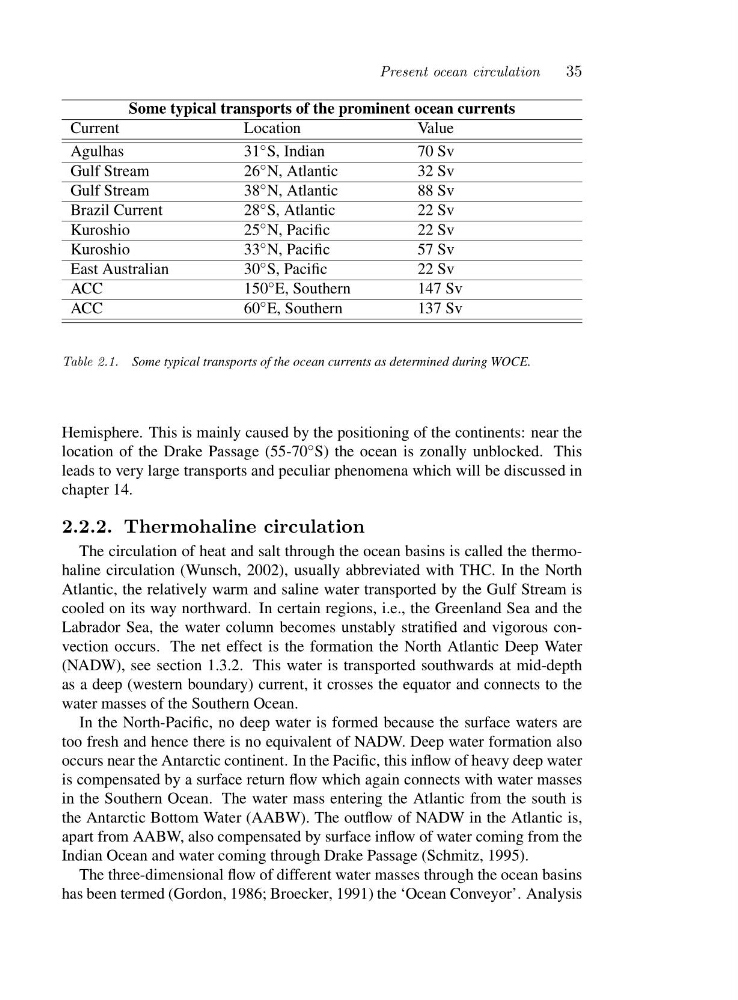
Table 2.1. Some typical transports of the ocean currents as determined during WOCE.
Hemisphere. This is mainly caused by the positioning of the continents: near the
location of the Drake Passage (55-70 ◦ S) the ocean is zonally unblocked. This
leads to very large transports and peculiar phenomena which will be discussed in
chapter 14.
2.2.2. Thermohaline circulation
The circulation of heat and salt through the ocean basins is called the thermohaline circulation (Wunsch, 2002), usually abbreviated with THC. In the North
Atlantic, the relatively warm and saline water transported by the Gulf Stream is
cooled on its way northward. In certain regions, i.e., the Greenland Sea and the
Labrador Sea, the water column becomes unstably stratified and vigorous convection occurs. The net effect is the formation the North Atlantic Deep Water
(NADW), see section 1.3.2. This water is transported southwards at mid-depth
as a deep (western boundary) current, it crosses the equator and connects to the
water masses of the Southern Ocean.
In the North-Pacific, no deep water is formed because the surface waters are
too fresh and hence there is no equivalent of NADW. Deep water formation also
occurs near the Antarctic continent. In the Pacific, this inflow of heavy deep water
is compensated by a surface return flow which again connects with water masses
in the Southern Ocean. The water mass entering the Atlantic from the south is
the Antarctic Bottom Water (AABW). The outflow of NADW in the Atlantic is,
apart from AABW, also compensated by surface inflow of water coming from the
Indian Ocean and water coming through Drake Passage (Schmitz, 1995).
The three-dimensional flow of different water masses through the ocean basins
has been termed (Gordon, 1986; Broecker, 1991) the ‘Ocean Conveyor’. Analysis
35
Some typical transports of the prominent ocean currents
Current
Location
Value
Agulhas
31 ◦ S, Indian
70 Sv
Gulf Stream
26 ◦ N, Atlantic
32 Sv
Gulf Stream
38 ◦ N, Atlantic
88 Sv
Brazil Current
28 ◦ S, Atlantic
22 Sv
Kuroshio
25 ◦ N, Pacific
22 Sv
Kuroshio
33 ◦ N, Pacific
57 Sv
East Australian
30 ◦ S, Pacific
22 Sv
ACC
150 ◦ E, Southern
147 Sv
ACC
60 ◦ E, Southern
137 Sv
Table 2.1. Some typical transports of the ocean currents as determined during WOCE.
Hemisphere. This is mainly caused by the positioning of the continents: near the
location of the Drake Passage (55-70 ◦ S) the ocean is zonally unblocked. This
leads to very large transports and peculiar phenomena which will be discussed in
chapter 14.
2.2.2. Thermohaline circulation
The circulation of heat and salt through the ocean basins is called the thermohaline circulation (Wunsch, 2002), usually abbreviated with THC. In the North
Atlantic, the relatively warm and saline water transported by the Gulf Stream is
cooled on its way northward. In certain regions, i.e., the Greenland Sea and the
Labrador Sea, the water column becomes unstably stratified and vigorous convection occurs. The net effect is the formation the North Atlantic Deep Water
(NADW), see section 1.3.2. This water is transported southwards at mid-depth
as a deep (western boundary) current, it crosses the equator and connects to the
water masses of the Southern Ocean.
In the North-Pacific, no deep water is formed because the surface waters are
too fresh and hence there is no equivalent of NADW. Deep water formation also
occurs near the Antarctic continent. In the Pacific, this inflow of heavy deep water
is compensated by a surface return flow which again connects with water masses
in the Southern Ocean. The water mass entering the Atlantic from the south is
the Antarctic Bottom Water (AABW). The outflow of NADW in the Atlantic is,
apart from AABW, also compensated by surface inflow of water coming from the
Indian Ocean and water coming through Drake Passage (Schmitz, 1995).
The three-dimensional flow of different water masses through the ocean basins
has been termed (Gordon, 1986; Broecker, 1991) the ‘Ocean Conveyor’. Analysis