

Thermohaline circulation
381
latitudes and hence this would weaken the meridional overturning in the Atlantic.
However, different models display a mosaic of different responses to the same
greenhouse forcing conditions. In some of the models, the meridional overturning
decreases substantially whereas in others it is hardly affected. We will focus only
on the basic mechanisms which cause the occurrence of the multiple equilibria and
which are responsible for the sensitivity of the ocean circulation to the freshwater
and heat flux forcing.
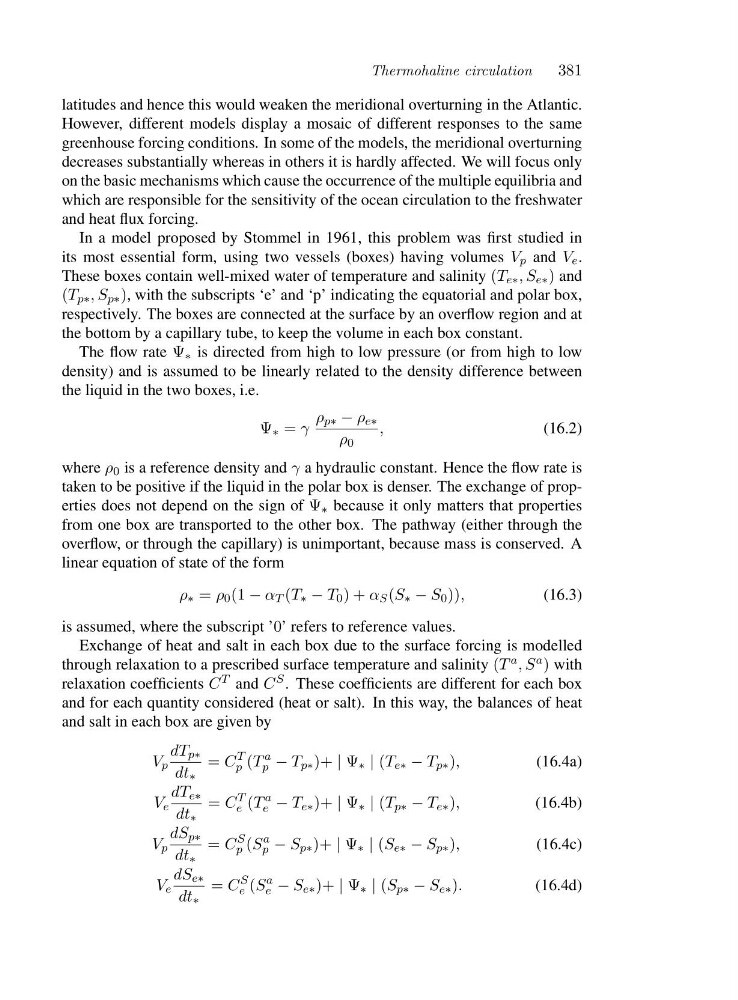
In a model proposed by Stommel in 1961, this problem was first studied in
its most essential form, using two vessels (boxes) having volumes V p and V e .
These boxes contain well-mixed water of temperature and salinity (T e∗ ,S e∗ ) and
(T p∗ ,S p∗ ), with the subscripts ‘e’ and ‘p’ indicating the equatorial and polar box,
respectively. The boxes are connected at the surface by an overflow region and at
the bottom by a capillary tube, to keep the volume in each box constant.
The flow rate Ψ ∗ is directed from high to low pressure (or from high to low
density) and is assumed to be linearly related to the density difference between
the liquid in the two boxes, i.e.
Ψ ∗ = γ
ρ p∗ − ρ e∗
ρ 0
,
(16.2)
where ρ 0 is a reference density and γ a hydraulic constant. Hence the flow rate is
taken to be positive if the liquid in the polar box is denser. The exchange of properties does not depend on the sign of Ψ ∗ because it only matters that properties
from one box are transported to the other box. The pathway (either through the
overflow, or through the capillary) is unimportant, because mass is conserved. A
linear equation of state of the form
ρ ∗ = ρ 0 (1 − α T (T ∗ − T 0 )+α S (S ∗ − S 0 )),
(16.3)
is assumed, where the subscript ’0’ refers to reference values.
Exchange of heat and salt in each box due to the surface forcing is modelled
through relaxation to a prescribed surface temperature and salinity (T a ,S a ) with
relaxation coefficients C T and C S . These coefficients are different for each box
and for each quantity considered (heat or salt). In this way, the balances of heat
and salt in each box are given by
V p
dT p∗
dt ∗
= C
T
p (T
a
p − T p∗ )+ | Ψ ∗ | (T e∗ − T p∗ ),
(16.4a)
V e
dT e∗
dt ∗
= C
T
e (T
a
e − T e∗ )+ | Ψ ∗ | (T p∗ − T e∗ ),
(16.4b)
V p
dS p∗
dt ∗
= C
S
p (S
a
p − S p∗ )+ | Ψ ∗ | (S e∗ − S p∗ ),
(16.4c)
V e
dS e∗
dt ∗
= C
S
e (S
a
e − S e∗ )+ | Ψ ∗ | (S p∗ − S e∗ ).
(16.4d)
381
latitudes and hence this would weaken the meridional overturning in the Atlantic.
However, different models display a mosaic of different responses to the same
greenhouse forcing conditions. In some of the models, the meridional overturning
decreases substantially whereas in others it is hardly affected. We will focus only
on the basic mechanisms which cause the occurrence of the multiple equilibria and
which are responsible for the sensitivity of the ocean circulation to the freshwater
and heat flux forcing.
In a model proposed by Stommel in 1961, this problem was first studied in
its most essential form, using two vessels (boxes) having volumes V p and V e .
These boxes contain well-mixed water of temperature and salinity (T e∗ ,S e∗ ) and
(T p∗ ,S p∗ ), with the subscripts ‘e’ and ‘p’ indicating the equatorial and polar box,
respectively. The boxes are connected at the surface by an overflow region and at
the bottom by a capillary tube, to keep the volume in each box constant.
The flow rate Ψ ∗ is directed from high to low pressure (or from high to low
density) and is assumed to be linearly related to the density difference between
the liquid in the two boxes, i.e.
Ψ ∗ = γ
ρ p∗ − ρ e∗
ρ 0
,
(16.2)
where ρ 0 is a reference density and γ a hydraulic constant. Hence the flow rate is
taken to be positive if the liquid in the polar box is denser. The exchange of properties does not depend on the sign of Ψ ∗ because it only matters that properties
from one box are transported to the other box. The pathway (either through the
overflow, or through the capillary) is unimportant, because mass is conserved. A
linear equation of state of the form
ρ ∗ = ρ 0 (1 − α T (T ∗ − T 0 )+α S (S ∗ − S 0 )),
(16.3)
is assumed, where the subscript ’0’ refers to reference values.
Exchange of heat and salt in each box due to the surface forcing is modelled
through relaxation to a prescribed surface temperature and salinity (T a ,S a ) with
relaxation coefficients C T and C S . These coefficients are different for each box
and for each quantity considered (heat or salt). In this way, the balances of heat
and salt in each box are given by
V p
dT p∗
dt ∗
= C
T
p (T
a
p − T p∗ )+ | Ψ ∗ | (T e∗ − T p∗ ),
(16.4a)
V e
dT e∗
dt ∗
= C
T
e (T
a
e − T e∗ )+ | Ψ ∗ | (T p∗ − T e∗ ),
(16.4b)
V p
dS p∗
dt ∗
= C
S
p (S
a
p − S p∗ )+ | Ψ ∗ | (S e∗ − S p∗ ),
(16.4c)
V e
dS e∗
dt ∗
= C
S
e (S
a
e − S e∗ )+ | Ψ ∗ | (S p∗ − S e∗ ).
(16.4d)