

Thermohaline circulation
377
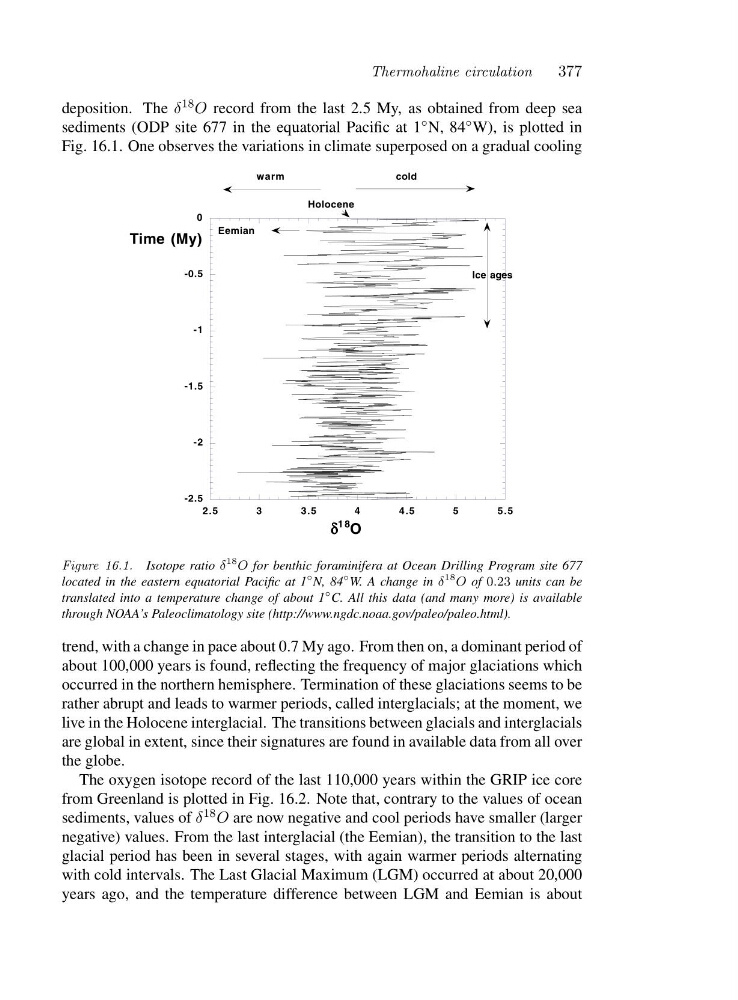
deposition. The δ 18 O record from the last 2.5 My, as obtained from deep sea
sediments (ODP site 677 in the equatorial Pacific at 1 ◦ N, 84 ◦ W), is plotted in
Fig. 16.1. One observes the variations in climate superposed on a gradual cooling
-2.5
-2
-1.5
-1
-0.5
0
2.5
3
3.5
4
4.5
5
5.5
δ δ δ
δ
18 O
Time (My)
Holocene
Eemian
cold
warm
Ice ages
Figure 16.1. Isotope ratio δ
18 O for benthic foraminifera at Ocean Drilling Program site 677
located in the eastern equatorial Pacific at 1
◦ N, 84
◦ W. A change in δ
18 O of 0.23 units can be
translated into a temperature change of about 1
◦ C. All this data (and many more) is available
through NOAA’s Paleoclimatology site (http://www.ngdc.noaa.gov/paleo/paleo.html).
trend, with a change in pace about 0.7 My ago. From then on, a dominant period of
about 100,000 years is found, reflecting the frequency of major glaciations which
occurred in the northern hemisphere. Termination of these glaciations seems to be
rather abrupt and leads to warmer periods, called interglacials; at the moment, we
live in the Holocene interglacial. The transitions between glacials and interglacials
are global in extent, since their signatures are found in available data from all over
the globe.
The oxygen isotope record of the last 110,000 years within the GRIP ice core
from Greenland is plotted in Fig. 16.2. Note that, contrary to the values of ocean
sediments, values of δ 18 O are now negative and cool periods have smaller (larger
negative) values. From the last interglacial (the Eemian), the transition to the last
glacial period has been in several stages, with again warmer periods alternating
with cold intervals. The Last Glacial Maximum (LGM) occurred at about 20,000
years ago, and the temperature difference between LGM and Eemian is about
377
deposition. The δ 18 O record from the last 2.5 My, as obtained from deep sea
sediments (ODP site 677 in the equatorial Pacific at 1 ◦ N, 84 ◦ W), is plotted in
Fig. 16.1. One observes the variations in climate superposed on a gradual cooling
-2.5
-2
-1.5
-1
-0.5
0
2.5
3
3.5
4
4.5
5
5.5
δ δ δ
δ
18 O
Time (My)
Holocene
Eemian
cold
warm
Ice ages
Figure 16.1. Isotope ratio δ
18 O for benthic foraminifera at Ocean Drilling Program site 677
located in the eastern equatorial Pacific at 1
◦ N, 84
◦ W. A change in δ
18 O of 0.23 units can be
translated into a temperature change of about 1
◦ C. All this data (and many more) is available
through NOAA’s Paleoclimatology site (http://www.ngdc.noaa.gov/paleo/paleo.html).
trend, with a change in pace about 0.7 My ago. From then on, a dominant period of
about 100,000 years is found, reflecting the frequency of major glaciations which
occurred in the northern hemisphere. Termination of these glaciations seems to be
rather abrupt and leads to warmer periods, called interglacials; at the moment, we
live in the Holocene interglacial. The transitions between glacials and interglacials
are global in extent, since their signatures are found in available data from all over
the globe.
The oxygen isotope record of the last 110,000 years within the GRIP ice core
from Greenland is plotted in Fig. 16.2. Note that, contrary to the values of ocean
sediments, values of δ 18 O are now negative and cool periods have smaller (larger
negative) values. From the last interglacial (the Eemian), the transition to the last
glacial period has been in several stages, with again warmer periods alternating
with cold intervals. The Last Glacial Maximum (LGM) occurred at about 20,000
years ago, and the temperature difference between LGM and Eemian is about