

358
DYNAMICAL OCEANOGRAPHY
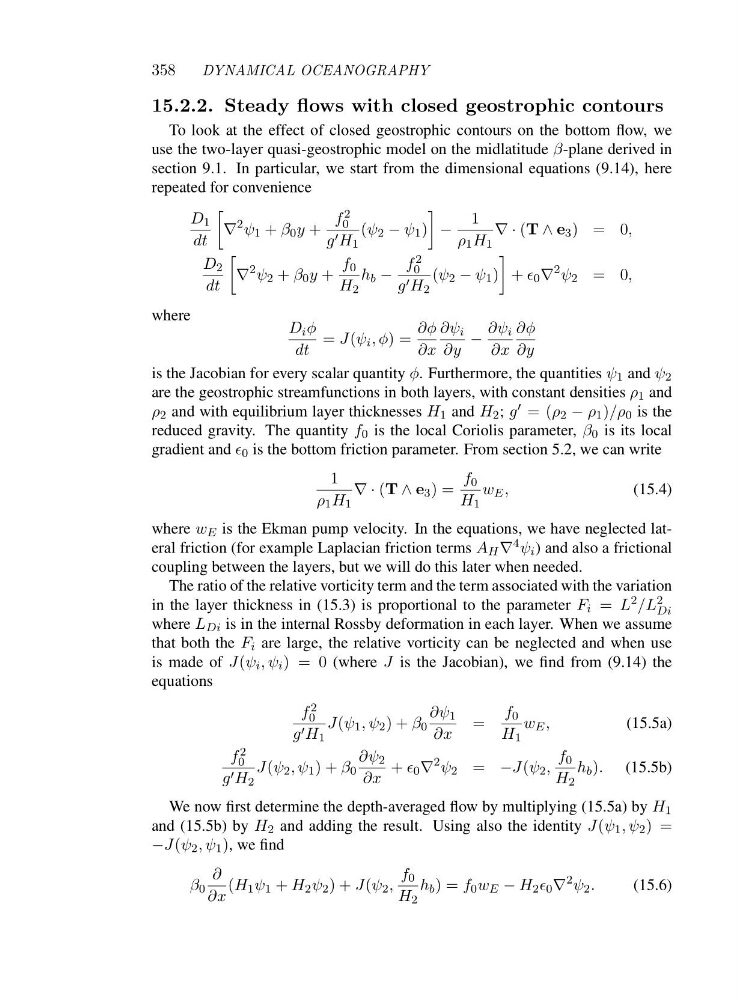
15.2.2. Steady flows with closed geostrophic contours
To look at the effect of closed geostrophic contours on the bottom flow, we
use the two-layer quasi-geostrophic model on the midlatitude β-plane derived in
section 9.1. In particular, we start from the dimensional equations (9.14), here
repeated for convenience
D 1
dt
∇
2 ψ 1 + β 0 y +
f 2
0
g ′ H 1
(ψ 2 − ψ 1 )
−
1
ρ 1 H 1
∇·(T ∧ e 3 )=0 ,
D 2
dt
∇
2 ψ 2 + β 0 y +
f 0
H 2
h b −
f 2
0
g ′ H 2
(ψ 2 − ψ 1 )
+ ǫ 0 ∇
2 ψ 2 =0 ,
where
D i φ
dt
= J(ψ i ,φ)=
∂φ
∂x
∂ψ i
∂y
−
∂ψ i
∂x
∂φ
∂y
is the Jacobian for every scalar quantity φ. Furthermore, the quantities ψ 1 and ψ 2
are the geostrophic streamfunctions in both layers, with constant densities ρ 1 and
ρ 2 and with equilibrium layer thicknesses H 1 and H 2 ; g ′ =( ρ 2 − ρ 1 )/ρ 0 is the
reduced gravity. The quantity f 0 is the local Coriolis parameter, β 0 is its local
gradient and ǫ 0 is the bottom friction parameter. From section 5.2, we can write
1
ρ 1 H 1
∇·(T ∧ e 3 )=
f 0
H 1
w E ,
(15.4)
where w E is the Ekman pump velocity. In the equations, we have neglected lateral friction (for example Laplacian friction terms A H ∇ 4 ψ i ) and also a frictional
coupling between the layers, but we will do this later when needed.
The ratio of the relative vorticity term and the term associated with the variation
in the layer thickness in (15.3) is proportional to the parameter F i = L 2 /L 2
Di
where L Di is in the internal Rossby deformation in each layer. When we assume
that both the F i are large, the relative vorticity can be neglected and when use
is made of J(ψ i ,ψ i )=0(where J is the Jacobian), we find from (9.14) the
equations
f 2
0
g ′ H 1
J(ψ 1 ,ψ 2 )+β 0
∂ψ 1
∂x
=
f 0
H 1
w E ,
(15.5a)
f 2
0
g ′ H 2
J(ψ 2 ,ψ 1 )+β 0
∂ψ 2
∂x
+ ǫ 0 ∇
2 ψ 2 = −J(ψ 2 ,
f 0
H 2
h b ). (15.5b)
We now first determine the depth-averaged flow by multiplying (15.5a) by H 1
and (15.5b) by H 2 and adding the result. Using also the identity J(ψ 1 ,ψ 2 )=
−J(ψ 2 ,ψ 1 ),wefind
β 0
∂
∂x
(H 1 ψ 1 + H 2 ψ 2 )+J(ψ 2 ,
f 0
H 2
h b )=f 0 w E − H 2 ǫ 0 ∇
2 ψ 2 .
(15.6)
DYNAMICAL OCEANOGRAPHY
15.2.2. Steady flows with closed geostrophic contours
To look at the effect of closed geostrophic contours on the bottom flow, we
use the two-layer quasi-geostrophic model on the midlatitude β-plane derived in
section 9.1. In particular, we start from the dimensional equations (9.14), here
repeated for convenience
D 1
dt
∇
2 ψ 1 + β 0 y +
f 2
0
g ′ H 1
(ψ 2 − ψ 1 )
−
1
ρ 1 H 1
∇·(T ∧ e 3 )=0 ,
D 2
dt
∇
2 ψ 2 + β 0 y +
f 0
H 2
h b −
f 2
0
g ′ H 2
(ψ 2 − ψ 1 )
+ ǫ 0 ∇
2 ψ 2 =0 ,
where
D i φ
dt
= J(ψ i ,φ)=
∂φ
∂x
∂ψ i
∂y
−
∂ψ i
∂x
∂φ
∂y
is the Jacobian for every scalar quantity φ. Furthermore, the quantities ψ 1 and ψ 2
are the geostrophic streamfunctions in both layers, with constant densities ρ 1 and
ρ 2 and with equilibrium layer thicknesses H 1 and H 2 ; g ′ =( ρ 2 − ρ 1 )/ρ 0 is the
reduced gravity. The quantity f 0 is the local Coriolis parameter, β 0 is its local
gradient and ǫ 0 is the bottom friction parameter. From section 5.2, we can write
1
ρ 1 H 1
∇·(T ∧ e 3 )=
f 0
H 1
w E ,
(15.4)
where w E is the Ekman pump velocity. In the equations, we have neglected lateral friction (for example Laplacian friction terms A H ∇ 4 ψ i ) and also a frictional
coupling between the layers, but we will do this later when needed.
The ratio of the relative vorticity term and the term associated with the variation
in the layer thickness in (15.3) is proportional to the parameter F i = L 2 /L 2
Di
where L Di is in the internal Rossby deformation in each layer. When we assume
that both the F i are large, the relative vorticity can be neglected and when use
is made of J(ψ i ,ψ i )=0(where J is the Jacobian), we find from (9.14) the
equations
f 2
0
g ′ H 1
J(ψ 1 ,ψ 2 )+β 0
∂ψ 1
∂x
=
f 0
H 1
w E ,
(15.5a)
f 2
0
g ′ H 2
J(ψ 2 ,ψ 1 )+β 0
∂ψ 2
∂x
+ ǫ 0 ∇
2 ψ 2 = −J(ψ 2 ,
f 0
H 2
h b ). (15.5b)
We now first determine the depth-averaged flow by multiplying (15.5a) by H 1
and (15.5b) by H 2 and adding the result. Using also the identity J(ψ 1 ,ψ 2 )=
−J(ψ 2 ,ψ 1 ),wefind
β 0
∂
∂x
(H 1 ψ 1 + H 2 ψ 2 )+J(ψ 2 ,
f 0
H 2
h b )=f 0 w E − H 2 ǫ 0 ∇
2 ψ 2 .
(15.6)