

Antarctic Circumpolar Current
345
A
B
h
0
A
B
f/H constant
f/H constant
gradient (f/H)
gradient (f/H)
U
JEBAR effect
γ
γ
JEBAR effect
U
(a)
(b)
(c)
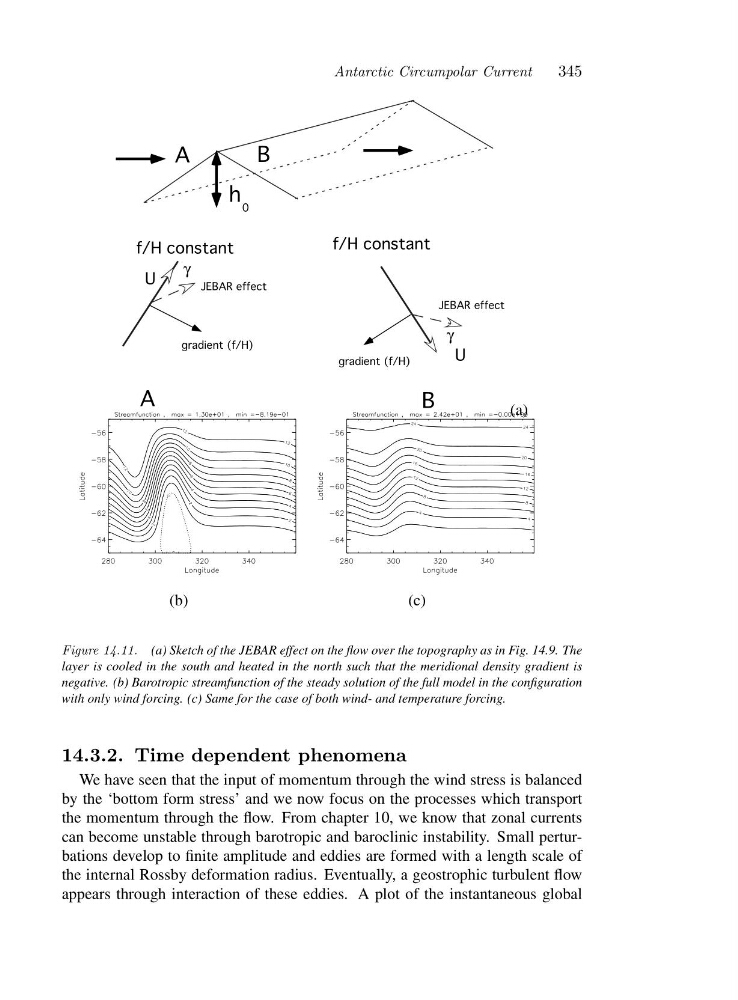
Figure 14.11. (a) Sketch of the JEBAR effect on the flow over the topography as in Fig. 14.9. The
layer is cooled in the south and heated in the north such that the meridional density gradient is
negative. (b) Barotropic streamfunction of the steady solution of the full model in the configuration
with only wind forcing. (c) Same for the case of both wind- and temperature forcing.
14.3.2. Time dependent phenomena
We have seen that the input of momentum through the wind stress is balanced
by the ‘bottom form stress’ and we now focus on the processes which transport
the momentum through the flow. From chapter 10, we know that zonal currents
can become unstable through barotropic and baroclinic instability. Small perturbations develop to finite amplitude and eddies are formed with a length scale of
the internal Rossby deformation radius. Eventually, a geostrophic turbulent flow
appears through interaction of these eddies. A plot of the instantaneous global
345
A
B
h
0
A
B
f/H constant
f/H constant
gradient (f/H)
gradient (f/H)
U
JEBAR effect
γ
γ
JEBAR effect
U
(a)
(b)
(c)
Figure 14.11. (a) Sketch of the JEBAR effect on the flow over the topography as in Fig. 14.9. The
layer is cooled in the south and heated in the north such that the meridional density gradient is
negative. (b) Barotropic streamfunction of the steady solution of the full model in the configuration
with only wind forcing. (c) Same for the case of both wind- and temperature forcing.
14.3.2. Time dependent phenomena
We have seen that the input of momentum through the wind stress is balanced
by the ‘bottom form stress’ and we now focus on the processes which transport
the momentum through the flow. From chapter 10, we know that zonal currents
can become unstable through barotropic and baroclinic instability. Small perturbations develop to finite amplitude and eddies are formed with a length scale of
the internal Rossby deformation radius. Eventually, a geostrophic turbulent flow
appears through interaction of these eddies. A plot of the instantaneous global