

342
DYNAMICAL OCEANOGRAPHY
280
360
-65
-55
0
h
0
x w
e
x
290
310
300
x 0
- D
x 1
φ
τ
-2 C
+8 C
T
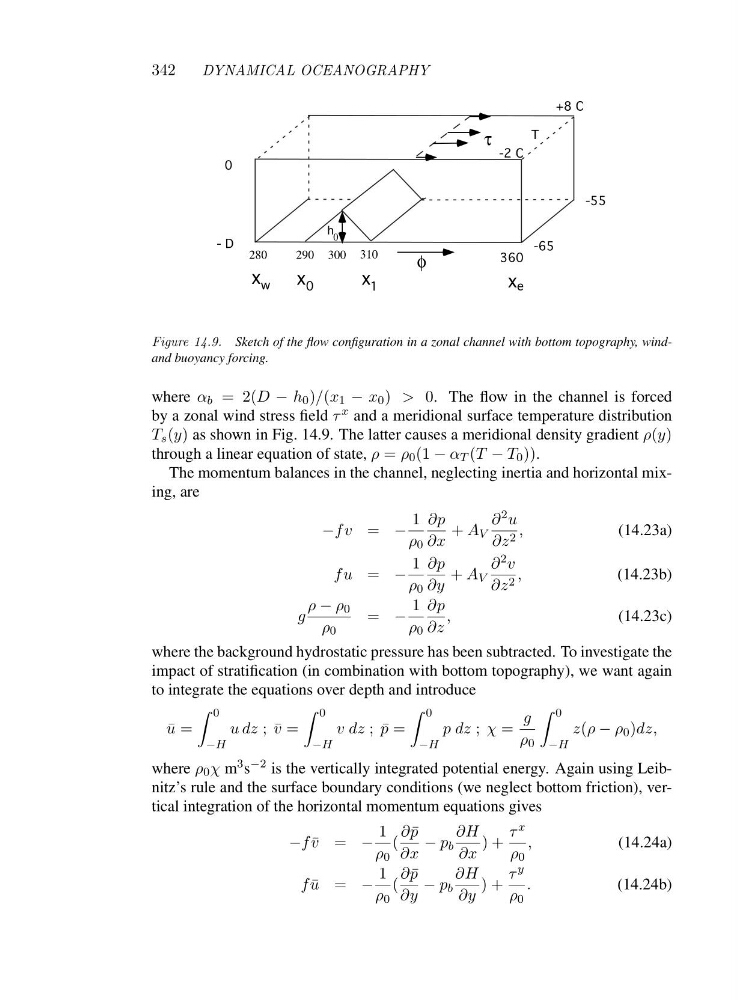
Figure 14.9. Sketch of the flow configuration in a zonal channel with bottom topography, windand buoyancy forcing.
where α b =2 ( D − h 0 )/(x 1 − x 0 ) > 0. The flow in the channel is forced
by a zonal wind stress field τ x and a meridional surface temperature distribution
T s (y) as shown in Fig. 14.9. The latter causes a meridional density gradient ρ(y)
through a linear equation of state, ρ = ρ 0 (1 − α T (T − T 0 )).
The momentum balances in the channel, neglecting inertia and horizontal mixing, are
−fv = −
1
ρ 0
∂p
∂x
+ A V
∂ 2 u
∂z 2 ,
(14.23a)
fu = −
1
ρ 0
∂p
∂y
+ A V
∂ 2 v
∂z 2 ,
(14.23b)
g
ρ − ρ 0
ρ 0
= −
1
ρ 0
∂p
∂z
,
(14.23c)
where the background hydrostatic pressure has been subtracted. To investigate the
impact of stratification (in combination with bottom topography), we want again
to integrate the equations over depth and introduce
¯
u =
0
−H
udz ;¯ v =
0
−H
vdz;¯ p =
0
−H
pdz; χ =
g
ρ 0
0
−H
z(ρ − ρ 0 )dz,
where ρ 0 χ m 3 s −2 is the vertically integrated potential energy. Again using Leibnitz’s rule and the surface boundary conditions (we neglect bottom friction), vertical integration of the horizontal momentum equations gives
−f ¯
v = −
1
ρ 0
(
∂ ¯
p
∂x
− p b
∂H
∂x
)+
τ x
ρ 0
,
(14.24a)
f ¯
u = −
1
ρ 0
(
∂ ¯
p
∂y
− p b
∂H
∂y
)+
τ y
ρ 0
.
(14.24b)
DYNAMICAL OCEANOGRAPHY
280
360
-65
-55
0
h
0
x w
e
x
290
310
300
x 0
- D
x 1
φ
τ
-2 C
+8 C
T
Figure 14.9. Sketch of the flow configuration in a zonal channel with bottom topography, windand buoyancy forcing.
where α b =2 ( D − h 0 )/(x 1 − x 0 ) > 0. The flow in the channel is forced
by a zonal wind stress field τ x and a meridional surface temperature distribution
T s (y) as shown in Fig. 14.9. The latter causes a meridional density gradient ρ(y)
through a linear equation of state, ρ = ρ 0 (1 − α T (T − T 0 )).
The momentum balances in the channel, neglecting inertia and horizontal mixing, are
−fv = −
1
ρ 0
∂p
∂x
+ A V
∂ 2 u
∂z 2 ,
(14.23a)
fu = −
1
ρ 0
∂p
∂y
+ A V
∂ 2 v
∂z 2 ,
(14.23b)
g
ρ − ρ 0
ρ 0
= −
1
ρ 0
∂p
∂z
,
(14.23c)
where the background hydrostatic pressure has been subtracted. To investigate the
impact of stratification (in combination with bottom topography), we want again
to integrate the equations over depth and introduce
¯
u =
0
−H
udz ;¯ v =
0
−H
vdz;¯ p =
0
−H
pdz; χ =
g
ρ 0
0
−H
z(ρ − ρ 0 )dz,
where ρ 0 χ m 3 s −2 is the vertically integrated potential energy. Again using Leibnitz’s rule and the surface boundary conditions (we neglect bottom friction), vertical integration of the horizontal momentum equations gives
−f ¯
v = −
1
ρ 0
(
∂ ¯
p
∂x
− p b
∂H
∂x
)+
τ x
ρ 0
,
(14.24a)
f ¯
u = −
1
ρ 0
(
∂ ¯
p
∂y
− p b
∂H
∂y
)+
τ y
ρ 0
.
(14.24b)