

340
DYNAMICAL OCEANOGRAPHY
z = -d
z = -h
x
x e
w
p
e
_
p
w
_
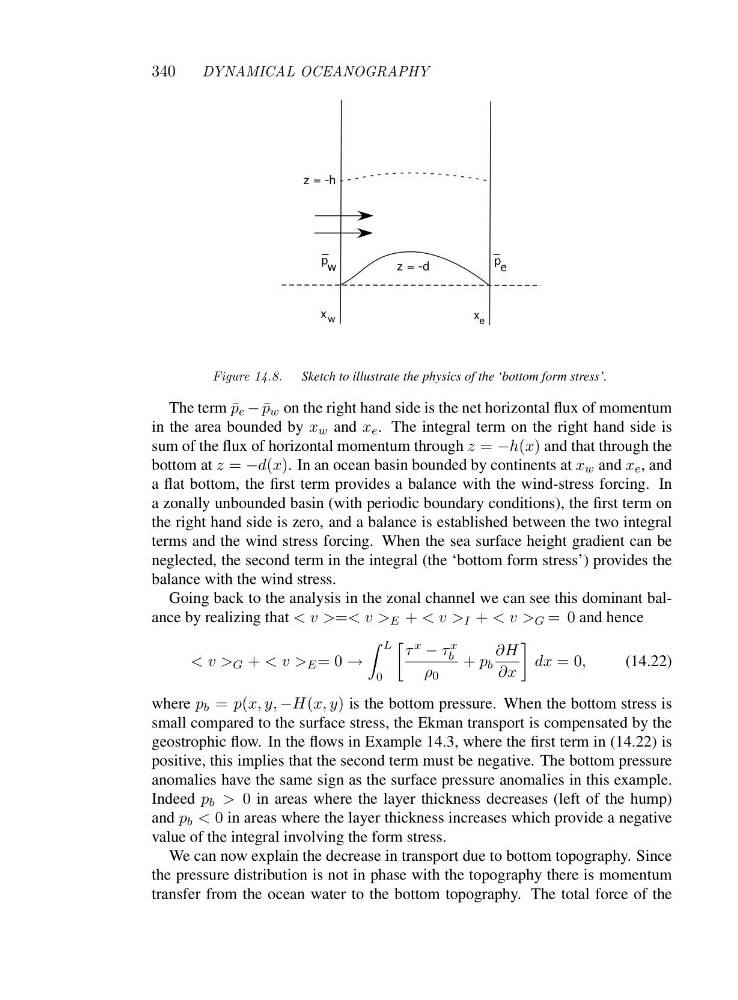
Figure 14.8. Sketch to illustrate the physics of the ‘bottom form stress’.
The term ¯
p e − ¯
p w on the right hand side is the net horizontal flux of momentum
in the area bounded by x w and x e . The integral term on the right hand side is
sum of the flux of horizontal momentum through z = −h(x) and that through the
bottom at z = −d(x). In an ocean basin bounded by continents at x w and x e ,and
a flat bottom, the first term provides a balance with the wind-stress forcing. In
a zonally unbounded basin (with periodic boundary conditions), the first term on
the right hand side is zero, and a balance is established between the two integral
terms and the wind stress forcing. When the sea surface height gradient can be
neglected, the second term in the integral (the ‘bottom form stress’) provides the
balance with the wind stress.
Going back to the analysis in the zonal channel we can see this dominant balance by realizing that= E + I + G =0and hence
G + E =0→
L
0
τ x − τ x
b
ρ 0
+ p b
∂H
∂x
dx =0,
(14.22)
where p b = p(x, y, −H(x, y) is the bottom pressure. When the bottom stress is
small compared to the surface stress, the Ekman transport is compensated by the
geostrophic flow. In the flows in Example 14.3, where the first term in (14.22) is
positive, this implies that the second term must be negative. The bottom pressure
anomalies have the same sign as the surface pressure anomalies in this example.
Indeed p b > 0 in areas where the layer thickness decreases (left of the hump)
and p b < 0 in areas where the layer thickness increases which provide a negative
value of the integral involving the form stress.
We can now explain the decrease in transport due to bottom topography. Since
the pressure distribution is not in phase with the topography there is momentum
transfer from the ocean water to the bottom topography. The total force of the
DYNAMICAL OCEANOGRAPHY
z = -d
z = -h
x
x e
w
p
e
_
p
w
_
Figure 14.8. Sketch to illustrate the physics of the ‘bottom form stress’.
The term ¯
p e − ¯
p w on the right hand side is the net horizontal flux of momentum
in the area bounded by x w and x e . The integral term on the right hand side is
sum of the flux of horizontal momentum through z = −h(x) and that through the
bottom at z = −d(x). In an ocean basin bounded by continents at x w and x e ,and
a flat bottom, the first term provides a balance with the wind-stress forcing. In
a zonally unbounded basin (with periodic boundary conditions), the first term on
the right hand side is zero, and a balance is established between the two integral
terms and the wind stress forcing. When the sea surface height gradient can be
neglected, the second term in the integral (the ‘bottom form stress’) provides the
balance with the wind stress.
Going back to the analysis in the zonal channel we can see this dominant balance by realizing that
L
0
τ x − τ x
b
ρ 0
+ p b
∂H
∂x
dx =0,
(14.22)
where p b = p(x, y, −H(x, y) is the bottom pressure. When the bottom stress is
small compared to the surface stress, the Ekman transport is compensated by the
geostrophic flow. In the flows in Example 14.3, where the first term in (14.22) is
positive, this implies that the second term must be negative. The bottom pressure
anomalies have the same sign as the surface pressure anomalies in this example.
Indeed p b > 0 in areas where the layer thickness decreases (left of the hump)
and p b < 0 in areas where the layer thickness increases which provide a negative
value of the integral involving the form stress.
We can now explain the decrease in transport due to bottom topography. Since
the pressure distribution is not in phase with the topography there is momentum
transfer from the ocean water to the bottom topography. The total force of the