

336
DYNAMICAL OCEANOGRAPHY
0
500
1000
1500
2000
2500
3000
3500
4000
280
290
300
310
320
330
340
350
360
φ φ
φ
φ
depth
0.25
0.1
h
0
(a)
0
5
10
15
20
25
30
35
40
0
0.1
0.2
0.3
0.4
0.5
Φ Φ Φ
Φ (Sv)
A
H
= 2.5 10
5 m 2 /s
h
0
/D
(b)
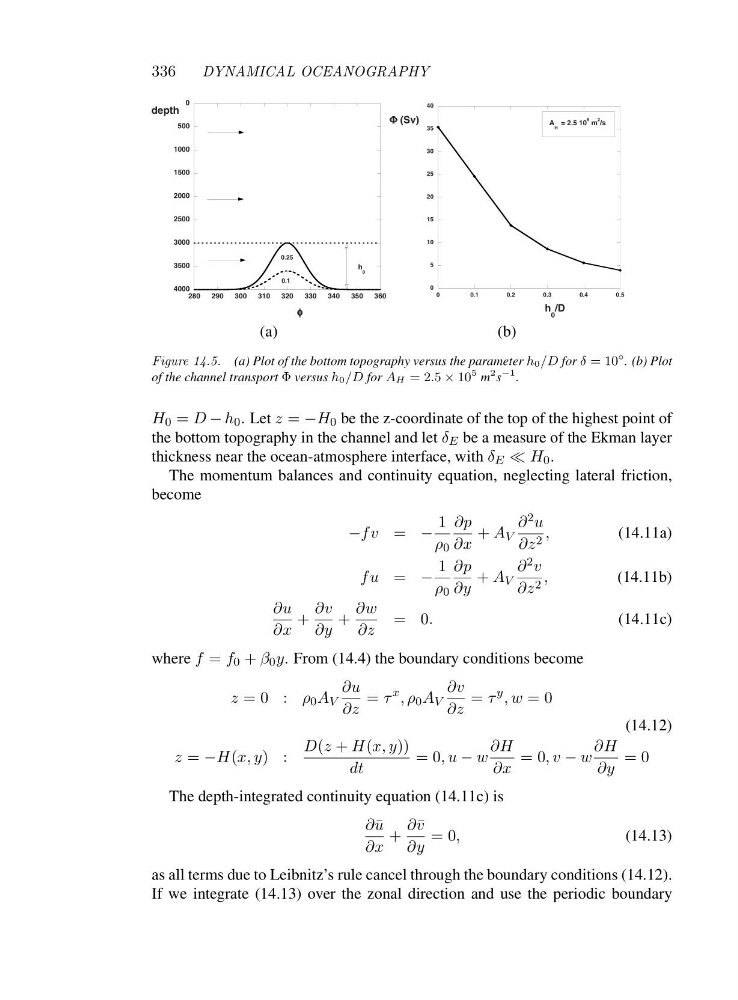
Figure 14.5. (a) Plot of the bottom topography versus the parameter h0/D for δ =10
◦ . (b) Plot
of the channel transport Φ versus h0/D for AH =2.5 × 10
5 m
2 s
−1 .
H 0 = D − h 0 .L e tz = −H 0 be the z-coordinate of the top of the highest point of
the bottom topography in the channel and let δ E be a measure of the Ekman layer
thickness near the ocean-atmosphere interface, with δ E ≪ H 0 .
The momentum balances and continuity equation, neglecting lateral friction,
become
−fv = −
1
ρ 0
∂p
∂x
+ A V
∂ 2 u
∂z 2 ,
(14.11a)
fu = −
1
ρ 0
∂p
∂y
+ A V
∂ 2 v
∂z 2 ,
(14.11b)
∂u
∂x
+
∂v
∂y
+
∂w
∂z
=0 .
(14.11c)
where f = f 0 + β 0 y. From (14.4) the boundary conditions become
z =0 : ρ 0 A V
∂u
∂z
= τ
x ,ρ 0 A V
∂v
∂z
= τ
y ,w =0
(14.12)
z = −H(x, y):
D(z + H(x, y))
dt
=0,u− w
∂H
∂x
=0,v− w
∂H
∂y
=0
The depth-integrated continuity equation (14.11c) is
∂ ¯
u
∂x
+
∂¯ v
∂y
=0,
(14.13)
as all terms due to Leibnitz’s rule cancel through the boundary conditions (14.12).
If we integrate (14.13) over the zonal direction and use the periodic boundary
DYNAMICAL OCEANOGRAPHY
0
500
1000
1500
2000
2500
3000
3500
4000
280
290
300
310
320
330
340
350
360
φ φ
φ
φ
depth
0.25
0.1
h
0
(a)
0
5
10
15
20
25
30
35
40
0
0.1
0.2
0.3
0.4
0.5
Φ Φ Φ
Φ (Sv)
A
H
= 2.5 10
5 m 2 /s
h
0
/D
(b)
Figure 14.5. (a) Plot of the bottom topography versus the parameter h0/D for δ =10
◦ . (b) Plot
of the channel transport Φ versus h0/D for AH =2.5 × 10
5 m
2 s
−1 .
H 0 = D − h 0 .L e tz = −H 0 be the z-coordinate of the top of the highest point of
the bottom topography in the channel and let δ E be a measure of the Ekman layer
thickness near the ocean-atmosphere interface, with δ E ≪ H 0 .
The momentum balances and continuity equation, neglecting lateral friction,
become
−fv = −
1
ρ 0
∂p
∂x
+ A V
∂ 2 u
∂z 2 ,
(14.11a)
fu = −
1
ρ 0
∂p
∂y
+ A V
∂ 2 v
∂z 2 ,
(14.11b)
∂u
∂x
+
∂v
∂y
+
∂w
∂z
=0 .
(14.11c)
where f = f 0 + β 0 y. From (14.4) the boundary conditions become
z =0 : ρ 0 A V
∂u
∂z
= τ
x ,ρ 0 A V
∂v
∂z
= τ
y ,w =0
(14.12)
z = −H(x, y):
D(z + H(x, y))
dt
=0,u− w
∂H
∂x
=0,v− w
∂H
∂y
=0
The depth-integrated continuity equation (14.11c) is
∂ ¯
u
∂x
+
∂¯ v
∂y
=0,
(14.13)
as all terms due to Leibnitz’s rule cancel through the boundary conditions (14.12).
If we integrate (14.13) over the zonal direction and use the periodic boundary