

18
DYNAMICAL OCEANOGRAPHY
ρ 2 S 2
T 2 p 2
w
w
ρ 1 S 1
T 1 p 1
z
z = - z
1
ρ 1 , S 1 , T 1 , p 1
ρ 2 , S 2 , T 2 , p 2
Background
Volume element
z = - z
2
Δ z
a z
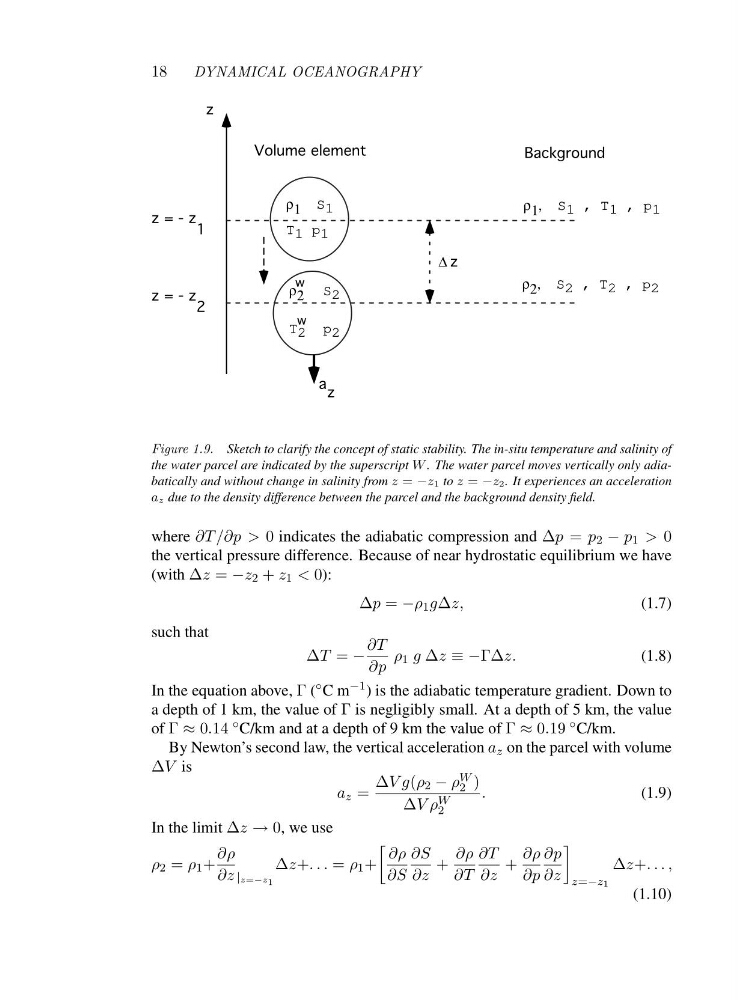
Figure 1.9. Sketch to clarify the concept of static stability. The in-situ temperature and salinity of
the water parcel are indicated by the superscript W . The water parcel moves vertically only adiabatically and without change in salinity from z = −z1 to z = −z2. It experiences an acceleration
az due to the density difference between the parcel and the background density field.
where ∂T/∂p > 0 indicates the adiabatic compression and Δp = p 2 − p 1 > 0
the vertical pressure difference. Because of near hydrostatic equilibrium we have
(with Δz = −z 2 + z 1 < 0):
Δp = −ρ 1 gΔz,
(1.7)
such that
ΔT = −
∂T
∂p
ρ 1 g Δz ≡−ΓΔz.
(1.8)
In the equation above, Γ ( ◦ Cm −1 ) is the adiabatic temperature gradient. Down to
a depth of 1 km, the value of Γ is negligibly small. At a depth of 5 km, the value
of Γ ≈ 0.14 ◦ C/km and at a depth of 9 km the value of Γ ≈ 0.19 ◦ C/km.
By Newton’s second law, the vertical acceleration a z on the parcel with volume
ΔV is
a z =
ΔVg(ρ 2 − ρ W
2 )
ΔVρ W
2
.
(1.9)
In the limit Δz → 0,weuse
ρ 2 = ρ 1 +
∂ρ
∂z |z=−z 1
Δz+... = ρ 1 +
∂ρ
∂S
∂S
∂z
+
∂ρ
∂T
∂T
∂z
+
∂ρ
∂p
∂p
∂z
z=−z1
Δz+...,
(1.10)
DYNAMICAL OCEANOGRAPHY
ρ 2 S 2
T 2 p 2
w
w
ρ 1 S 1
T 1 p 1
z
z = - z
1
ρ 1 , S 1 , T 1 , p 1
ρ 2 , S 2 , T 2 , p 2
Background
Volume element
z = - z
2
Δ z
a z
Figure 1.9. Sketch to clarify the concept of static stability. The in-situ temperature and salinity of
the water parcel are indicated by the superscript W . The water parcel moves vertically only adiabatically and without change in salinity from z = −z1 to z = −z2. It experiences an acceleration
az due to the density difference between the parcel and the background density field.
where ∂T/∂p > 0 indicates the adiabatic compression and Δp = p 2 − p 1 > 0
the vertical pressure difference. Because of near hydrostatic equilibrium we have
(with Δz = −z 2 + z 1 < 0):
Δp = −ρ 1 gΔz,
(1.7)
such that
ΔT = −
∂T
∂p
ρ 1 g Δz ≡−ΓΔz.
(1.8)
In the equation above, Γ ( ◦ Cm −1 ) is the adiabatic temperature gradient. Down to
a depth of 1 km, the value of Γ is negligibly small. At a depth of 5 km, the value
of Γ ≈ 0.14 ◦ C/km and at a depth of 9 km the value of Γ ≈ 0.19 ◦ C/km.
By Newton’s second law, the vertical acceleration a z on the parcel with volume
ΔV is
a z =
ΔVg(ρ 2 − ρ W
2 )
ΔVρ W
2
.
(1.9)
In the limit Δz → 0,weuse
ρ 2 = ρ 1 +
∂ρ
∂z |z=−z 1
Δz+... = ρ 1 +
∂ρ
∂S
∂S
∂z
+
∂ρ
∂T
∂T
∂z
+
∂ρ
∂p
∂p
∂z
z=−z1
Δz+...,
(1.10)