

282
DYNAMICAL OCEANOGRAPHY
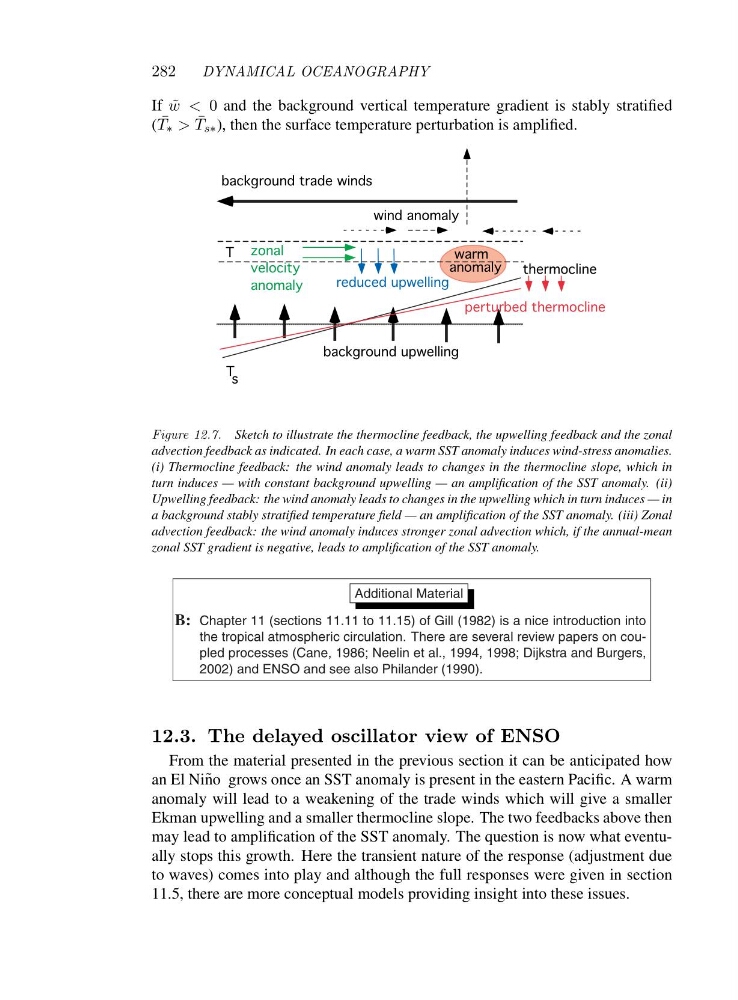
If ˜
w<0 and the background vertical temperature gradient is stably stratified
( ¯
T ∗ > ¯
T s∗ ), then the surface temperature perturbation is amplified.
warm
anomaly
background trade winds
wind anomaly
background upwelling
thermocline
perturbed thermocline
T
T
s
reduced upwelling
zonal
velocity
anomaly
Figure 12.7. Sketch to illustrate the thermocline feedback, the upwelling feedback and the zonal
advection feedback as indicated. In each case, a warm SST anomaly induces wind-stress anomalies.
(i) Thermocline feedback: the wind anomaly leads to changes in the thermocline slope, which in
turn induces — with constant background upwelling — an amplification of the SST anomaly. (ii)
Upwelling feedback: the wind anomaly leads to changes in the upwelling which in turn induces — in
a background stably stratified temperature field — an amplification of the SST anomaly. (iii) Zonal
advection feedback: the wind anomaly induces stronger zonal advection which, if the annual-mean
zonal SST gradient is negative, leads to amplification of the SST anomaly.
Additional Material
B: Chapter 11 (sections 11.11 to 11.15) of Gill (1982) is a nice introduction into
the tropical atmospheric circulation. There are several review papers on coupled processes (Cane, 1986; Neelin et al., 1994, 1998; Dijkstra and Burgers,
2002) and ENSO and see also Philander (1990).
12.3. The delayed oscillator view of ENSO
From the material presented in the previous section it can be anticipated how
an El Ni˜ no grows once an SST anomaly is present in the eastern Pacific. A warm
anomaly will lead to a weakening of the trade winds which will give a smaller
Ekman upwelling and a smaller thermocline slope. The two feedbacks above then
may lead to amplification of the SST anomaly. The question is now what eventually stops this growth. Here the transient nature of the response (adjustment due
to waves) comes into play and although the full responses were given in section
11.5, there are more conceptual models providing insight into these issues.
DYNAMICAL OCEANOGRAPHY
If ˜
w<0 and the background vertical temperature gradient is stably stratified
( ¯
T ∗ > ¯
T s∗ ), then the surface temperature perturbation is amplified.
warm
anomaly
background trade winds
wind anomaly
background upwelling
thermocline
perturbed thermocline
T
T
s
reduced upwelling
zonal
velocity
anomaly
Figure 12.7. Sketch to illustrate the thermocline feedback, the upwelling feedback and the zonal
advection feedback as indicated. In each case, a warm SST anomaly induces wind-stress anomalies.
(i) Thermocline feedback: the wind anomaly leads to changes in the thermocline slope, which in
turn induces — with constant background upwelling — an amplification of the SST anomaly. (ii)
Upwelling feedback: the wind anomaly leads to changes in the upwelling which in turn induces — in
a background stably stratified temperature field — an amplification of the SST anomaly. (iii) Zonal
advection feedback: the wind anomaly induces stronger zonal advection which, if the annual-mean
zonal SST gradient is negative, leads to amplification of the SST anomaly.
Additional Material
B: Chapter 11 (sections 11.11 to 11.15) of Gill (1982) is a nice introduction into
the tropical atmospheric circulation. There are several review papers on coupled processes (Cane, 1986; Neelin et al., 1994, 1998; Dijkstra and Burgers,
2002) and ENSO and see also Philander (1990).
12.3. The delayed oscillator view of ENSO
From the material presented in the previous section it can be anticipated how
an El Ni˜ no grows once an SST anomaly is present in the eastern Pacific. A warm
anomaly will lead to a weakening of the trade winds which will give a smaller
Ekman upwelling and a smaller thermocline slope. The two feedbacks above then
may lead to amplification of the SST anomaly. The question is now what eventually stops this growth. Here the transient nature of the response (adjustment due
to waves) comes into play and although the full responses were given in section
11.5, there are more conceptual models providing insight into these issues.