

274
DYNAMICAL OCEANOGRAPHY
The spatial patterns of the annual mean state of the surface winds and
sea surface temperature (SST) in the Pacific were shown in chapter 11
(Fig. 11.1 and Fig. 11.2). In this chapter, anomalies of this mean state
are considered. About once every four years the sea surface temperature
in the eastern Pacific is much higher than average; this phenomenon is
called El Ni˜ no. Sea surface temperature anomalies of up to a few degrees
can occur and are accompanied by a weakening/strengthening of the trade
winds, the latter called the Southern Oscillation. In this chapter, the focus is on a dynamical understanding of the El Ni˜ no/ Southern Oscillation
(ENSO) phenomenon. After the presentation of a few basic characteristics of ENSO in section 12.1, we discuss coupled processes and feedbacks
between the equatorial ocean circulation and atmosphere in section 12.2.
Sections 12.3 and 12.4 introduce modern conceptual models of ENSO
viewed as a delayed oscillator phenomenon.
12.1. Basic Phenomena
The El Ni˜ no/Southern Oscillation (ENSO) is the most prominent example of
interannual variability in the climate system. Because it develops on relatively
short time scales, it is one of the best studied climate phenomena, both observationally and theoretically. ENSO is caused by processes in both the tropical ocean
and atmosphere with a central role for the sea surface temperature.
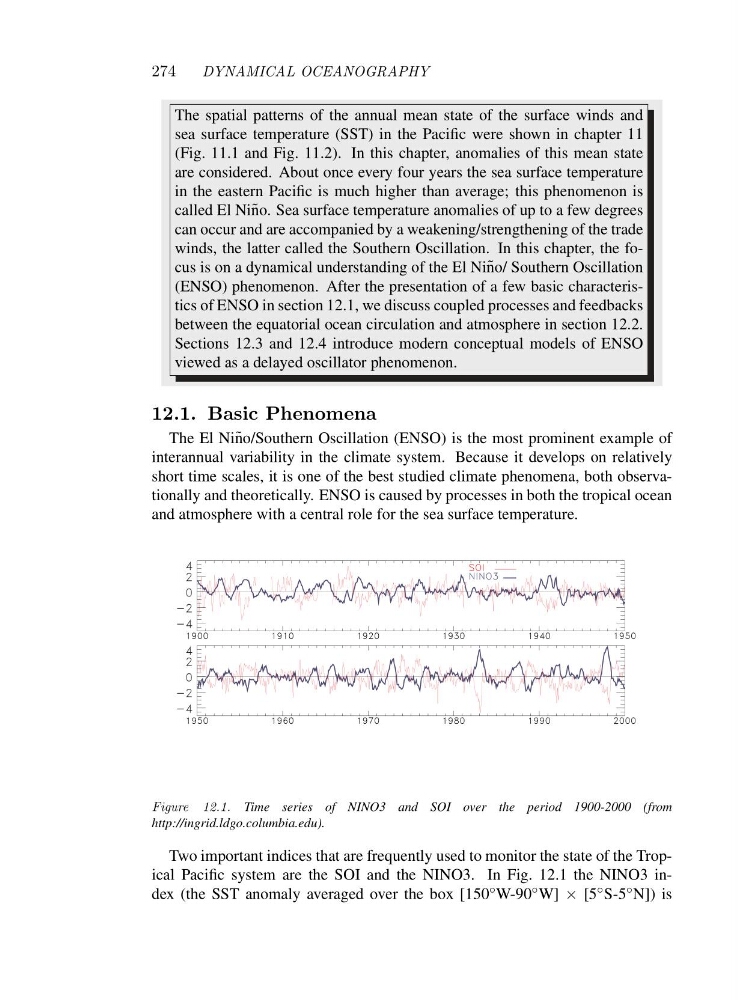
Figure 12.1. Time series of NINO3 and SOI over the period 1900-2000 (from
http://ingrid.ldgo.columbia.edu).
Two important indices that are frequently used to monitor the state of the Tropical Pacific system are the SOI and the NINO3. In Fig. 12.1 the NINO3 index (the SST anomaly averaged over the box [150 ◦ W-90 ◦ W] × [5 ◦ S-5 ◦ N]) is
DYNAMICAL OCEANOGRAPHY
The spatial patterns of the annual mean state of the surface winds and
sea surface temperature (SST) in the Pacific were shown in chapter 11
(Fig. 11.1 and Fig. 11.2). In this chapter, anomalies of this mean state
are considered. About once every four years the sea surface temperature
in the eastern Pacific is much higher than average; this phenomenon is
called El Ni˜ no. Sea surface temperature anomalies of up to a few degrees
can occur and are accompanied by a weakening/strengthening of the trade
winds, the latter called the Southern Oscillation. In this chapter, the focus is on a dynamical understanding of the El Ni˜ no/ Southern Oscillation
(ENSO) phenomenon. After the presentation of a few basic characteristics of ENSO in section 12.1, we discuss coupled processes and feedbacks
between the equatorial ocean circulation and atmosphere in section 12.2.
Sections 12.3 and 12.4 introduce modern conceptual models of ENSO
viewed as a delayed oscillator phenomenon.
12.1. Basic Phenomena
The El Ni˜ no/Southern Oscillation (ENSO) is the most prominent example of
interannual variability in the climate system. Because it develops on relatively
short time scales, it is one of the best studied climate phenomena, both observationally and theoretically. ENSO is caused by processes in both the tropical ocean
and atmosphere with a central role for the sea surface temperature.
Figure 12.1. Time series of NINO3 and SOI over the period 1900-2000 (from
http://ingrid.ldgo.columbia.edu).
Two important indices that are frequently used to monitor the state of the Tropical Pacific system are the SOI and the NINO3. In Fig. 12.1 the NINO3 index (the SST anomaly averaged over the box [150 ◦ W-90 ◦ W] × [5 ◦ S-5 ◦ N]) is