

268
DYNAMICAL OCEANOGRAPHY
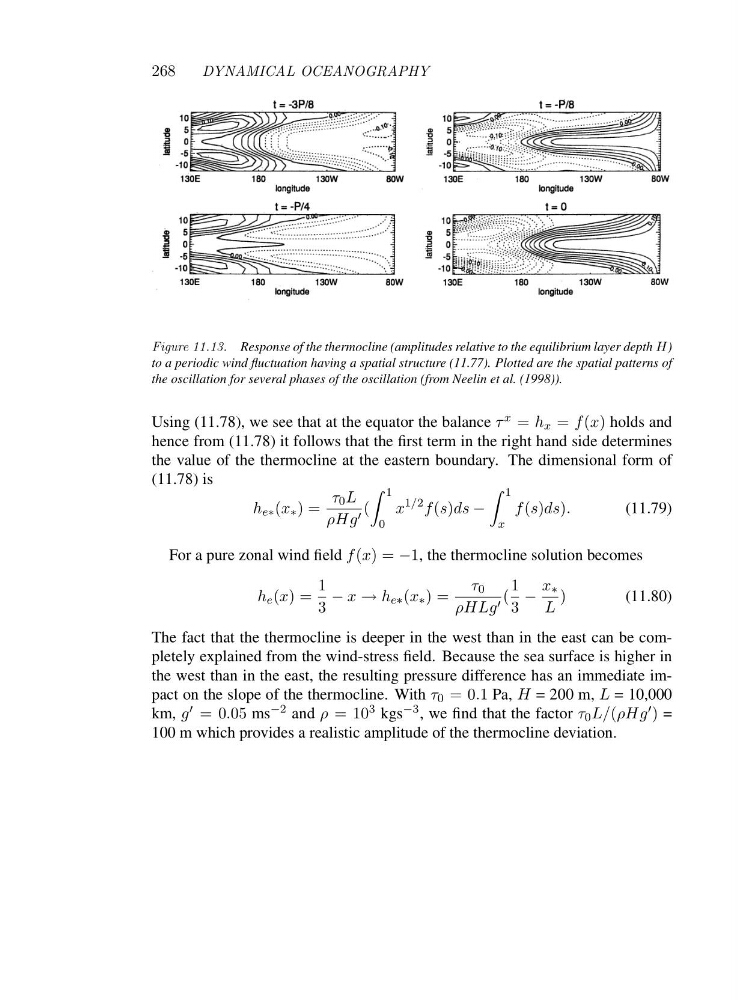
Figure 11.13. Response of the thermocline (amplitudes relative to the equilibrium layer depth H)
to a periodic wind fluctuation having a spatial structure (11.77). Plotted are the spatial patterns of
the oscillation for several phases of the oscillation (from Neelin et al. (1998)).
Using (11.78), we see that at the equator the balance τ x = h x = f (x) holds and
hence from (11.78) it follows that the first term in the right hand side determines
the value of the thermocline at the eastern boundary. The dimensional form of
(11.78) is
h e∗ (x ∗ )=
τ 0 L
ρHg ′ (
1
0
x
1/2 f (s)ds −
1
x
f (s)ds).
(11.79)
For a pure zonal wind field f (x)=−1, the thermocline solution becomes
h e (x)=
1
3
− x → h e∗ (x ∗ )=
τ 0
ρHLg ′ (
1
3
−
x ∗
L
)
(11.80)
The fact that the thermocline is deeper in the west than in the east can be completely explained from the wind-stress field. Because the sea surface is higher in
the west than in the east, the resulting pressure difference has an immediate impact on the slope of the thermocline. With τ 0 =0 .1 Pa, H = 200 m, L = 10,000
km, g ′ =0 .05 ms −2 and ρ =1 0 3 kgs −3 , we find that the factor τ 0 L/(ρHg ′ ) =
100 m which provides a realistic amplitude of the thermocline deviation.
DYNAMICAL OCEANOGRAPHY
Figure 11.13. Response of the thermocline (amplitudes relative to the equilibrium layer depth H)
to a periodic wind fluctuation having a spatial structure (11.77). Plotted are the spatial patterns of
the oscillation for several phases of the oscillation (from Neelin et al. (1998)).
Using (11.78), we see that at the equator the balance τ x = h x = f (x) holds and
hence from (11.78) it follows that the first term in the right hand side determines
the value of the thermocline at the eastern boundary. The dimensional form of
(11.78) is
h e∗ (x ∗ )=
τ 0 L
ρHg ′ (
1
0
x
1/2 f (s)ds −
1
x
f (s)ds).
(11.79)
For a pure zonal wind field f (x)=−1, the thermocline solution becomes
h e (x)=
1
3
− x → h e∗ (x ∗ )=
τ 0
ρHLg ′ (
1
3
−
x ∗
L
)
(11.80)
The fact that the thermocline is deeper in the west than in the east can be completely explained from the wind-stress field. Because the sea surface is higher in
the west than in the east, the resulting pressure difference has an immediate impact on the slope of the thermocline. With τ 0 =0 .1 Pa, H = 200 m, L = 10,000
km, g ′ =0 .05 ms −2 and ρ =1 0 3 kgs −3 , we find that the factor τ 0 L/(ρHg ′ ) =
100 m which provides a realistic amplitude of the thermocline deviation.