

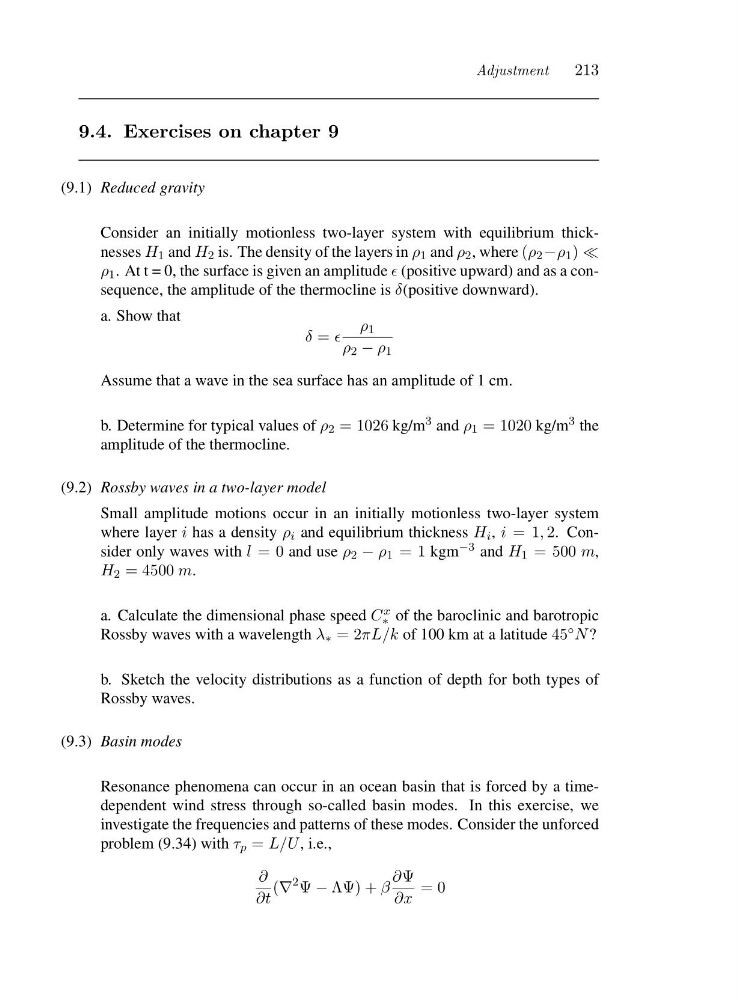
Adjustment
213
9.4. Exercises on chapter 9
(9.1) Reduced gravity
Consider an initially motionless two-layer system with equilibrium thicknesses H 1 and H 2 is. The density of the layers in ρ 1 and ρ 2 , where (ρ 2 −ρ 1 ) ≪
ρ 1 . At t = 0, the surface is given an amplitude ǫ (positive upward) and as a consequence, the amplitude of the thermocline is δ(positive downward).
a. Show that
δ = ǫ
ρ 1
ρ 2 − ρ 1
Assume that a wave in the sea surface has an amplitude of 1 cm.
b. Determine for typical values of ρ 2 = 1026 kg/m 3 and ρ 1 = 1020 kg/m 3 the
amplitude of the thermocline.
(9.2) Rossby waves in a two-layer model
Small amplitude motions occur in an initially motionless two-layer system
where layer i has a density ρ i and equilibrium thickness H i , i =1 , 2. Consider only waves with l =0and use ρ 2 − ρ 1 =1kgm −3 and H 1 =5 0 0m,
H 2 = 4500 m.
a. Calculate the dimensional phase speed C x
∗ of the baroclinic and barotropic
Rossby waves with a wavelength λ ∗ =2πL/k of 100 km at a latitude 45 ◦ N ?
b. Sketch the velocity distributions as a function of depth for both types of
Rossby waves.
(9.3) Basin modes
Resonance phenomena can occur in an ocean basin that is forced by a timedependent wind stress through so-called basin modes. In this exercise, we
investigate the frequencies and patterns of these modes. Consider the unforced
problem (9.34) with τ p = L/U , i.e.,
∂
∂t
(∇
2 Ψ − ΛΨ) + β
∂Ψ
∂x
=0
213
9.4. Exercises on chapter 9
(9.1) Reduced gravity
Consider an initially motionless two-layer system with equilibrium thicknesses H 1 and H 2 is. The density of the layers in ρ 1 and ρ 2 , where (ρ 2 −ρ 1 ) ≪
ρ 1 . At t = 0, the surface is given an amplitude ǫ (positive upward) and as a consequence, the amplitude of the thermocline is δ(positive downward).
a. Show that
δ = ǫ
ρ 1
ρ 2 − ρ 1
Assume that a wave in the sea surface has an amplitude of 1 cm.
b. Determine for typical values of ρ 2 = 1026 kg/m 3 and ρ 1 = 1020 kg/m 3 the
amplitude of the thermocline.
(9.2) Rossby waves in a two-layer model
Small amplitude motions occur in an initially motionless two-layer system
where layer i has a density ρ i and equilibrium thickness H i , i =1 , 2. Consider only waves with l =0and use ρ 2 − ρ 1 =1kgm −3 and H 1 =5 0 0m,
H 2 = 4500 m.
a. Calculate the dimensional phase speed C x
∗ of the baroclinic and barotropic
Rossby waves with a wavelength λ ∗ =2πL/k of 100 km at a latitude 45 ◦ N ?
b. Sketch the velocity distributions as a function of depth for both types of
Rossby waves.
(9.3) Basin modes
Resonance phenomena can occur in an ocean basin that is forced by a timedependent wind stress through so-called basin modes. In this exercise, we
investigate the frequencies and patterns of these modes. Consider the unforced
problem (9.34) with τ p = L/U , i.e.,
∂
∂t
(∇
2 Ψ − ΛΨ) + β
∂Ψ
∂x
=0