

8
DYNAMICAL OCEANOGRAPHY
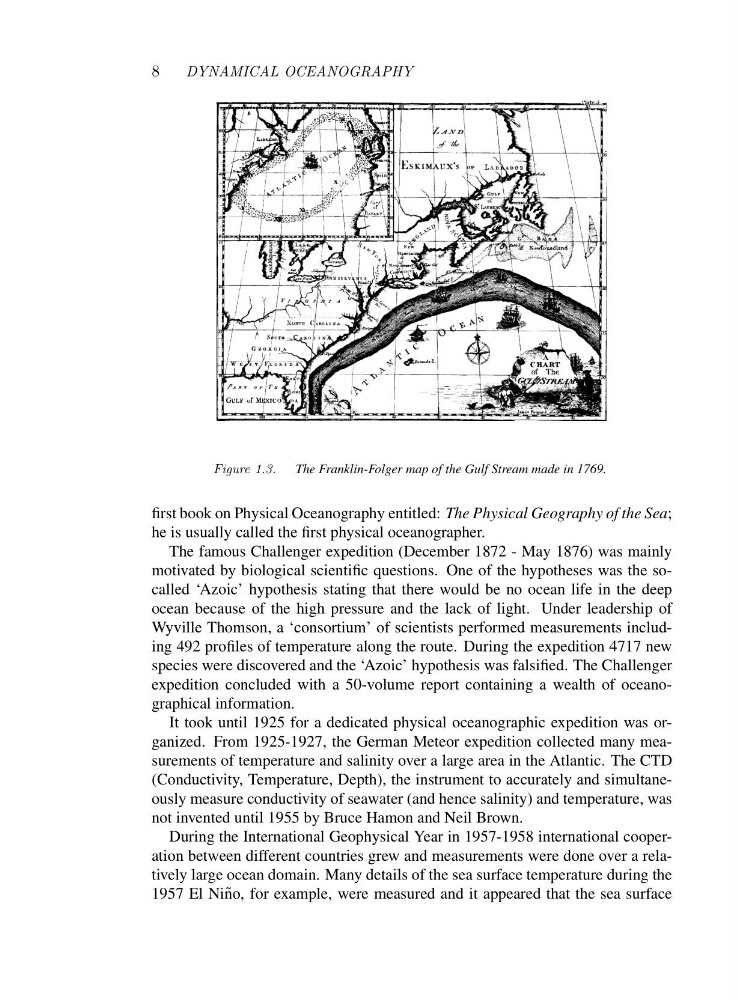
Figure 1.3. The Franklin-Folger map of the Gulf Stream made in 1769.
first book on Physical Oceanography entitled: The Physical Geography of the Sea;
he is usually called the first physical oceanographer.
The famous Challenger expedition (December 1872 - May 1876) was mainly
motivated by biological scientific questions. One of the hypotheses was the socalled ‘Azoic’ hypothesis stating that there would be no ocean life in the deep
ocean because of the high pressure and the lack of light. Under leadership of
Wyville Thomson, a ‘consortium’ of scientists performed measurements including 492 profiles of temperature along the route. During the expedition 4717 new
species were discovered and the ‘Azoic’ hypothesis was falsified. The Challenger
expedition concluded with a 50-volume report containing a wealth of oceanographical information.
It took until 1925 for a dedicated physical oceanographic expedition was organized. From 1925-1927, the German Meteor expedition collected many measurements of temperature and salinity over a large area in the Atlantic. The CTD
(Conductivity, Temperature, Depth), the instrument to accurately and simultaneously measure conductivity of seawater (and hence salinity) and temperature, was
not invented until 1955 by Bruce Hamon and Neil Brown.
During the International Geophysical Year in 1957-1958 international cooperation between different countries grew and measurements were done over a relatively large ocean domain. Many details of the sea surface temperature during the
1957 El Ni˜ no, for example, were measured and it appeared that the sea surface
DYNAMICAL OCEANOGRAPHY
Figure 1.3. The Franklin-Folger map of the Gulf Stream made in 1769.
first book on Physical Oceanography entitled: The Physical Geography of the Sea;
he is usually called the first physical oceanographer.
The famous Challenger expedition (December 1872 - May 1876) was mainly
motivated by biological scientific questions. One of the hypotheses was the socalled ‘Azoic’ hypothesis stating that there would be no ocean life in the deep
ocean because of the high pressure and the lack of light. Under leadership of
Wyville Thomson, a ‘consortium’ of scientists performed measurements including 492 profiles of temperature along the route. During the expedition 4717 new
species were discovered and the ‘Azoic’ hypothesis was falsified. The Challenger
expedition concluded with a 50-volume report containing a wealth of oceanographical information.
It took until 1925 for a dedicated physical oceanographic expedition was organized. From 1925-1927, the German Meteor expedition collected many measurements of temperature and salinity over a large area in the Atlantic. The CTD
(Conductivity, Temperature, Depth), the instrument to accurately and simultaneously measure conductivity of seawater (and hence salinity) and temperature, was
not invented until 1955 by Bruce Hamon and Neil Brown.
During the International Geophysical Year in 1957-1958 international cooperation between different countries grew and measurements were done over a relatively large ocean domain. Many details of the sea surface temperature during the
1957 El Ni˜ no, for example, were measured and it appeared that the sea surface