

Stratification
177
UL
DNF rǫF r 2 /ǫ
10 −2
10 6
10 3
10 −2
10 −3
10 −4
10 −2
10 −1
10 5
10 3
10 −2
10 −2
10 −2
10 −2
m/s
m
m
1/s
-
-
-
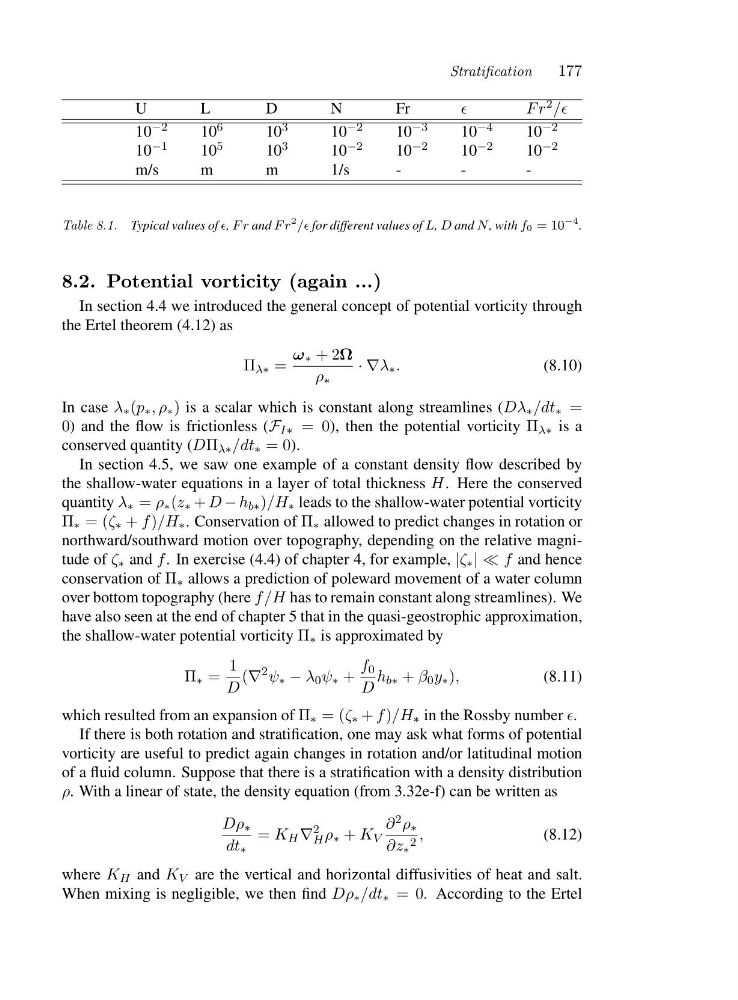
Table 8.1. Typical values of ǫ, Frand Fr
2 /ǫ for different values of L, D and N , with f0 =10
−4 .
8.2. Potential vorticity (again ...)
In section 4.4 we introduced the general concept of potential vorticity through
the Ertel theorem (4.12) as
Π λ∗ =
ω ∗ +2Ω
ρ ∗
·∇λ ∗ .
(8.10)
In case λ ∗ (p ∗ ,ρ ∗ ) is a scalar which is constant along streamlines (Dλ ∗ /dt ∗ =
0) and the flow is frictionless (F I∗ =0 ), then the potential vorticity Π λ∗ is a
conserved quantity (DΠ λ∗ /dt ∗ =0).
In section 4.5, we saw one example of a constant density flow described by
the shallow-water equations in a layer of total thickness H. Here the conserved
quantity λ ∗ = ρ ∗ (z ∗ + D − h b∗ )/H ∗ leads to the shallow-water potential vorticity
Π ∗ =(ζ ∗ + f )/H ∗ . Conservation of Π ∗ allowed to predict changes in rotation or
northward/southward motion over topography, depending on the relative magnitude of ζ ∗ and f . In exercise (4.4) of chapter 4, for example, |ζ ∗ |≪f and hence
conservation of Π ∗ allows a prediction of poleward movement of a water column
over bottom topography (here f/H has to remain constant along streamlines). We
have also seen at the end of chapter 5 that in the quasi-geostrophic approximation,
the shallow-water potential vorticity Π ∗ is approximated by
Π ∗ =
1
D
(∇
2 ψ ∗ − λ 0 ψ ∗ +
f 0
D
h b∗ + β 0 y ∗ ),
(8.11)
which resulted from an expansion of Π ∗ =(ζ ∗ + f )/H ∗ in the Rossby number ǫ.
If there is both rotation and stratification, one may ask what forms of potential
vorticity are useful to predict again changes in rotation and/or latitudinal motion
of a fluid column. Suppose that there is a stratification with a density distribution
ρ. With a linear of state, the density equation (from 3.32e-f) can be written as
Dρ ∗
dt ∗
= K H ∇
2
H ρ ∗ + K V
∂ 2 ρ ∗
∂z ∗
2
,
(8.12)
where K H and K V are the vertical and horizontal diffusivities of heat and salt.
When mixing is negligible, we then find Dρ ∗ /dt ∗ =0 . According to the Ertel
177
UL
DNF rǫF r 2 /ǫ
10 −2
10 6
10 3
10 −2
10 −3
10 −4
10 −2
10 −1
10 5
10 3
10 −2
10 −2
10 −2
10 −2
m/s
m
m
1/s
-
-
-
Table 8.1. Typical values of ǫ, Frand Fr
2 /ǫ for different values of L, D and N , with f0 =10
−4 .
8.2. Potential vorticity (again ...)
In section 4.4 we introduced the general concept of potential vorticity through
the Ertel theorem (4.12) as
Π λ∗ =
ω ∗ +2Ω
ρ ∗
·∇λ ∗ .
(8.10)
In case λ ∗ (p ∗ ,ρ ∗ ) is a scalar which is constant along streamlines (Dλ ∗ /dt ∗ =
0) and the flow is frictionless (F I∗ =0 ), then the potential vorticity Π λ∗ is a
conserved quantity (DΠ λ∗ /dt ∗ =0).
In section 4.5, we saw one example of a constant density flow described by
the shallow-water equations in a layer of total thickness H. Here the conserved
quantity λ ∗ = ρ ∗ (z ∗ + D − h b∗ )/H ∗ leads to the shallow-water potential vorticity
Π ∗ =(ζ ∗ + f )/H ∗ . Conservation of Π ∗ allowed to predict changes in rotation or
northward/southward motion over topography, depending on the relative magnitude of ζ ∗ and f . In exercise (4.4) of chapter 4, for example, |ζ ∗ |≪f and hence
conservation of Π ∗ allows a prediction of poleward movement of a water column
over bottom topography (here f/H has to remain constant along streamlines). We
have also seen at the end of chapter 5 that in the quasi-geostrophic approximation,
the shallow-water potential vorticity Π ∗ is approximated by
Π ∗ =
1
D
(∇
2 ψ ∗ − λ 0 ψ ∗ +
f 0
D
h b∗ + β 0 y ∗ ),
(8.11)
which resulted from an expansion of Π ∗ =(ζ ∗ + f )/H ∗ in the Rossby number ǫ.
If there is both rotation and stratification, one may ask what forms of potential
vorticity are useful to predict again changes in rotation and/or latitudinal motion
of a fluid column. Suppose that there is a stratification with a density distribution
ρ. With a linear of state, the density equation (from 3.32e-f) can be written as
Dρ ∗
dt ∗
= K H ∇
2
H ρ ∗ + K V
∂ 2 ρ ∗
∂z ∗
2
,
(8.12)
where K H and K V are the vertical and horizontal diffusivities of heat and salt.
When mixing is negligible, we then find Dρ ∗ /dt ∗ =0 . According to the Ertel